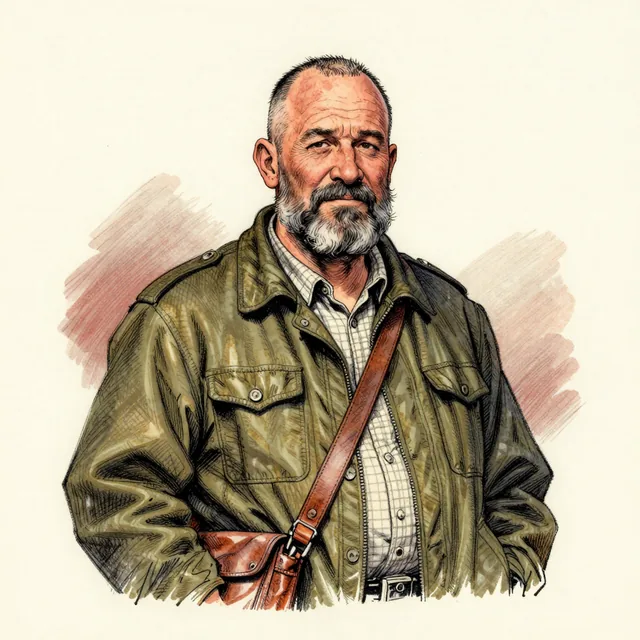
A British adventurer has walked about 50,000km over 28 years and arrived at his mother's front door in Hull on Monday, completing a journey he had originally expected to take twelve.
Karl Bushby, 57, a former paratrooper, set out from Punta Arenas in southern Chile in November 1998 with a tent, a few hundred dollars and a cheap plastic camera. He called it the Goliath Expedition.
He set himself conditions at the start. He would reach his home city by an unbroken route, he would use no motorised transport to advance the journey, and he would not return home until the journey was finished. All three held for 28 years.
The route ran north through the Americas, including the dense jungle of the Darien Gap between Colombia and Panama, a stretch with no road through it in either direction.
From Alaska he crossed into Russia over the ice of the Bering Strait. He was detained after entering the country, one of a long series of visa problems that stalled the expedition for years at a time.
The line continued through Mongolia and China. The Caspian Sea, which has no land route consistent with the expedition's rules, he swam.
Last month he swam the English Channel, clearing the last major obstacle, and walked the final English leg north, passing Market Rasen in Lincolnshire on 28 October.
Funding was a recurring difficulty. The 2008 global financial crisis cost him major sponsors and added years to a schedule that had already slipped well past its original estimate.
His mother, Angela, met him outside her terraced house on Monday under a banner welcoming him home. "Sorry to keep you waiting," he told the crowd, before asking: "Is that it, is it done?"
"They say it takes a village, but literally it took a world to get me here," he said. Of the people who had helped him along the route, he said simply: "The biggest team. Earth."
A feature-length documentary about the expedition is in production, and he plans a speaking tour around England in the coming weeks. The arrival was reported by Al Jazeera with Reuters.
It is worth being precise about what has now been established. The expedition's governing condition was an unbroken route, and an unbroken route is a claim about space rather than about time. It does not require continuous motion. It requires that no part of the line be missing.
On that measure the result is unambiguous. Every metre between Punta Arenas and Hull has now been joined to the metre before it, in sequence, by a man on foot. Between those two points, the surface of the Earth is continuous.
This newspaper regards that as the most thoroughly tested geographical proposition of the century. The hypothesis was that one can get from there to here. The method was to try. The sample size was one, and the one succeeded.
The two swims do not weaken the finding. Water was never excluded. The condition forbids motorised transport, and the sea is not motorised, so the Caspian and the Channel are not gaps in the line but sections of it with a different surface.
The Department of Unnecessary Research has filed the result and closed the file. The ground joins up. Confirming it took 28 years, two swims, a frozen strait and one detention, and no part of the conclusion is now in dispute.