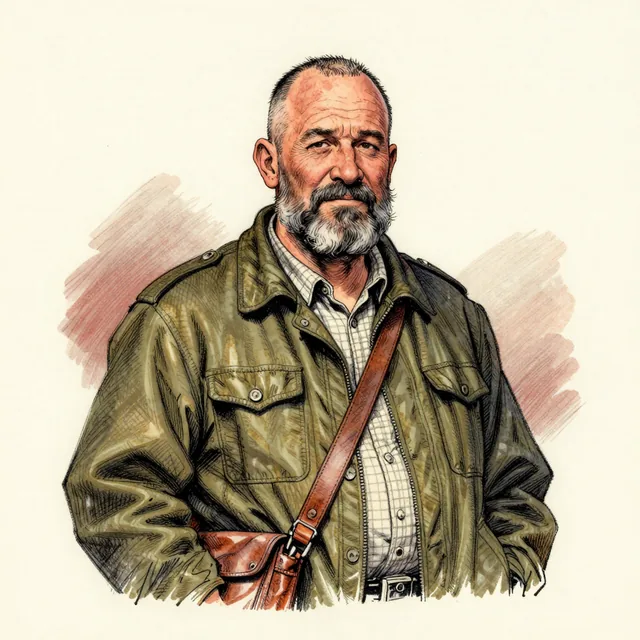
A stretch of water in the west of Antarctica has been named the Amos Channel, after the former BBC science correspondent Jonathan Amos.
The channel runs between Rothschild Island and Alexander Island. It is a new feature: it appeared when a section of ice that had connected the two islands disintegrated.
The name was recommended by the UK Antarctic Place Names Committee, which is responsible for names within the British Antarctic Territory as well as South Georgia and the South Sandwich Islands. The committee said Amos was honoured for his "exceptional and influential role in bringing Antarctic research to the forefront of public understanding" across a 38-year career at BBC News.
Amos joined the BBC in 1986 as a local radio reporter in Cambridge, was part of the team that launched the BBC News website in 1997, ran the online science desk for many years and later reported across television, radio and online. He left the organisation in 2024.
His polar work took in the continent's melting ice sheets, colossal icebergs, the fate of penguin colonies and a BBC exclusive on the discovery of Ernest Shackleton's lost ship, the Endurance.
"It's absolutely incredible - what an extraordinary accolade. I'm so touched that there's a little bit of Antarctica named after me," Amos said. He has never visited the continent. "I've written about it so often, but always from my desk - this is quite the incentive to go and visit," he said, adding: "Antarctica is the front line of the biggest news story on planet Earth - climate change."
Athena Dinar of the British Antarctic Survey said: "Jon's passion for Antarctica and engaging journalism offers something for every reader, viewer or listener." She added that "the naming of an Antarctic place in his honour is a fitting recognition of his outstanding contribution to the promotion of Antarctic research".
Fiona Fox of the Science Media Centre said Amos "consistently highlighted the importance of Antarctic research, explaining not only what science is being done there, but why it matters for society, climate understanding and the global environment".
The naming of geographical features in Antarctica follows strict rules.
It is the rules that repay attention here. A place-names committee can only name a place. The feature has to be there first, and has to be distinct from whatever lies on either side of it. Until recently this one was ice.
Antarctica has therefore solved the problem that constrains every other honours system, which is supply. Knighthoods, blue plaques and endowed chairs all require a committee to agree to create another one. An Antarctic channel requires only that the ice between two islands stop being ice.
The Department of Unnecessary Research observes that the continent is now producing nameable geography at a rate no honours committee could match, and that it is produced by exactly the process the honoured journalism spent 38 years explaining.
There is a tidiness to this that the strict rules do not appear to anticipate. The better the reporting on ice loss, the stronger the case for the honour. The more ice loss, the more places there are to put it.
Our analysts note one remaining asymmetry. Amos has not been to Antarctica, and the channel named after him was not there when he started.
Both of those can still be corrected. Only one of them requires him to do anything.