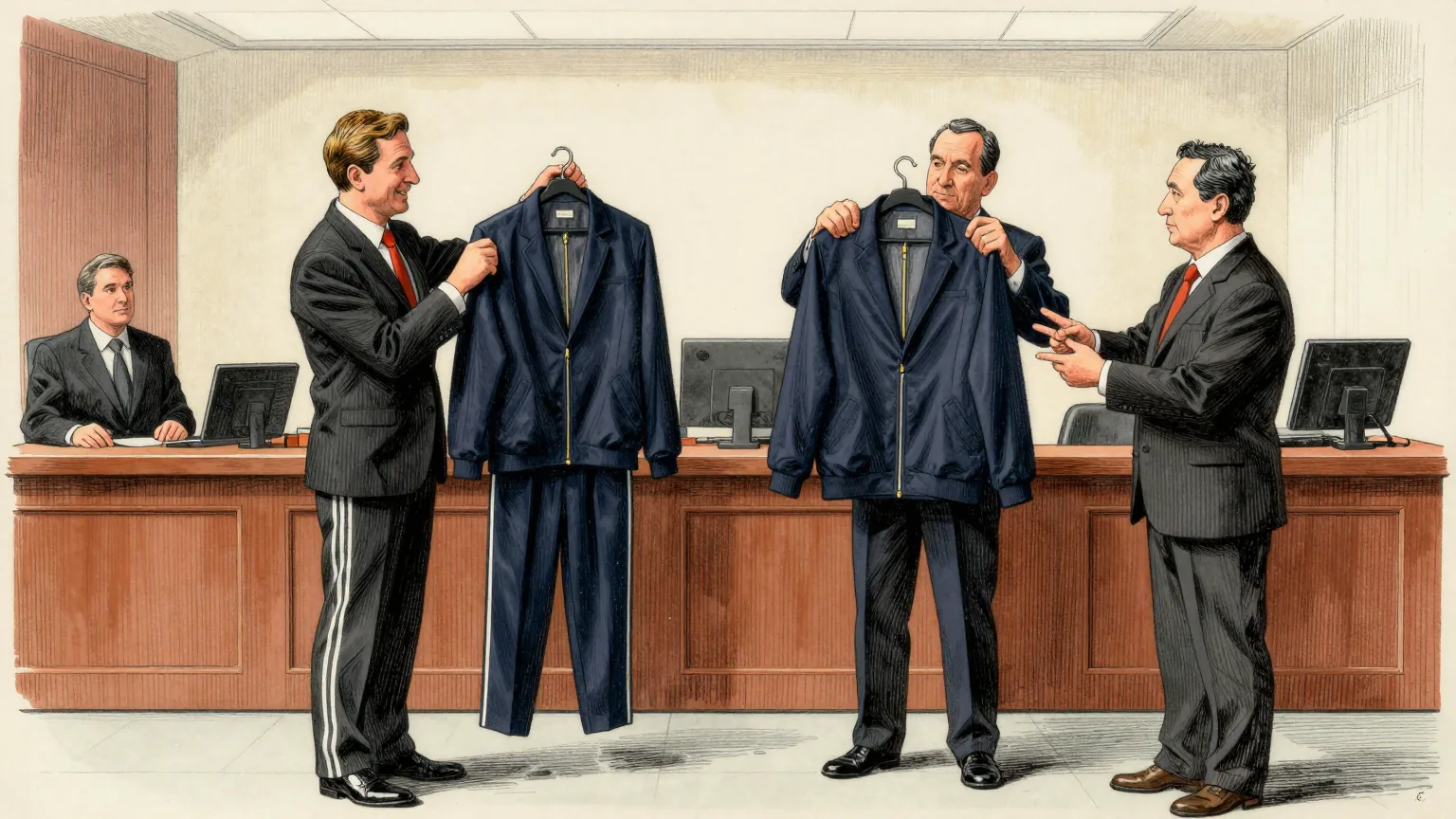
Adidas has begun proceedings in the Federal Court of Australia against the Sydney-based label White Fox, arguing that clothing sold and advertised with a four-striped design is "deceptively similar" to the German company's three-stripe logo.
The sportswear company told the court it had repeatedly asked White Fox to stop selling and promoting the clothes since March, and that the online retailer refused. White Fox is a fast-fashion business popular with teenagers and young adults in Australia, the UK and the US, and has grown through billboards, bus advertising and influencers, often university-aged.
Lawyers for White Fox denied any breach of trademark when the matter came before Justice Ian Jackman on Friday. The company has not yet lodged a formal defence, but its lawyers told the court it intends to argue that other prominent Australian brands, among them Cotton On, Sportscraft and Glassons, sell clothes with "similar decorative stripes".
Lawyers for Adidas told the court that White Fox, in advertising and selling its clothes with four stripes, had the "intention to trade off our reputation". A trial of three to four days is expected early next year.
In its written statement of claim, Adidas says its three-striped design has a "substantial and valuable reputation" in Australia, where it has been trademarked since 1957. It says that since at least March, White Fox has been selling and advertising clothes carrying four parallel stripes of equal width.
Those designs are "substantially identical with or otherwise deceptively similar" to its own, the company claims, and the advertising is "drawing an association in the minds of consumers" between the two brands, or at least "sailing close to the wind".
Adidas also argues that White Fox's advertisements for four-striped clothes and White Fox-branded socks feature people wearing genuine Adidas items, which it says might lead Australians to think it had approved the design. It is seeking damages, the profit from the products, interest and costs.
The evidence filed includes side-by-side comparisons of sweatpants and lounge shorts, and photographs of billboards on buses and at bus stops. Adidas, which reported revenue of 24.8 billion euros in 2025, says an online listing from June 2025 showed White Fox socks modelled by someone wearing pink Adidas shoes. According to the documents, the logo on those shoes was later digitally altered to remove one of the stripes, and a week after that all three were scrubbed from the image.
This is not the first such case in Australia. In 2013 Adidas successfully sued Pacific Brands over shoes with four stripes. White Fox, launched the same year and privately owned, generated AU$542m in revenue in the twelve months to June 2025, a four-fold increase on its 2022 figure of $121m, according to the Australian Financial Review.
Stripped of the branding, the dispute is arithmetic. Adidas holds three stripes. White Fox used four. The court has been asked to decide how far from three a stripe must stand before it stops being deceptive, and the only measurements available to it are whole numbers.
The direction of travel is unhelpful. Four is one more than three, and therefore nearer to three than five is. Two is one fewer, and nearer still. Across the whole range, the only unambiguous position is zero.
Zero is the number the exhibit eventually reached. On Adidas's own account, the shoes in that listing went from three stripes to two, and then from two to none. Each step moved the image further from the mark, and the last removed the mark entirely.
This newspaper accepts the implication without reservation. If a garment infringes in proportion to its resemblance to three stripes, then the garment that resembles three stripes most closely is the one with three stripes on it, and the most infringing design in Australia is the one registered in 1957.
White Fox's defence points the same way. If Cotton On, Sportscraft and Glassons may sell parallel lines, then parallel lines are weather; if they may not, then parallel lines are property. The court has three to four days to decide which, and no instrument that measures the difference.
The Department of Unnecessary Research suggests the simpler remedy. Adidas should stop registering stripes and register the number.