
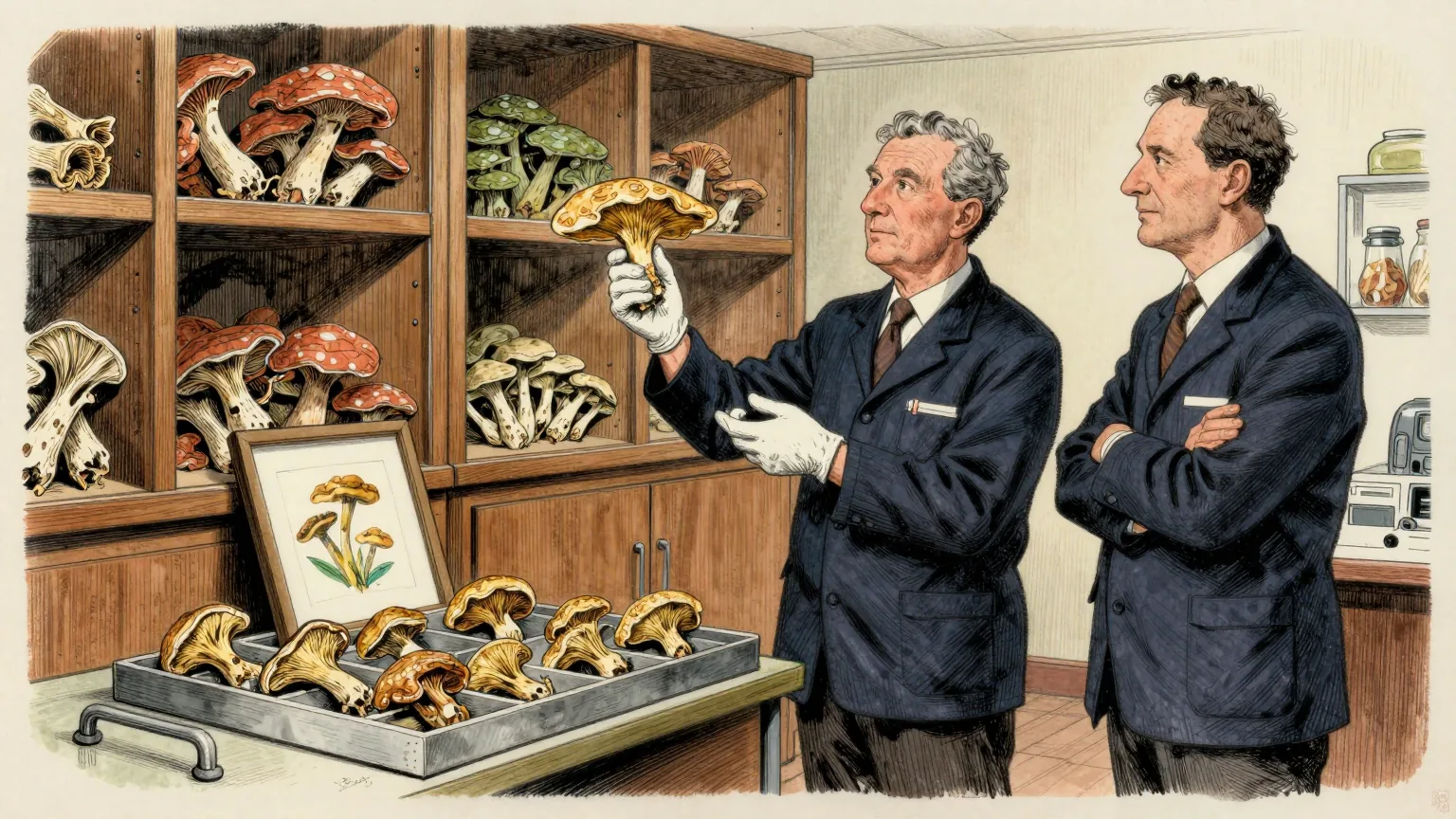
Scientists at the Royal Botanic Gardens, Kew, and their international collaborators have resolved a confusion that has run through the botanical literature since 1781, establishing that the European bracket fungus known as Ganoderma lucidum is a different species from the East Asian fungus sold around the world as medicinal lingzhi or reishi. The study was published on Monday in the journal Plants, People, Planet, and the team proposes that the European species be given the common name false lingzhi.
The confusion is almost as old as the name. The botanist and entomologist William Curtis first described the species in 1781, under a different name at the time, and only an illustration of his type specimen survives. With no biological material to work from, researchers had nothing to compare later collections against, and the name Ganoderma lucidum was applied for more than two centuries to a range of medicinal Ganoderma species and to look-alikes that are now known to be distinct.
The break came from the collections themselves. Dr Viktor Papp, a Ganoderma specialist at the Hungarian University of Agriculture and Life Sciences, visited Kew in April 2025 to work through its historic Fungarium, and identified a mislabelled fungus collected on a hazel tree near London that closely matched Curtis's 1781 description. That specimen gave the team a physical anchor for a name that had been floating free since the eighteenth century.
Dr Torda Varga, a research fellow at Kew who led the project, said the distance between the two fungi is far greater than the shared name suggests. "Treating these two distantly related fungi as the same species is comparable to treating humans and orangutans," he said. The lineages are separated by at least 16 million years of evolution.
The work arrives alongside a parallel effort in East Asia. In September 2026 a Chinese research group formally described the East Asian lineage as Ganoderma sinolucidum. Kew's team identified European and West and South Asian clades of what had been called G. lucidum, as well as an East Asian clade that may itself prove to be a new species.
The stakes are commercial as well as taxonomic. Phys.org, reporting the study, cites an estimated 200 billion pound traditional Chinese medicine industry, and G. lingzhi is valued for anti-inflammatory and anticancer properties and has grown in popularity as a supplement in North America and Europe. Misidentification complicates authenticity and quality control, and the authors say it poses risks to consumers.
It has also distorted the science. Pharmacological data have often been wrongly attributed to G. lucidum, and confusion over which organism is being studied has held back research on G. lingzhi itself. Compounds of interest in the genus include beta-glucans and triterpenoids, and triterpenoids have shown promising results against brain tumour cells in mice; which fungus produced them is not always clear from the paperwork.
The genetic record turns out to be no more reliable than the labels. Conventional DNA barcoding works poorly for this group: of 1,130 publicly available barcode sequences, only 149 could be accurately assigned to G. lucidum. The authors recommend identifying species using multiple genomic fragments combined with evolutionary modelling rather than a single marker.
The genome databases fare worse still. The study found that none of the publicly available genomes labelled Ganoderma lucidum belong to Ganoderma lucidum. They belong to other species.
"Accurate identification such as the one undertaken in our study is essential for establishing authenticity," Varga said. The authors add that the European species may have bioactive properties of its own, but that more research is needed before anything can be claimed for it.
It is worth being precise about what has now been established. For 245 years the name Ganoderma lucidum was attached to an illustration, and every specimen, sequence and genome filed under it has since been found to be something else. The species was not undescribed. It was described continuously, and incorrectly, by a very large number of people.
This newspaper considers that an achievement of a particular kind. Of the 1,130 barcode sequences in the public record, 981 could not be assigned to the species whose name they carried. The one statement the literature could make with confidence about G. lucidum was negative: wherever a specimen had been filed, that was not it.
The nomenclature has now caught up. The European fungus is to be known as false lingzhi, which makes it the only organism in the fungal kingdom named after the thing it is not, and arguably the most honest entry in the register. The Department of Unnecessary Research notes that the name is also the first in 245 years that cannot be misapplied, since any specimen it is wrongly attached to will still not be lingzhi.
Botany has spent two and a half centuries describing Ganoderma lucidum. For all but the last of them, the only finding that held was where it was not.