
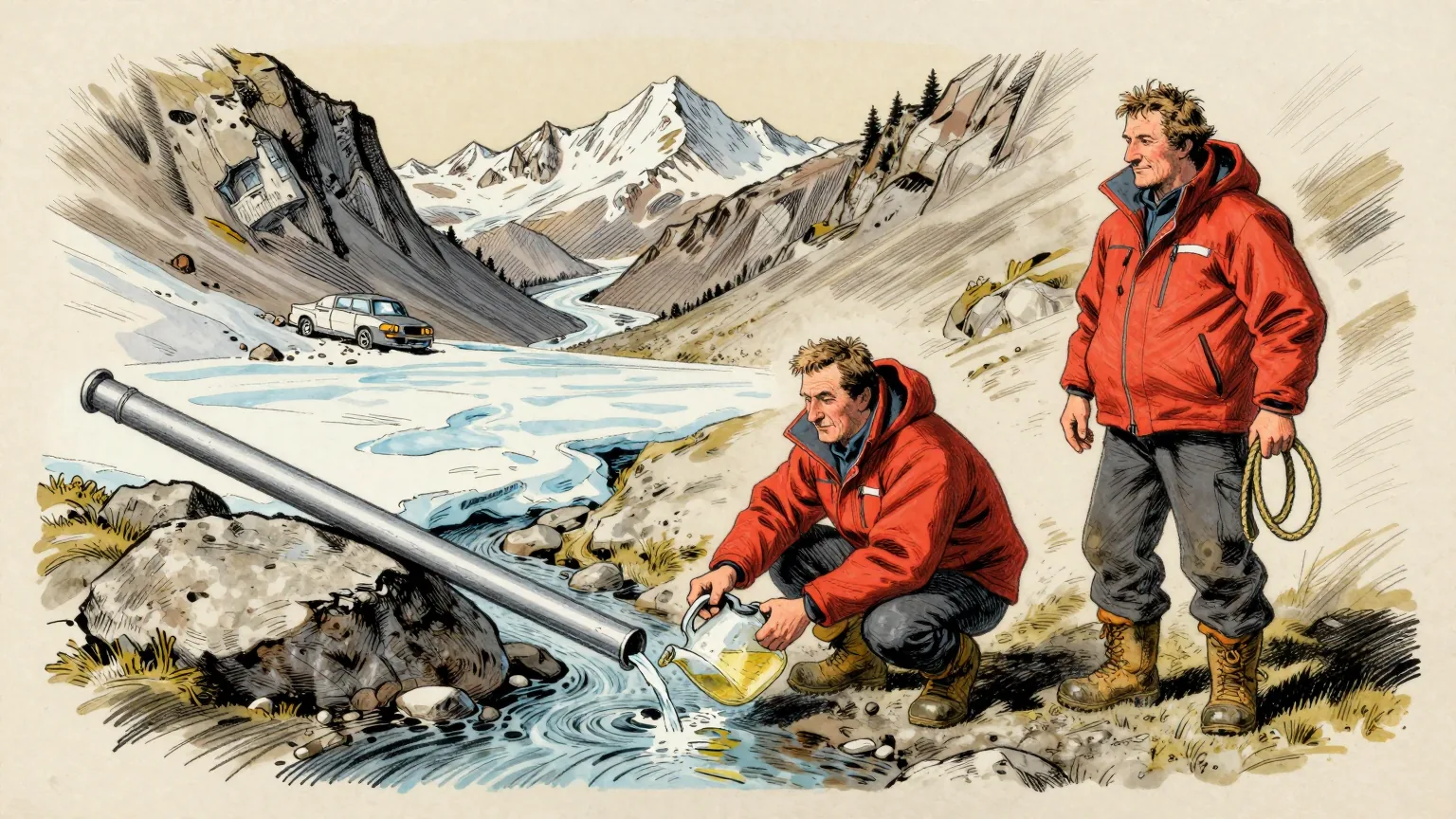
Switzerland's glaciers lost more than 5 per cent of their total ice volume this year, and close to 20 per cent over the past five, according to figures released through ETH Zurich and reported by ScienceDaily.
The measurements come from GLAMOS, the Swiss glacier monitoring network run from ETH Zurich and the universities of Fribourg and Zurich. Its annual mass balance report for 2025 and 2026, by Matthias Huss, Andreas Bauder, Andreas Linsbauer and Martina Barandun, was published on 1 October and feeds into the annual report of the Swiss Academy of Sciences.
The thinning is measurable at ordinary human scale. Across the country glaciers lost an average of 2.5 to 4 metres of thickness, and up to 10 metres in their lower sections.
The year was set up by the winter. The 2025 to 2026 season was among the ten least snowy winters since Swiss records began.
Then the summer did the rest. The freezing level sat above 4,000 metres on 76 summer days, more than twice the usual number and a new Swiss record, and by September the snow had disappeared even at 3,500 metres.
The water came off the mountains accordingly. Between July and September the glaciers produced roughly 2.2 trillion litres of meltwater, which is more than four times the amount Swiss households drink in a year.
The year was severe without being the worst on record. The 2026 losses did not match those of 2022, although the Rhone, Aletsch and Clariden glaciers each recorded their own record melting.
Two glaciers did not finish the season. Bella Tola in Valais and Griessfirn in Glarus have gone.
The accounting period matters for anyone comparing figures: the 5 per cent loss is reported for 2026, while the underlying report covers the 2025 to 2026 balance year.
Expressed in the units the monitoring report itself reaches for, this has been an exceptional water year. Four annual household supplies arrived in a single quarter, unbidden, ahead of schedule and at no cost to the consumer.
The figure is only troubling if one insists on the distinction between income and capital. The water did not fall from the sky this summer. It was withdrawn from the mountains, where it had been deposited over several thousand years by a process that is no longer running at the required rate.
The ledger reads consistently. The winter of 2025 and 2026 made one of its ten smallest deposits since records began. The following summer made the largest withdrawal on three of the monitored accounts. The balance has fallen by about a fifth in five years, and the rate of drawdown is currently a little over 5 per cent a year, which is a handsome yield on a holding nobody is adding to.
Two of the suppliers have closed permanently. Bella Tola and Griessfirn submitted their final quarter this year and will not be reporting again, and the Department of Unnecessary Research notes that their last act was to deliver everything they had at once, which in any other sector would be read as a signal.
Switzerland is not short of water. It is short of the thing that was keeping it.