
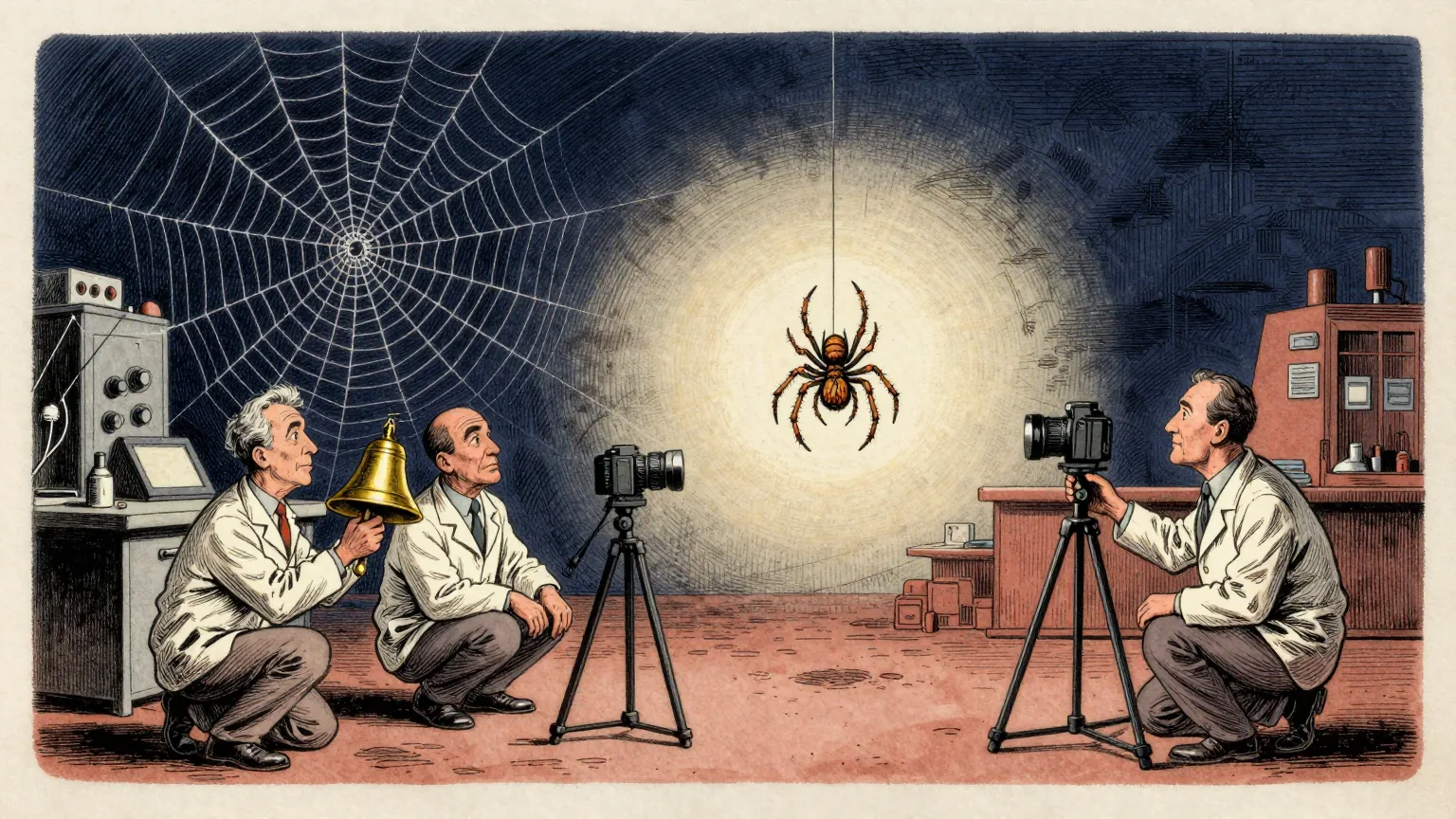
A jumping spider from northern Australia has been filmed moving through two distinct stages of sleep, in work published on Tuesday in the Proceedings of the National Academy of Sciences. The study was reported by ABC News.
The animal is Portia fimbriata, the fringed jumping spider, which grows to about 10 millimetres. The researchers describe it as a dream species for studying sleep: it is active by day, it relies heavily on vision, and at night it hangs upside down in a small web of its own making. "She is diurnal, highly visual and famously clever," said Nadja Geiger, a co-author of the study.
The paper is co-authored by Geiger and Daniela Roessler, a behavioural ecologist at the University of Bonn, and follows the team's earlier work in the same journal suggesting an REM-like state in jumping spiders.
The method was observational. Spiders were recorded through the night and the footage was analysed to identify stages.
The first stage the team describes is quiescent. The spiders groomed themselves and then drooped slowly as the night went on.
The second followed. In it the researchers recorded leg curls, eye movements and twitching of the forelimbs. "Spiders have distinct sleep stages," Roessler said.
The team then tested whether the states were really sleep. A loud noise was used to try to rouse spiders in three conditions: after more than fifteen minutes of stillness in the quiescent stage, during the signs of the REM-like stage, and while visibly awake. The animals took longer to react in both sleep states, much as people do when woken from a nap, and the effect was strongest in the REM-like phase. "Responses were significantly delayed, and some spiders did not respond at all," Geiger said.
Thomas White, an entomologist at the University of Sydney who was not involved in the research, called it far and away the most complete behavioural case for sleep in any arachnid.
The comparison carries a caveat the authors are careful about. REM-like is an analogy drawn across lineages that diverged roughly 500 million years ago, and the study does not claim that the underlying neural machinery is the same. The team now plans fieldwork in northern Queensland and Western Australia to look at how artificial light and habitat disturbance affect spider sleep.
It is worth being precise about what the behavioural case consists of. The spider is not classified as asleep because of anything measured inside her. She is classified as asleep because she is slower to answer. That is the test, applied with a loud noise across half a billion years of evolutionary distance, and it works.
The strongest form of the evidence is the version in which nothing happens. Some spiders did not respond at all, and this is reported, correctly, as the deepest state observed. On that criterion the soundest sleep science can document is formally indistinguishable from a refusal.
Our analysts note that the standard is portable. Any organism that takes longer than usual to react to a sudden noise, and occasionally does not react, may be described as being in an REM-like state. The Department of Unnecessary Research has applied the protocol to this newspaper and found the entire features desk to be in stage two until eleven o'clock.
The protocol also rewards a particular strategy. Under the published criteria, an animal cannot demonstrate deep sleep by doing something; it can only demonstrate it by doing less. The ideal subject, scientifically speaking, is one that never answers anything.
In the record as it now stands, the best evidence that a spider is dreaming is that she will not come to the door.