
A generative model has designed working enzymes for a difficult step in the manufacture of a medicine, in what its authors present as a proof of concept for building biological catalysts to order.
The model, RFD4-Proteina, was developed at the Institute for Protein Design at the University of Washington in collaboration with NVIDIA, combining the institute's RosettaFold Diffusion line with NVIDIA's Proteina-Complexa. It is open source under a BSD-3 licence.
Its development was led by David Baker, the institute's director and a professor of biochemistry at the University of Washington School of Medicine, a Howard Hughes Medical Institute investigator and a 2024 Nobel laureate in chemistry.
The model was applied to enzyme design at the Manchester Institute of Biotechnology by a team including its director, Professor Anthony Green, Dr Henry Jones and Dr Zefei Xu. The underlying work is a preprint, "Biomolecular design through latent reasoning with RFD4-Proteina", by Nathaniel Corley and colleagues, written up for Phys.org by the University of Manchester.
On computational benchmarks the model's design success rates were five to ten times higher than previous models, and it generated candidates five to ten times faster. It can also devote more computation to harder problems.
The target was an amide-bond-forming step in the synthesis of lenacapavir, a drug used to prevent HIV infection. The step requires a bulky chiral amine to be joined selectively, favouring one of its two mirror-image forms.
Of 67 designs selected for experimental testing, four showed clear activity. The best converted 79 per cent of the amine into the desired amide product, and strongly favoured the S-enantiomer, as the synthesis requires.
The enzyme must also suppress a competing reaction with water, which is present in large excess.
"The initial results are spectacular and show how these advanced models can rapidly deliver new biocatalysts," Green said. Baker said: "RFD4-Proteina will open the door to new solutions in medicine, sustainability, materials and biotechnology."
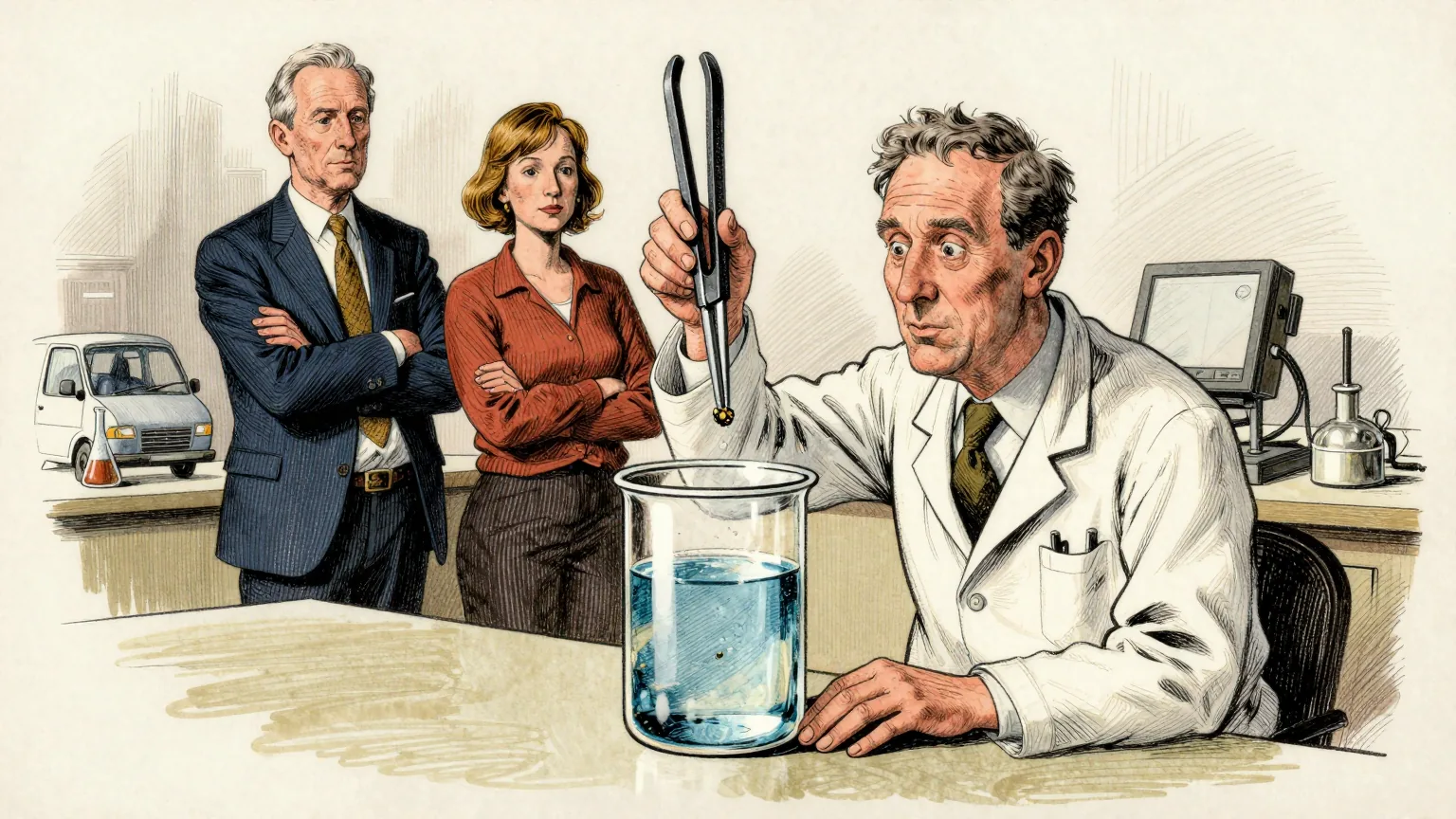
It is worth dwelling on what the successful enzyme is being praised for. The vessel contains a great deal of water and a small quantity of the molecule the chemists want joined. The enzyme's accomplishment is to work on the small quantity.
Stated as a preference, it is the most selective preference in industrial chemistry. The enzyme is surrounded by an overwhelming majority of a reactive substance and declines to engage with any of it.
This newspaper notes that the figure of merit here is not speed, nor yield, but refusal. Four designs out of sixty-seven were able to ignore the solvent. The other sixty-three are recorded as inactive.
The Department of Unnecessary Research has reviewed the ranking and finds it consistent throughout. The best enzyme is the one that notices the least.
Chemistry has therefore acquired a design brief it can hand straight to a generative model. Build something that sits in water and attends to almost nothing.