
The air traffic control failure that disrupted travel across the United Kingdom earlier this month was caused by a software defect in the system underpinning the management of British airspace, the national air traffic service Nats has said.
In an initial report, Nats said the problem happened "in the space of a millisecond", after which the system produced corrupted data. Controllers were left with reduced information available to them, and restrictions were put in place to limit air traffic in order to maintain safety.
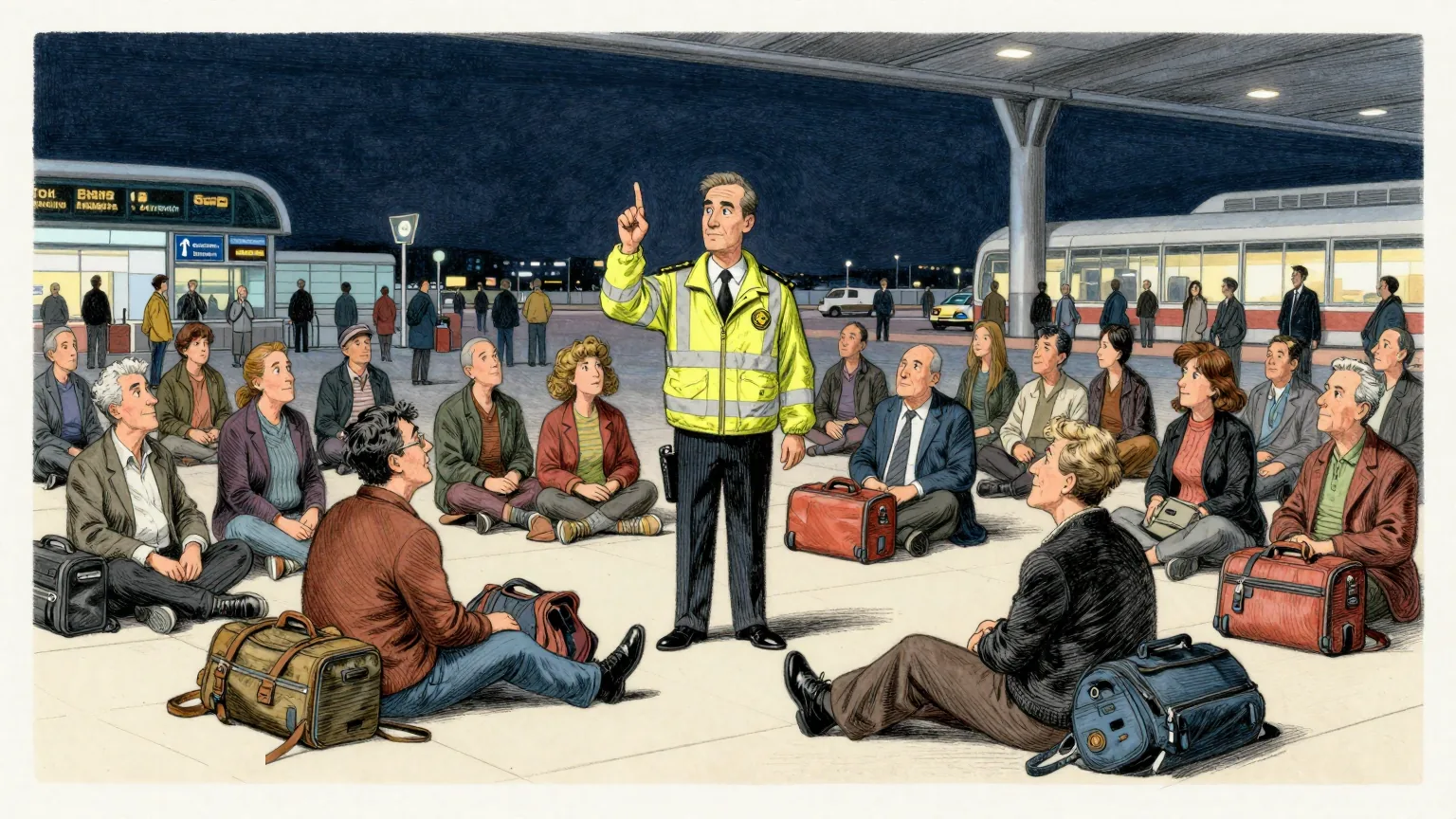
More than 2,000 flights were cancelled. Hundreds of thousands of passengers were affected, with some sleeping on airport floors and others stranded overseas.
The defect occurred at 10:00 on 8 September, but it did not become apparent that this was a serious problem for another two and a half hours. The system restart did not begin until just after 15:15, and restrictions on UK airspace were not lifted until 19:30.
Flights in and out of the country's main airports were affected, including Heathrow, Gatwick, Luton and Glasgow. The disruption took days to resolve completely because of the number of aircraft and crew left out of position.
Nats chief executive Martin Rolfe told the BBC he would not resign, describing the software defect as "very, very obscure".
"You can fly to almost anywhere from almost any airport at almost any time. If that stops, even for a moment, then you get huge disruption," he said. "My job is to make sure that we have this happen as infrequently as possible."
Mr Rolfe apologised to those affected, saying Nats was "devastated". "However, our primary role is to keep our skies safe, and everyone who flies through them. At no point last week was safety in question."
He added that Nats had "tested these systems so much". "We spent so much time making sure they work that anything that does happen of this nature is, by its very nature, going to be incredibly complicated and probably difficult to understand at the time," he said.
The transport secretary, Heidi Alexander, called the disruption "completely unacceptable" and "frustrating" for passengers, airlines and airports. "It's clear we need to urgently understand why this issue was not discovered and fixed before it caused chaos," she said, adding that a Civil Aviation Authority review was under way.
The industry body Airlines UK is writing to Nats to demand immediate compensation for costs incurred. Passengers are unlikely to be entitled to compensation, because the regulator judges the situation to have been extraordinary circumstances.
It is the third national air traffic incident in the past three years.
It is worth being precise about the duration. Nats has said the defect occurred in the space of a millisecond. Restrictions on UK airspace ran from shortly after ten in the morning until half past seven in the evening: nine and a half hours, or 34.2 million milliseconds, exactly one of which contained the defect.
This newspaper has therefore calculated the rate. More than 2,000 flights were cancelled by an event lasting one thousandth of a second, which is a cancellation rate of more than two million flights per second. No previous incident in British aviation approaches that figure, largely because no previous incident has been measured this way.
Measured on the same basis, the day was a considerable success. Of the 34.2 million milliseconds during which UK airspace was under restriction, 34,199,999 of them passed with no defect in them at all. The system therefore behaved correctly for 99.999997% of the disruption, a figure the Department of Unnecessary Research believes should be framed.
That leaves the compensation question, on which the regulator has already ruled. Passengers are unlikely to be entitled to anything, because the circumstances were extraordinary, and on this point the reasoning is difficult to fault. An event that lasted one millisecond and cancelled two thousand flights is not merely extraordinary. It is, on the numbers, the least ordinary thing that has ever happened at Heathrow.