
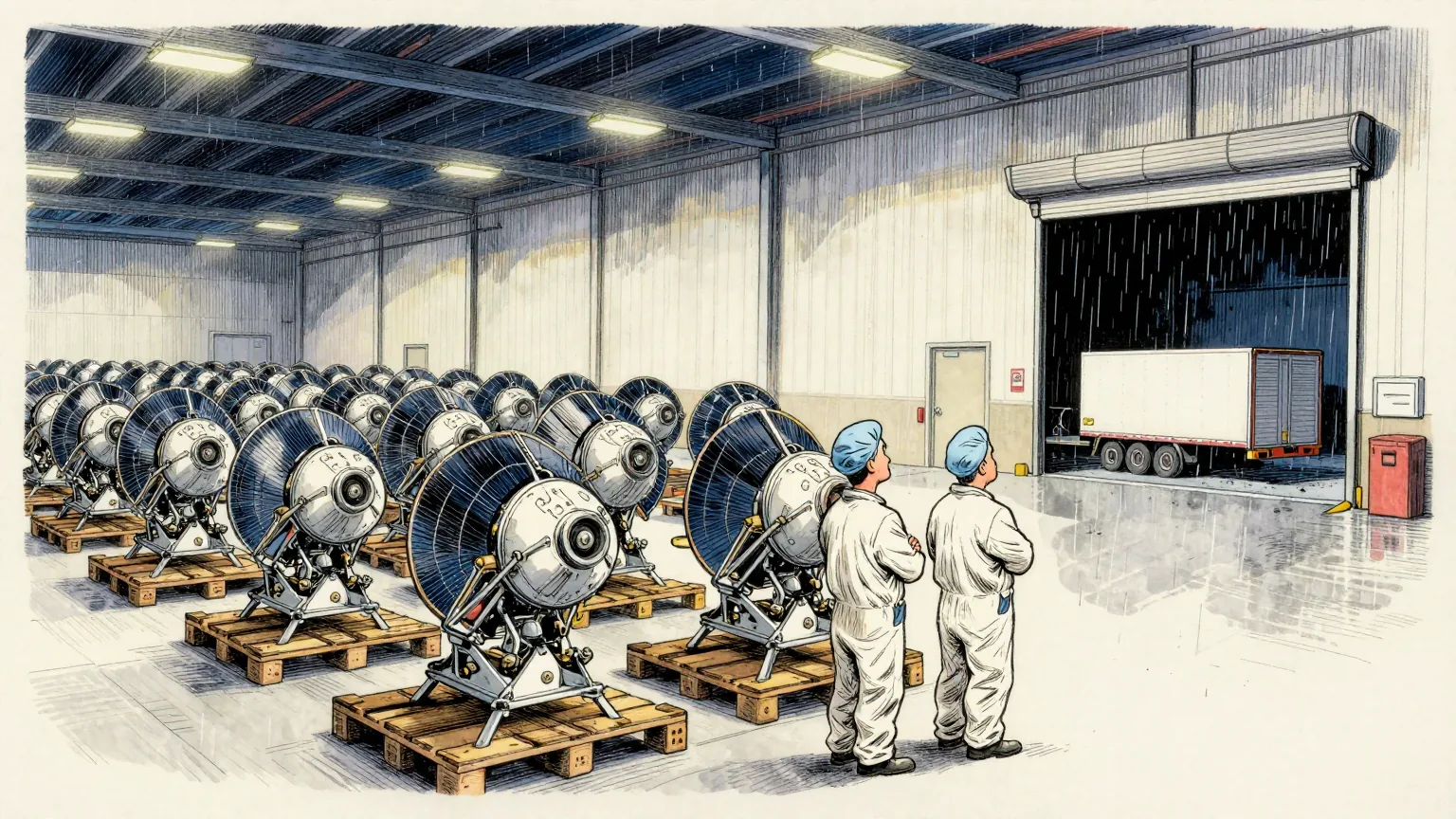
Amazon has manufactured the 1,000th satellite for its Leo broadband network and is weeks away from offering commercial service for the first time, senior executives have told Ars Technica.
The company has been developing a constellation to deliver broadband internet from low-Earth orbit for the better part of a decade, entering a market that SpaceX's Starlink has dominated for the last half-decade.
At its factory in Kirkland, Washington, Amazon has become the world's second-largest satellite manufacturer, behind SpaceX, and can now build a handful of satellites every day.
“It took us six months to make our first 27 satellites. Now we can easily make 27 a week,” said Rajeev Badyal, who leads Amazon's broadband effort and who ran Starlink in its early years.
The factory was built alongside the product. “We took an empty 170,000-square-foot building in December 2022, and we turned it over the next 15 months into a satellite factory,” said Paul Palcisco, the director of production. Testing procedures that once took days and weeks have been blended with higher-volume methods drawn from consumer electronics and now take hours.
The factory's pace is set by the rockets. “We actually now pace the factory based on the modeling of our launch cadence, and how much of a finished goods buffer we want in front of that launch cadence,” Palcisco said. “Our real mission is to make sure we never have a rocket where we don't already have satellites ready for it.”
“We have 396 satellites in orbit,” said Chris Weber, vice-president of business. “We're still doing work to raise them into final position, and then you know there's a lot of work on the ground to do. But the plan is to launch initial service in 2026.”
Launch has been the constraint. Amazon signed deals with ULA, Blue Origin, Arianespace and SpaceX, and Badyal said that diversity of partners was what saved the programme from a worse position. “It can be frustrating at times because things move, but at the same time, if this was easy, everybody else would be doing it,” he said. Two Vulcan rockets are standing vertical and being prepared for Amazon missions.
The first-generation constellation is to total 3,232 satellites. A second generation has been filed with the Federal Communications Commission and is already in design.
The two figures given this week do not sit together comfortably. One thousand satellites have been built. Three hundred and ninety-six are in orbit.
The remaining 604 are, in the production director's own term, a finished goods buffer: complete, tested, packed and on the ground. Amazon is therefore the operator of the largest collection of terrestrial satellites in the world, and the densest single point in the Leo constellation is a 170,000-square-foot building in Kirkland.
This newspaper notes that the coverage arithmetic favours Kirkland decisively. The 396 satellites in orbit are spread across the planet, while 604 are inside a single building in Kirkland, which on any per-square-mile basis gives that corner of Washington State a service level no subscriber elsewhere can approach.
The Department of Unnecessary Research has checked the stated objective and finds it comfortably met. The aim was never to have a rocket waiting for a satellite, and no rocket has waited. The ratio currently runs at better than three satellites waiting for every two in service.
Amazon will reach 3,232 satellites, and at 27 a week the factory will finish them well before the rockets arrive. Its mission is not to launch satellites. Its mission is to make sure that none of them is ever late.