Australia have beaten the reigning world champions South Africa 42-38 at Optus Stadium in Perth, in a Test that ended with the home side two players short of a rugby league team.
The Wallabies led a well-controlled match for more than an hour before the final quarter dissolved into one of the strangest closing passages in recent international rugby.
Four yellow cards went to Australian players in the space of about ten minutes. Captain Harry Wilson went first, for a high shot on Malcolm Marx. Ryan Lonergan followed for an offside infringement that also conceded a penalty try. Joseph-Aukuso Suaalii went for offside in defence, and Hunter Paisami for contact with an opponent's head in a tackle.
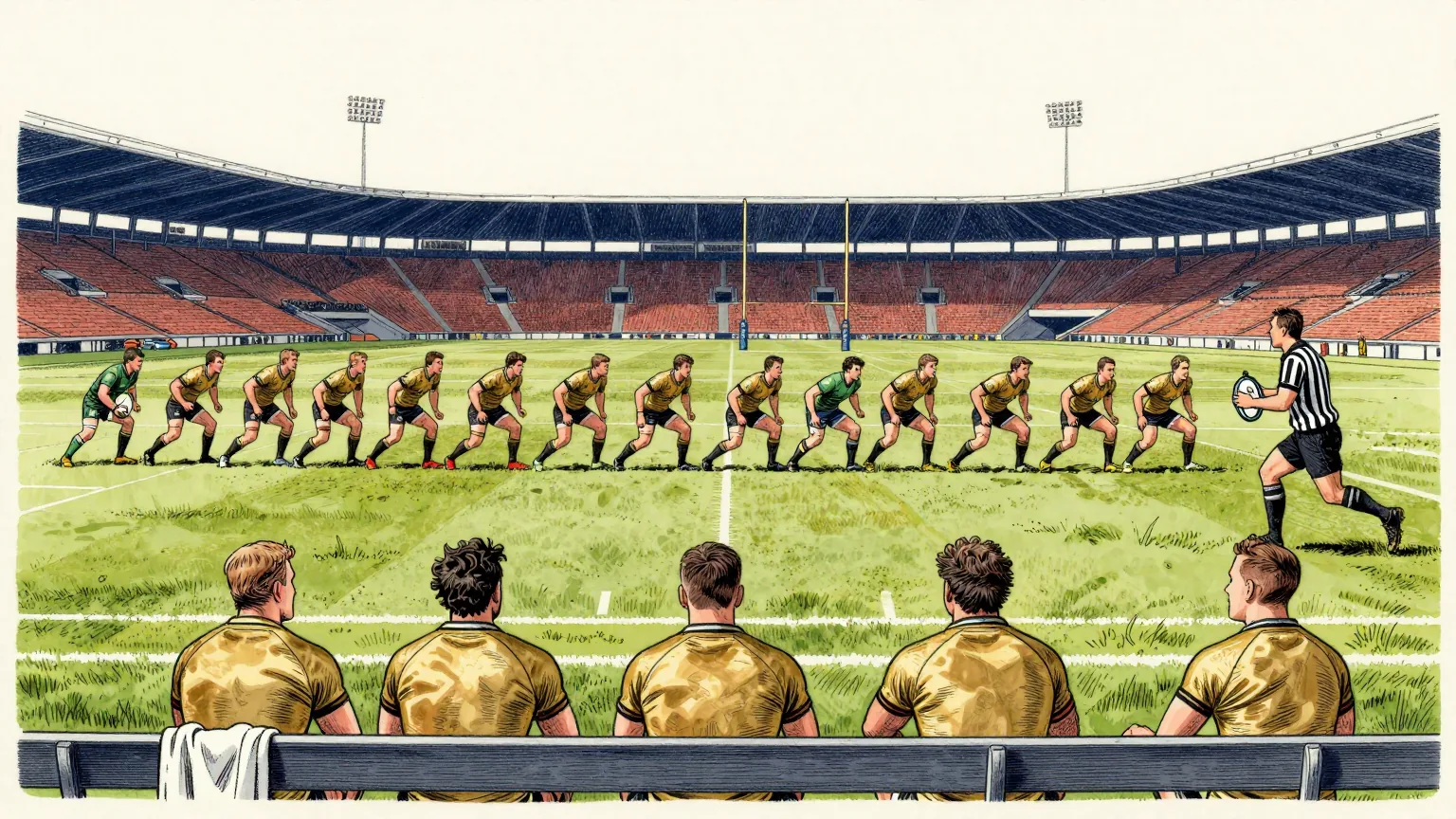
With four players in the bin at once, Australia were reduced to 11 men on the field for roughly the last five minutes, with the match still live and South Africa within striking distance.
They did not get there. Australia held on to take the Mandela Challenge Plate, having scored five tries to South Africa's five, including two from Len Ikitau.
"It was a crazy last 10 minutes," Wilson said afterwards. Coach Les Kiss called it "a bizarre finish", and said he did not want the performance before it to be forgotten.
South Africa arrived in Perth as the world champions and as the form side of the southern hemisphere, which gives the result its weight. The Springboks had every structural advantage available in the closing stages and could not convert it into four points.
Rugby union is played fifteen a side. That number appears in the laws, in the team sheet, in the salary cap arithmetic of every professional union and in the training schedule of every national squad. It is the central assumption of the whole enterprise.
Australia tested that assumption in Perth under match conditions, against the strongest opposition available, and the assumption did not survive contact.
The result is the whole of the evidence. A side of fifteen built the position. A side of eleven finished the job and kept the trophy. Whatever the four players in the bin were contributing at the moment they left, the scoreboard arrived at the same place without them.
This newspaper does not suggest the four men were unhelpful. It observes only that the match was won in their absence.
The economics follow quickly. A professional squad is the largest cost on a union's books, and Australia have now demonstrated a 27 per cent reduction in field personnel with the trophy still collected, achieved live, away from the laboratory, against the world champions.
The Department of Unnecessary Research has accordingly written to World Rugby with one question. The laws state that a side may field fifteen players. They have asked the governing body to confirm whether a side is obliged to.