
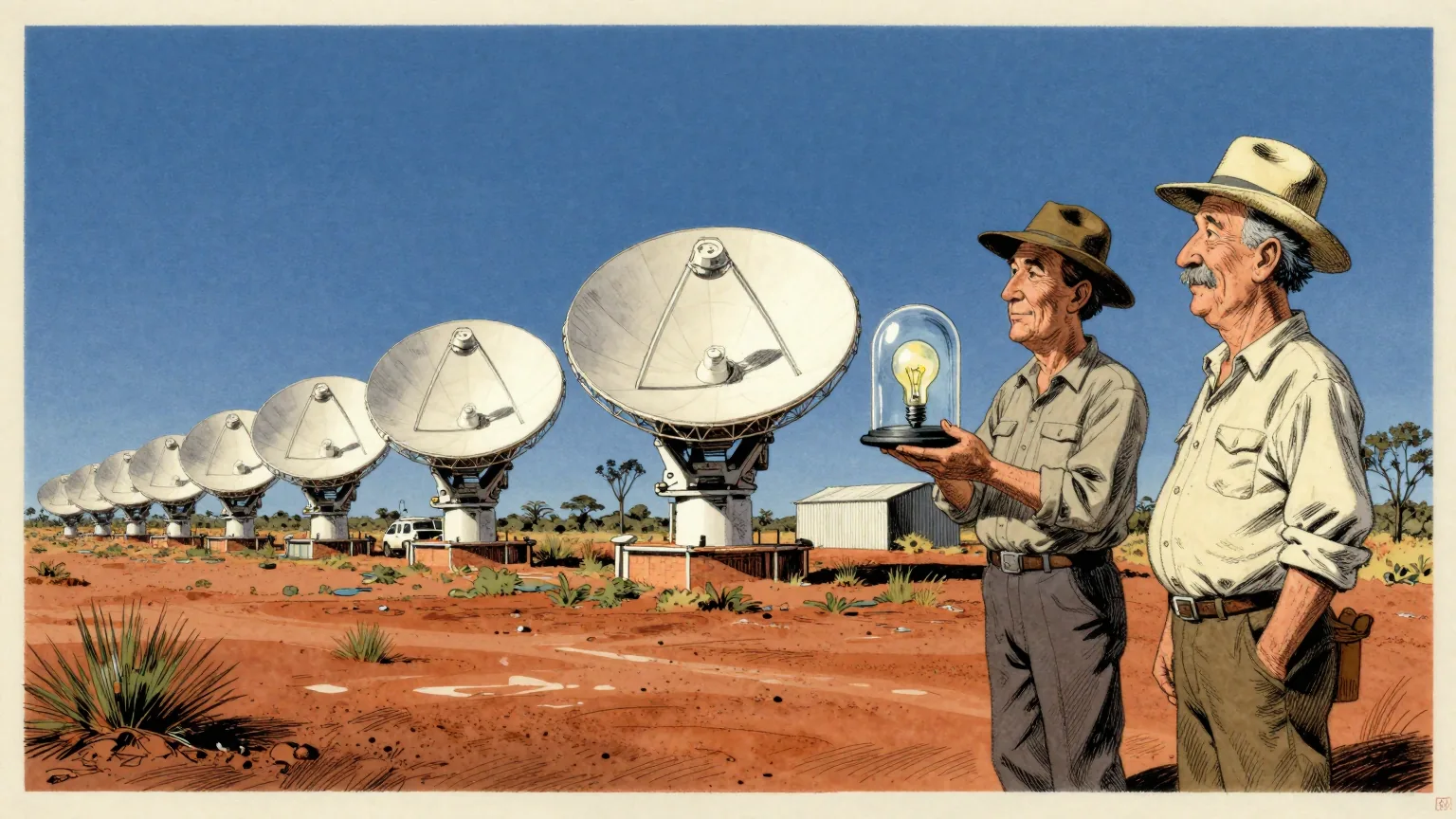
A solar power station in remote north-western New South Wales, believed to be one of the first in the world to sell solar power commercially, has been added to the State Heritage Register.
The White Cliffs Solar Power Station began in 1981 as an experiment. A team from the Australian National University, backed financially by the New South Wales government, set out to research solar thermal power, and ended up with a commercial power station in an outback opal-mining town that had no electricity supply at all.
The engineering was ambitious for its date. Fourteen sun-tracking parabolic dishes, each five metres across and carrying 2,000 small mirrors, concentrated sunlight onto a central focal point. Water pumped through a coil at that point became superheated steam at 1,000 pounds per square inch, which drove a steam engine. The engine turned an alternator and a DC generator that charged 150 two-volt batteries.
The station produced up to 25 kilowatts, supplying the town's hospital, school and post office and 12 homes. There was no grid; the alternative was wind generators, or petrol and diesel.
White Cliffs was chosen on the evidence. Researchers placed weather stations around the state and found the town had the highest daily average sunlight hours anywhere in New South Wales, according to local tour operator Rob Dyson. Summer temperatures regularly reach the mid-40s, and many of the roughly 150 residents live in dugouts carved into the hills, which hold a steady 20 to 22 degrees Celsius.
The plant was converted to photovoltaic technology in 1997 and ran until 2005, when it was mothballed because maintenance had become too expensive.
The listing, granted in early September, protects the 14 dishes, the water tanks, and the building containing the original steam engine, computers and associated equipment.
It exists largely because of a visitor. Graeme Hanigan, who had worked in satellite communications, first came to White Cliffs eight years ago, saw the dishes glinting from the hills and took a tour. He went on to form the White Cliffs Solar Thermal Power Station Friends Inc to preserve the site. "It's been here for 50 years out of sheer luck, but it'll degrade, it'll fall apart and rust if we don't look after it," he said, adding that Engineers Australia had described it as equal in importance to the Snowy Mountains Scheme or the Sydney Harbour Bridge: "It's nowhere near as big, but it's of that importance."
The state's heritage office frames the listing in terms of visitors too. "State Heritage Register items tell the stories of NSW. That's a big drawcard for people to come into regional areas and experience what's important to all of us, as people for NSW," said Alexandra Boukouvalas, senior manager of heritage programs. Locals hope it brings tourism to a town of 150.
Heritage listing is a protective instrument, and it is worth being exact about what it protects. The dishes, the tanks and the steam engine must now be conserved substantially as they are.
That gives White Cliffs a distinction held by no other power station in the country. It is the only one in Australia that may not be made better. Every other plant in the national fleet can be re-panelled, re-inverted, expanded or replaced on commercial grounds; this one is fixed at 25 kilowatts, in perpetuity, by statute.
The figure has accordingly changed category. Twenty-five kilowatts is no longer a limitation of 1981 technology. It is a heritage characteristic, protected in the same instrument and on the same basis as the mirrors and the tanks, and an engineer who improved it would be damaging the item.
The listing has also solved the problem that closed the station. White Cliffs was mothballed in 2005 because maintenance cost too much. Maintenance is now compulsory.
The Department of Unnecessary Research has drawn the general rule and submitted it for consideration. The surest way to preserve any technology is to stop it working and then forbid anyone from fixing it properly, at which point its continued existence becomes a matter of law rather than of economics.
The dishes will track the sun for another century. They will not be asked to do anything with it.