
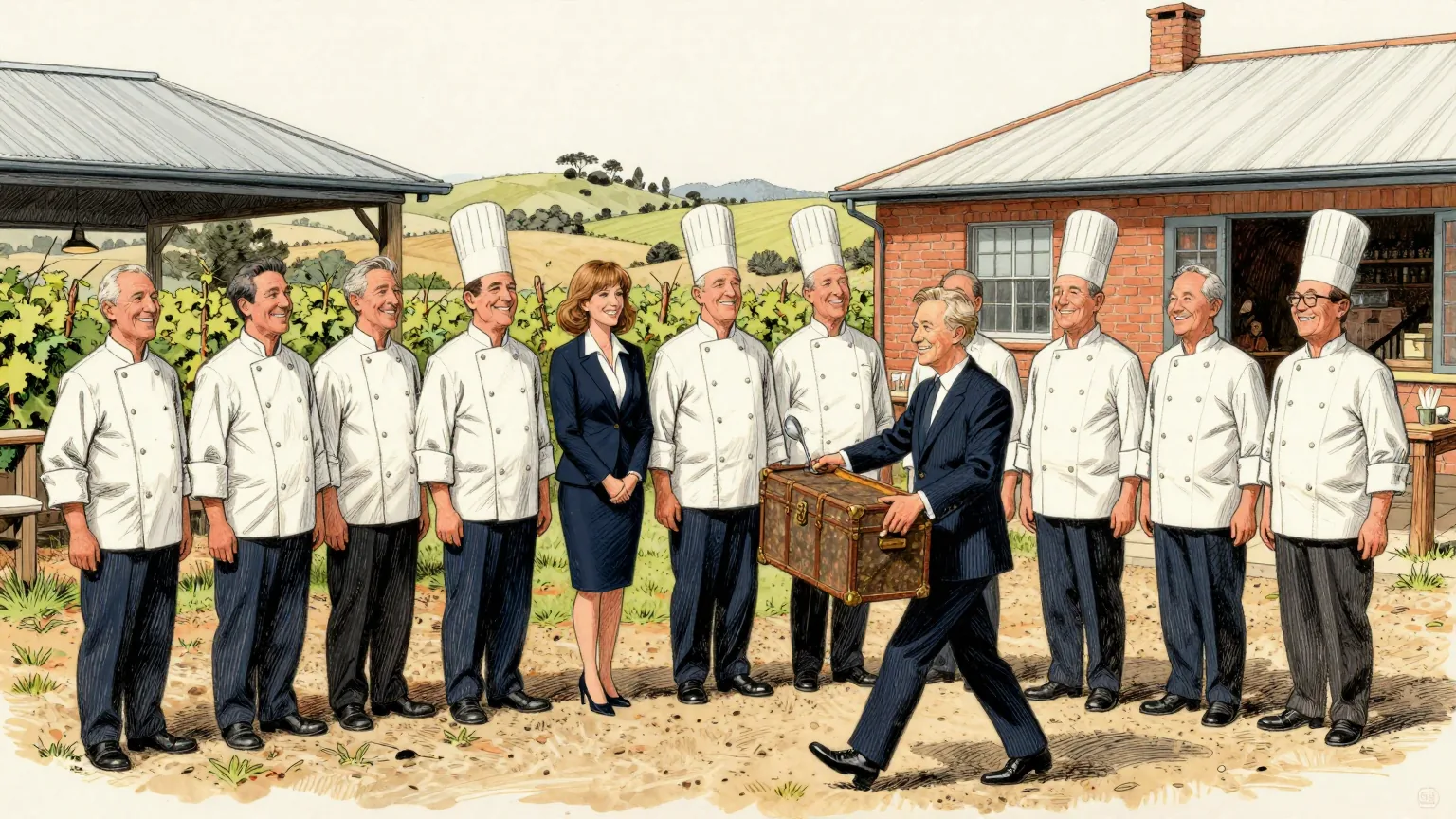
Michelin has awarded stars in Australia for the first time, and all eleven of them went to restaurants in a single state.
The only venue given two stars was Magill Estate Restaurant at Rosslyn Park, in Adelaide. Ten more took one star each in Wednesday's announcement.
The one-star list runs to Anvers Restaurant at Kangarilla, Maxwell Restaurant at McLaren Vale, Botanic in Adelaide, Arkhé at Norwood, Esmay in Adelaide, Aurora at ILA in Adelaide, Hentley Farm at Seppeltsfield, LVN Restaurant at Bird in Hand in Woodside, Aptos at Stirling and Skillogalee Barrel House at Sevenhill.
The South Australian government paid for Michelin's incognito inspectors to visit the state. The national broadcaster ABC, whose reporting the BBC cited, said that was the reason no restaurant elsewhere in the country was recognised.
The state has not disclosed how much it paid. The tourism minister, Emily Bourke, defended the spending in an interview with ABC News. "It is enabling us to create a tourism destination and put us on the world map," she said.
Michelin has approached Australia's national tourism board about bringing the guide to the country more than once, without success. South Australia decided to go it alone and pursued its own deal.
There is a recent precedent across the Tasman. New Zealand became the first destination in Oceania to feature in the guide in July, agreeing to pay NZ$6.3m (£2.7m; $3.5m) over three years for its inclusion.
Magill's chef and owner, Scott Huggins, said he had "dreamt of working in Michelin star restaurants as a youngster" and had worked in them in Europe and Japan. "It's one thing working for one, one thing achieving two," he said.
The guide was created in 1900 by the brothers André and Édouard Michelin, originally to encourage motorists to travel and so to sell more tyres. Stars were introduced in 1926.
Michelin's own definitions are explicit about distance. One star recognises high-quality cooking. Two stars indicate excellent cooking worth a detour. Three are reserved for exceptional cuisine worth a special journey.
Beyond the starred venues, the wider guide covers more than 70 other South Australian restaurants, some of them in the Bib Gourmand category, which highlights good food at more moderate prices.
It is worth being precise about what has been established. Eleven restaurants in South Australia have been inspected and found to be excellent. No restaurant anywhere else in Australia has been found to be anything at all, because no inspector went looking.
This newspaper regards the result as methodologically immaculate. A guide that visited one state and awarded stars in one state has achieved perfect agreement between its findings and its itinerary.
The two-star definition is the part that repays attention. Excellent cooking worth a detour. A detour is a departure from a route, and the only route the inspectors took was the one the state government arranged.
Three stars, reserved for cuisine worth a special journey, are therefore unavailable in Australia on procedural grounds. A special journey cannot be made to somewhere the guide has already been paid to reach.
The Department of Unnecessary Research has written to Michelin with the obvious follow-up. If a state can purchase the arrival of inspectors, and inspectors are the sole instrument by which excellence is detected, then the guide is not a map of where the best food in Australia is. It is a map of where the invoice was settled. Eleven restaurants are world-class. The rest of the continent is merely unobserved.