Horticulturists at the Australian National Botanic Gardens in Canberra have successfully cloned four of the six plants that make up the entire known wild population of Eucalyptus recurva, one of the rarest trees on Earth.
The species, a small multi-stemmed mallee known as the Mongarlowe mallee or the ice age gum, survives in a restricted area of southern New South Wales, a short drive south of the capital. It is listed as critically endangered. The largest of the six plants is estimated to be between 3,000 and 6,000 years old.
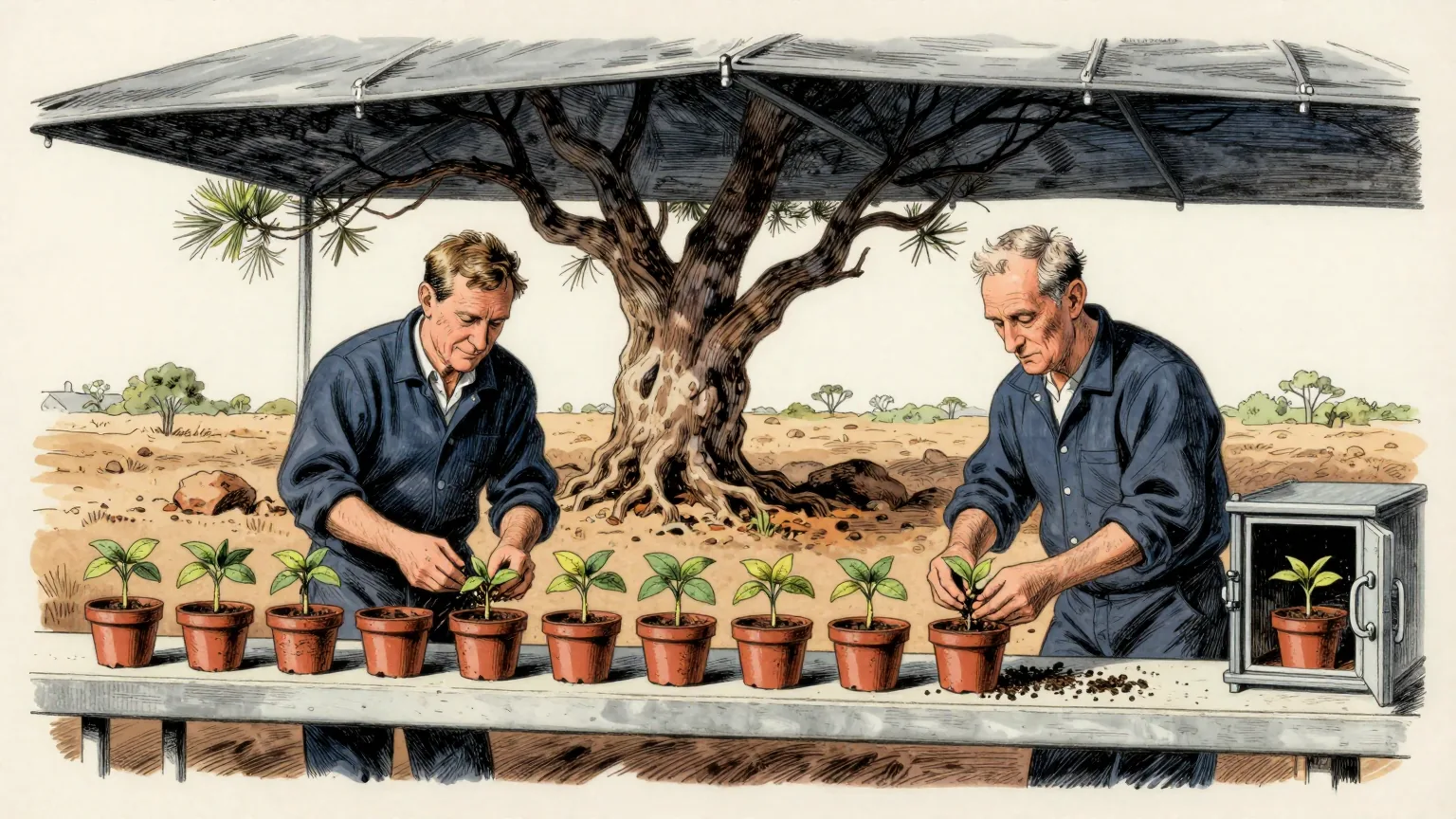
The propagation work is being carried out by the gardens with the New South Wales government's Saving our Species programme. Cuttings taken from the wild plants are grafted onto hybrid Eucalyptus recurva rootstock in the nursery, a technique that sidesteps the species' near-total failure to set seed.
Four of the six have taken. Each has produced multiple copies, which are being held as what the conservation teams describe as an insurance population: plants kept in cultivation so that the loss of a wild individual is not also the loss of its genetic material.
"If anything happens to those plants, we're really facing an extinction of the species," said Peter Bredell, a senior conservation horticulturist at the gardens.
The reason the species cannot rescue itself is arithmetic as much as biology. The six survivors are too widely separated to pollinate one another, they flower infrequently and not at the same time, and there is no known wild seed. The population has stopped reproducing while continuing to live, which for a plant that may be six thousand years old is a slower problem than it sounds.
Flowering is not a quick test of success either. The species can take up to twenty years to flower, so the grafted plants now standing in the Canberra nursery will confirm nothing about their own fertility until the 2040s.
There is a further constraint on the cultivated material. To keep it genetically true, the teams have to prevent the plants from being pollinated by the many other eucalypts growing nearby. Genevieve Wright, a senior threatened species officer with Saving our Species, is among those overseeing the programme.
It is worth being precise about what has been secured. The gardens now hold more Eucalyptus recurva plants than exist in the wild. They do not hold more Eucalyptus recurva than existed before. Every plant on the bench is a cutting taken from one of four individuals, which means the species has been successfully increased in number without being increased.
This newspaper regards that as the most efficient conservation outcome currently available. A grafted copy is the same plant in a second location, so the population can be raised indefinitely while the gene pool remains fixed at four. Nothing further needs to be found.
The insurance analogy holds rather better than the gardens may intend. An insurance policy does not reduce the chance of a loss; it duplicates the asset. Four of the six wild plants are now held in two places at once. The remaining two are held in one place, which makes them the uninsured portion of a species of six.
The twenty-year wait to flower sets the term of the policy. If the copies prove fertile in the 2040s, the species will begin reproducing for the first time in living memory. If they do not, the gardens will still hold a complete and permanent record of four plants, which is a better position than the one the programme started from.
The Department of Unnecessary Research has asked the gardens to settle the only question still open: whether a plant copied four times has been saved four times, or once. It notes in passing that the oldest of the six has not produced a viable seed in six thousand years, and is therefore, by every measure the project currently uses, the most successful of them.