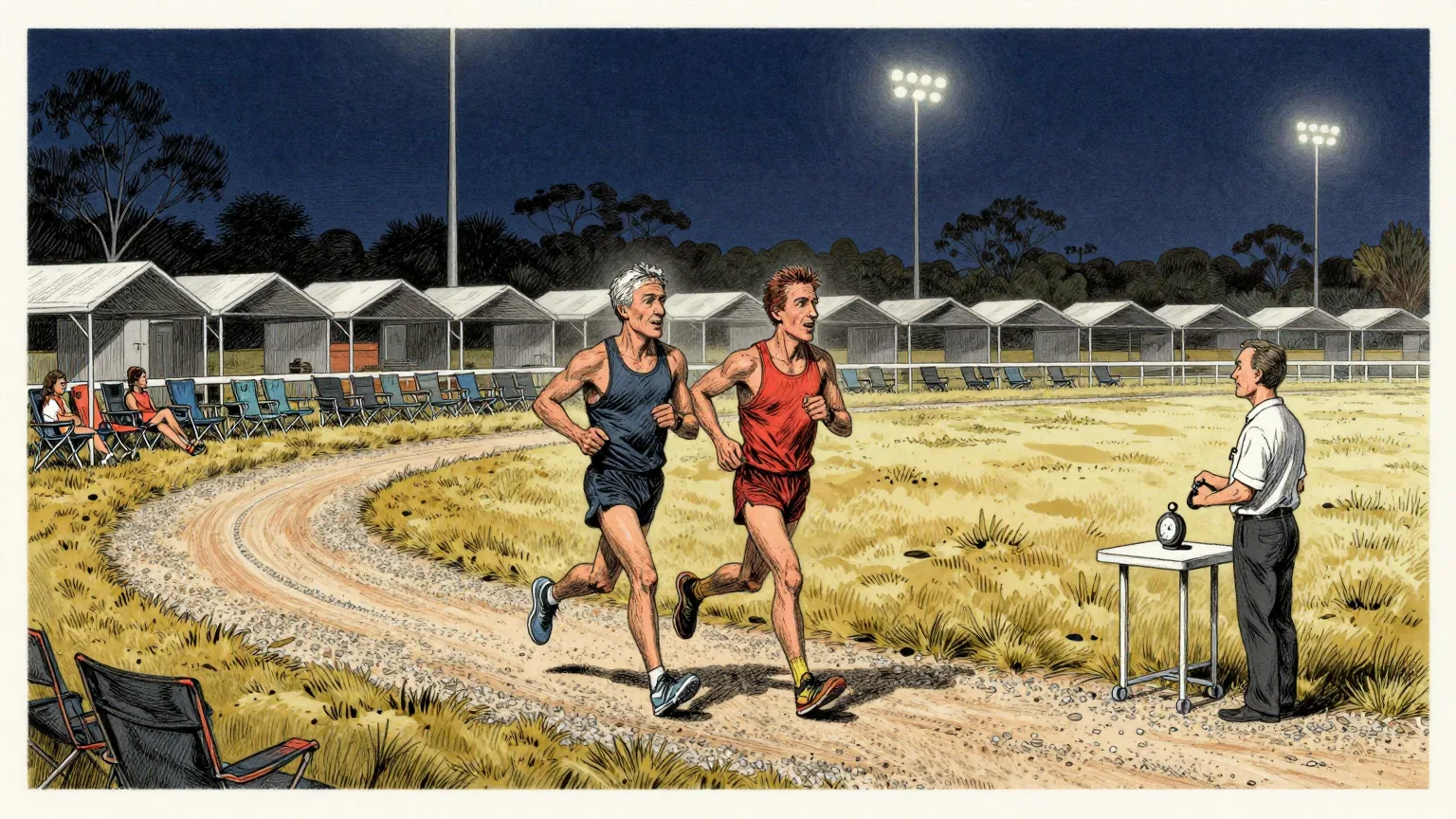
About 900 runners from 67 nations, including 15 Australians, crossed the start line of the Backyard Ultra World Team Championship at 11pm on Saturday AEDT at Kembla Grange in the New South Wales Illawarra.
The format is deceptively simple. Each athlete completes a 6.7-kilometre course loop on the hour, every hour, until one runner remains. Food and whatever sleep is available are squeezed into the rest of the hour, in an event that can stretch beyond four days.
Australia's team has completed more than 1,000 laps between them. Two of its 15 competitors, Dan Camac and Ben Nicholls, are still going, and are hoping to reach 100 hours, which would be Thursday morning.
The attrition has been severe. "There's a mixture of fatigue, not getting their nutrition right, body ailments that are going on," Australian race director Red Barnett said. "So unfortunately, we just had one after the other [drop out] and are left with two."
Jonathan Ash was the first Australian to stop, on Monday afternoon, after exceeding the hour limit on his 41st lap. The Shellharbour engineer is the second Australian ever to complete 100 laps, equal to 670 kilometres, over four days in 2024.
The first was Phil Gore, who is on the sidelines injured this year and spending it tending to fellow athletes. Gore set the world record last year with 119 laps, or 797.3km, after five days on a southern Queensland farm.
Melbourne's Brandon Lee Gretch stopped after lap 73 at about midnight on Wednesday, and said he was proud of his effort, having achieved a personal best. "Myself as an eight-year-old would be so proud to know I got to put on the green and gold," the 32-year-old said.
The discipline is young. Backyard ultras were invented 15 years ago by Gary "Lazarus Lake" Cantrell and hosted at his Bell Buckle property in Tennessee. "He wanted to challenge people to complete 100 miles in 24 hours," Barnett said. "It just grew in popularity as people pushed beyond the 24-hour mark. It is a bit of a crazy event."
Barnett expects conditions to become "drastically harder" for the two who remain. "When there is only two left, they really need to work together," she said. "Having a lot of people around to support and cheer them on, even through the nights, all that really helps, but it's going to be a huge mental test."
The rules repay precise reading. There is no distance to be covered and no finish line to cross. The event continues until one runner remains, which means that no competitor's total is determined by the course.
It is determined by whoever stops second-last. Gore's 797.3 kilometres is a fact about Gore, and equally a fact about every athlete who was no longer on the loop at the time.
Training, on this analysis, is only half of the preparation. The other half belongs to the rest of the field, and the Department of Unnecessary Research notes that a competitor can improve a backyard ultra result without moving at all, simply by having a rival sit down.
The race director's advice to the final two follows the format exactly. With two left they really do need to work together, which in an event decided by the moment one of them stops means close co-operation with the only person on the course capable of ending it.
There is no finish line, so nobody will finish. One runner will be left standing at Kembla Grange, and the sport records that as a win.