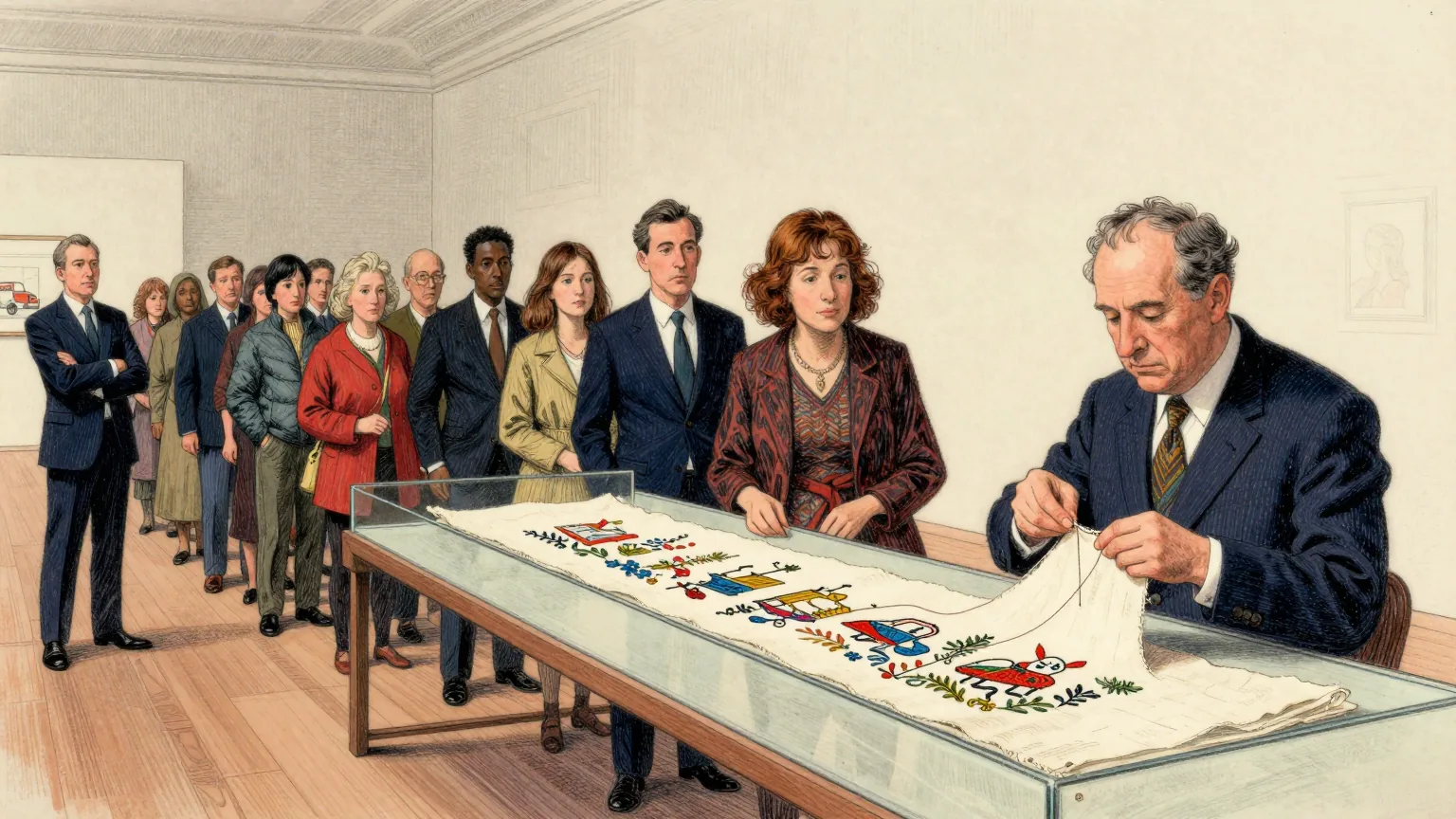
The British Museum has banned visitors from photographing the Bayeux Tapestry, saying the restriction is needed to keep people moving past the nearly 1,000-year-old embroidery at a steady pace.
The museum announced the decision on Monday, eleven days after the exhibition opened on 10 September. "We have made the decision to restrict photography while people are moving along the length of the tapestry," it said.
The museum also said: "There has been enormous interest in viewing the tapestry, and our priority is to ensure that all visitors have the best experience possible."
That interest is not in dispute. The exhibition is sold out until 31 December, a second tranche of tickets does not go on sale until 21 October, and the display runs until 11 July 2027.
The tapestry is an eleventh-century embroidery roughly 70 metres long. It carries 627 figures and more than 700 animals, and tells the story of the Norman conquest of England as a continuous sequence of scenes read from one end to the other.
It was made in England and has been held in Bayeux, in Normandy. The loan to London has brought it back across the Channel, which accounts for the queue.
The London display also differs physically from the one in Bayeux. There the work hangs vertically; at the British Museum it is laid flat inside a raised glass cabinet, with visitors moving along it under a one-way system. The museum estimates the visit takes about 40 minutes.
Forty minutes for 70 metres is a walking pace of well under two metres a minute. It is a slow shuffle by design, and the museum's difficulty is that a visitor who stops to raise a phone stops everyone behind them as well.
Restrictions of this kind are ordinary museum practice. Flash photography is limited for conservation reasons across the sector, and crowd-flow rules are common in exhibitions with timed entry.
It is worth stating plainly what the object in the case is. The Bayeux Tapestry is 70 metres of sequential pictures, made in a century that had no other way of holding an event still. Its entire function was to record what happened so that people could look at it afterwards.
That function has now been formally suspended at the point of contact. Visitors may look at the record. They may not make one.
This newspaper regards the decision as a restoration rather than a restriction. For the first time in roughly 950 years, the tapestry is being viewed under the conditions it was designed for: once, in person, at walking pace, by people who will have to remember it.
The arithmetic is favourable. There are 627 figures and more than 700 animals in the case, and, for the duration of the exhibition, exactly no new images of them leaving the building. The ratio of pictures inside the room to pictures outside it has been fixed for the first time since the invention of the camera.
The Department of Unnecessary Research notes that the tapestry survived nine centuries under precisely this arrangement, and has asked the museum to clarify only one point of policy. If a visitor were to walk the 70 metres at the prescribed pace, return home and embroider what they saw onto a strip of linen, the Department can identify no rule against it, and no meaningful difference between the result and the original.