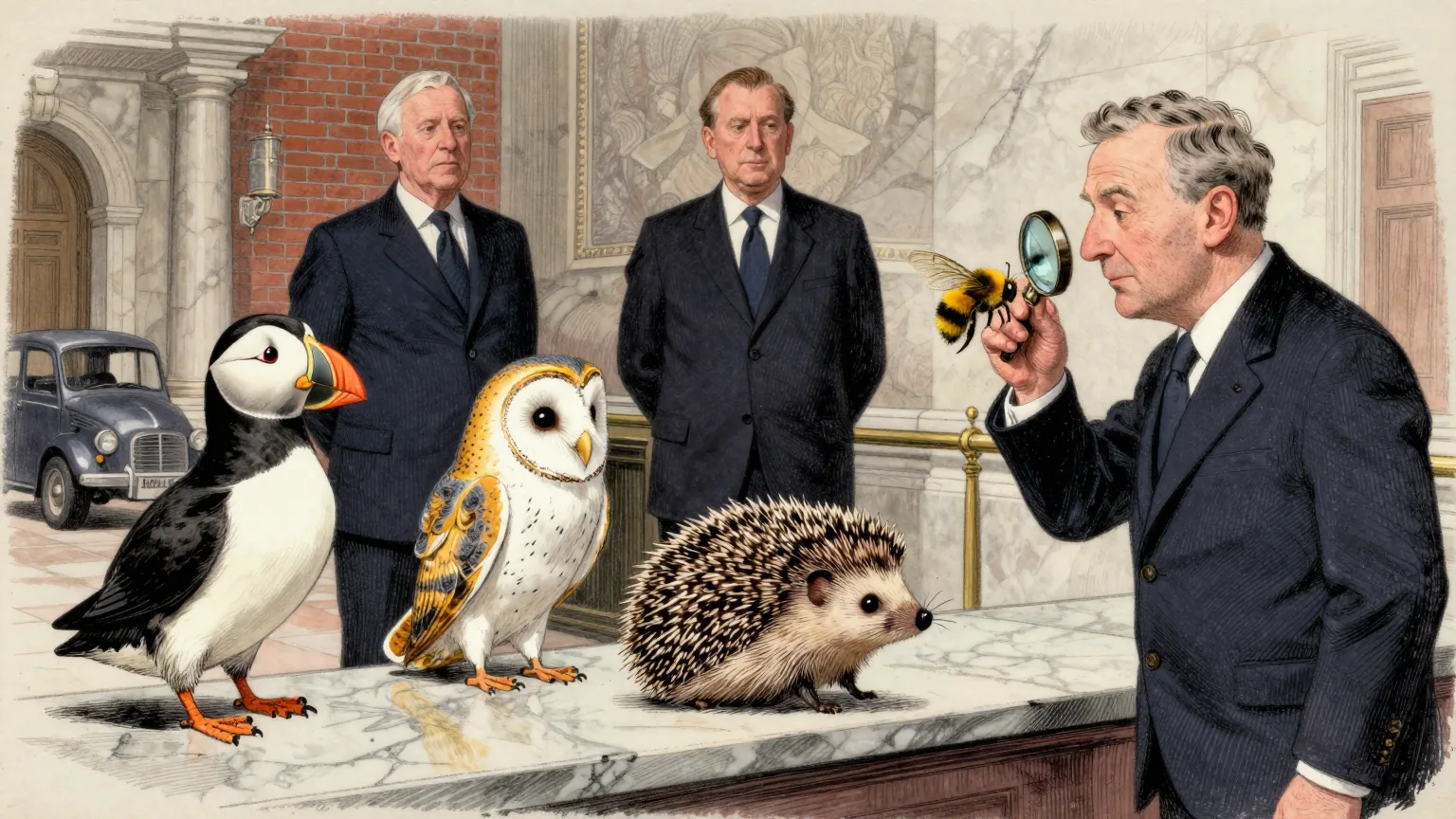
The Bank of England has named the four animals that will appear on its next series of banknotes: the Atlantic puffin, the barn owl, the buff-tailed bumblebee and the European hedgehog.
Each will be the central image on one of the four denominations, the 5, 10, 20 and 50 pound notes, although the Bank has not said which animal will appear on which note. That decision will be made in due course and announced closer to launch.
The choice follows a consultation that opened on 3 June and ran for a month. A panel of wildlife experts drew up a shortlist of 18 mammals, birds, amphibians, insects and fish, and respondents were invited to select up to six. The consultation received 478,531 responses, the most the Bank has ever had for a banknote imagery consultation, and those responding placed 2,549,003 selections across the shortlist.
The buff-tailed bumblebee was the clear winner, receiving 360,399 nominations, nearly 90,000 more than the barn owl's 270,596. The European hedgehog was the most popular animal in the mammals category with 259,665.
The Atlantic puffin was not the most nominated animal in its own group, or in any other. The red fox, among the mammals, received 244,651 nominations, and the common kingfisher, among the birds, received 211,277, against the puffin's 183,137. The puffin was selected because it was the most popular marine animal.
The Bank said the inclusion of a marine animal added variety to the series, made the denominations easier to distinguish, and gave an opportunity to celebrate the British coastline. It had said in advance that it would not necessarily choose the four animals receiving the highest number of responses, because it was important that the animals represent different environments from across the UK.
"We have chosen four distinct and inspiring animals that not only showcase the great variety of wildlife we have in the UK but will also enhance the security of our banknotes," said Victoria Cleland, the Bank's chief cashier.
It will be the first time since 1970 that the reverse of a Bank of England note has not carried a notable figure from history. The notes now in circulation show Sir Winston Churchill on the 5, the author Jane Austen on the 10, the artist JMW Turner on the 20 and the mathematician and wartime codebreaker Alan Turing on the 50. The monarch will continue to appear on the other side.
The Bank said the redesign was primarily intended to stop counterfeiting, which means all images need to be replaced on banknotes over time. Rhys Phillips, the Bank's incoming chief cashier and the person responsible for delivering the new series, said the work would take years.
"We'll now work to design, test and produce the banknotes, combining the imagery we've announced today with cutting-edge security features and materials science," he said.
Wildlife is not new to British money. Mackerel, otters, red squirrels and ospreys already appear on notes issued by the Royal Bank of Scotland, and the puffin and the bee feature on the Royal Mint's redesigned 20 pence and one pound coins.
It is worth being precise about what the public was asked to do here, because the answer is not quite what the ballot said. The consultation was about imagery. The imagery, on the chief cashier's own account, will enhance the security of the notes. The 478,531 respondents were therefore taking part, without being told so, in the largest public consultation on anti-counterfeiting ever held in the United Kingdom.
On the evidence published, the country's preferred defence against forgery is a bumblebee, carried by 360,399 nominations to the barn owl's 270,596. The hedgehog took the mammals. The forger's task is now understood to involve insects.
The puffin's selection states the principle most clearly. Two animals polled higher and neither of them was coastal. The fox's 244,651 nominations were not beaten by a more popular animal. They were beaten by the British coastline, which a fox does not have.
This newspaper regards the arrangement as sound in its own terms. A banknote must be hard to copy and easy to tell apart from the next one, and the Bank has now established that both properties can be held by an animal. Which animal holds which value is a matter for the testing programme.
The remaining questions are procedural. If the four animals are security features, the shortlist of 18 was a procurement exercise, and the fourteen that did not win are unsuccessful tenders. The basking shark, on 69,699, has been passed over on grounds of popularity, variety or coastline, and the published material does not say which.
The Department of Unnecessary Research has put the obvious consequence to the Bank for confirmation: that a counterfeiter who can draw a convincing bumblebee will have cleared, by public mandate, the central defence of the pound.