Cats appear to recognise one another through a chemical signature in their urine made up of thirteen unusual fatty acids, according to research from Iwate University in Japan published in the journal Current Biology.
The compounds are branched-chain fatty acids, or BFAs. The team reported that a literature review found no previous reports of the same BFAs occurring in mammalian excretions or secretions, which makes the set distinctive to the animals studied.
The research was directed by Professor Masao Miyazaki of Iwate University, working with colleagues in Japan, Germany and Spain.
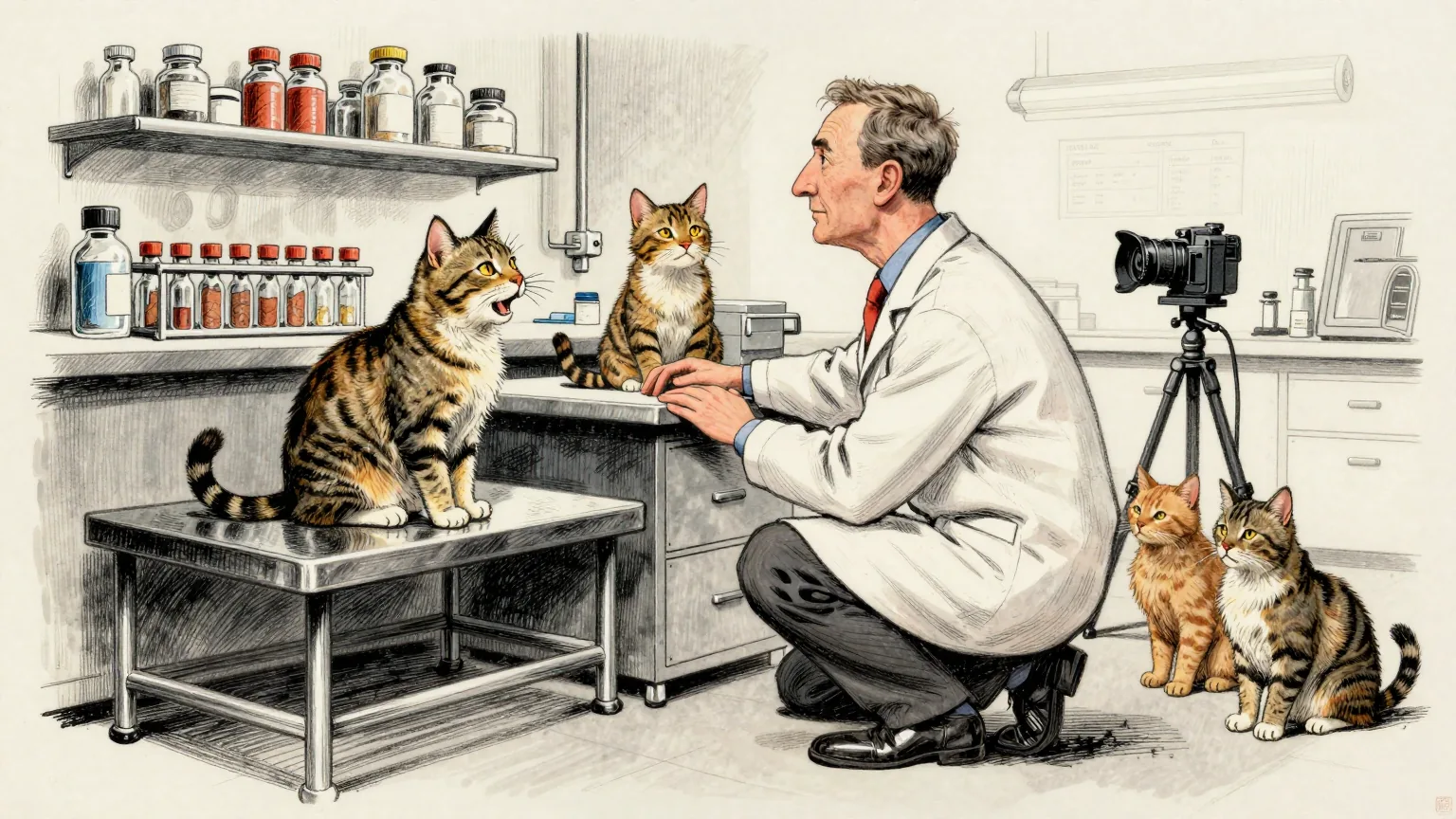
The starting point was behavioural. "After confirming that cats can distinguish individual urine odors, we used the flehmen response as a clue to identify urinary molecules that may contribute to individual scent recognition," Miyazaki said. The flehmen response is the open-mouthed grimace cats make when drawing a scent across the roof of the mouth.
The chemistry then had to account for two things at once: the signal has to differ between animals, and it has to stay put long enough to be read.
On the first point, the team found that BFA profiles varied considerably between animals while remaining comparatively stable when the same cats were sampled on different dates. Genetic relationships influenced how similar two profiles were, but each cat kept its own distinguishable profile even within the same family.
On the second, the compounds are semi-volatile and evaporate more slowly than typical odour molecules. In samples held at 25C they remained comparatively stable for at least 24 hours.
The BFAs were also detected in lions, tigers, leopards, jaguars, lynxes, Iriomote cats and Tsushima leopard cats, with the exact profiles varying by species.
Set out in those terms, the finding is not a discovery about scent. It is the description of an identity document, and a better one than anything the species that funded the study has managed to issue itself.
Consider the specification. It is unique to the holder. It is issued at birth and cannot be transferred, forged by a relative or left in a coat pocket. It is machine-readable by any other cat without equipment, training or a connection of any kind.
It carries a validity period of at least 24 hours at room temperature, after which it expires cleanly and is replaced. It is renewed continuously and free of charge, and no cat has ever had to attend an appointment to obtain one.
The scheme is also international. The same class of compounds turns up in lions in Africa, jaguars in South America and Tsushima leopard cats on a Japanese island, with local variation by species, which is precisely how a well-designed travel document family is supposed to work.
This newspaper can identify only one design flaw, and it is a presentational one. The document cannot be shown. It can only be deposited at a location and abandoned, after which the holder leaves and the reader arrives later.
The Department of Unnecessary Research accepts that this makes verification asynchronous and has asked whether any human authority is prepared to adopt the standard. The Department's own position is that thirteen compounds, no appointment and a 24-hour expiry represents a clear improvement on the current arrangements, and that the deposit requirement is a matter of implementation.