
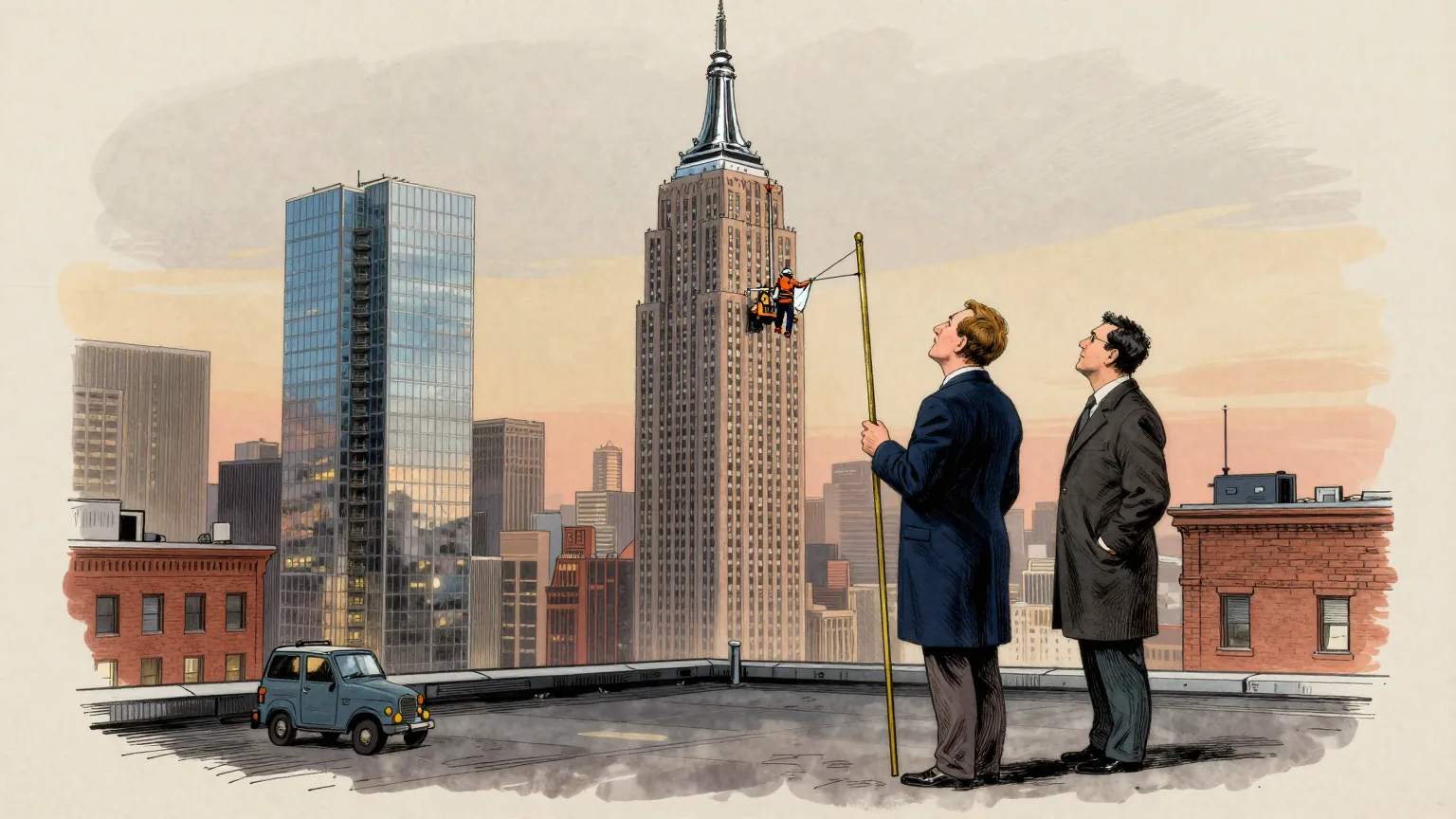
The Chrysler Building, one of the most distinctive high-rises on Manhattan's skyline, is to undergo a major renovation as part of a multi-million-dollar sale deal, with its Art Deco crown polished and restored and its 77-storey facade repaired.
The developer Tishman Speyer has taken over the lease from the Cooper Union for the Advancement of Science and Art, the private New York college that has owned the land beneath the building since 1902.
Tishman Speyer and its partners will invest $235m in the project. The work includes upgrades to the building's mechanical, elevator, electrical and air handling systems, and a refit of the 61st floor, home to the huge eagle gargoyles, which will also house an "upscale" lounge.
The developer plans to use most of the building, which stands close to Grand Central station, as office space, following what it calls a "prebuild approach" that lets firms move into finished premises quickly.
Its reasoning rests on scarcity. The area "has one of the lowest office availability rates in Manhattan", the company said, adding: "Construction of new office supply in the neighbourhood has been virtually nonexistent for decades."
The building's own history is a study in brief advantage. At 1,046ft, or 319m, it was the tallest building in the world when it opened, having been financed by the motor magnate Walter Chrysler and built between 1928 and 1930 to a design by William Van Alen, who modelled the eagle gargoyles on the hood ornaments of the 1929 Chrysler car. It was overtaken by the nearby Empire State Building less than a year later.
The land was bequeathed to the Cooper Union by the children of Peter Cooper, the manufacturer and industrialist who founded the college in 1859; its alumni include Thomas Edison. Under the deal the college will receive ground lease payments it says will finance "a bold plan to restore full-tuition scholarships for all undergraduates".
"The significance of this agreement is ultimately about what it makes possible for generations of Cooper Union students," said the college's president, Steven McLaughlin.
The developer's case for the building is, on its own terms, a case against building. The neighbourhood is attractive because it has one of the lowest office availability rates in Manhattan, and it has one of the lowest availability rates because almost nothing has been built there for decades.
The asset, in other words, is the absence. What has been bought into is a shortage, and a shortage is depleted by use.
This newspaper has followed the arithmetic to its end. Every lease signed in the restored building reduces the availability rate that justified restoring it, so the project consumes its own investment case one tenant at a time, and becomes fully successful at precisely the moment it stops being worth doing.
Our analysts note that the building has been here before. It was the tallest in the world for under a year, and lost the title not by shrinking but because somebody else built. The $235m now going into the crown is being spent on the one part of the structure whose only achievement was to be briefly higher than everything else.
The Department of Unnecessary Research has identified the single durable position in Manhattan property. The surest way to maintain one of the lowest office availability rates in the neighbourhood is to leave the offices empty.