
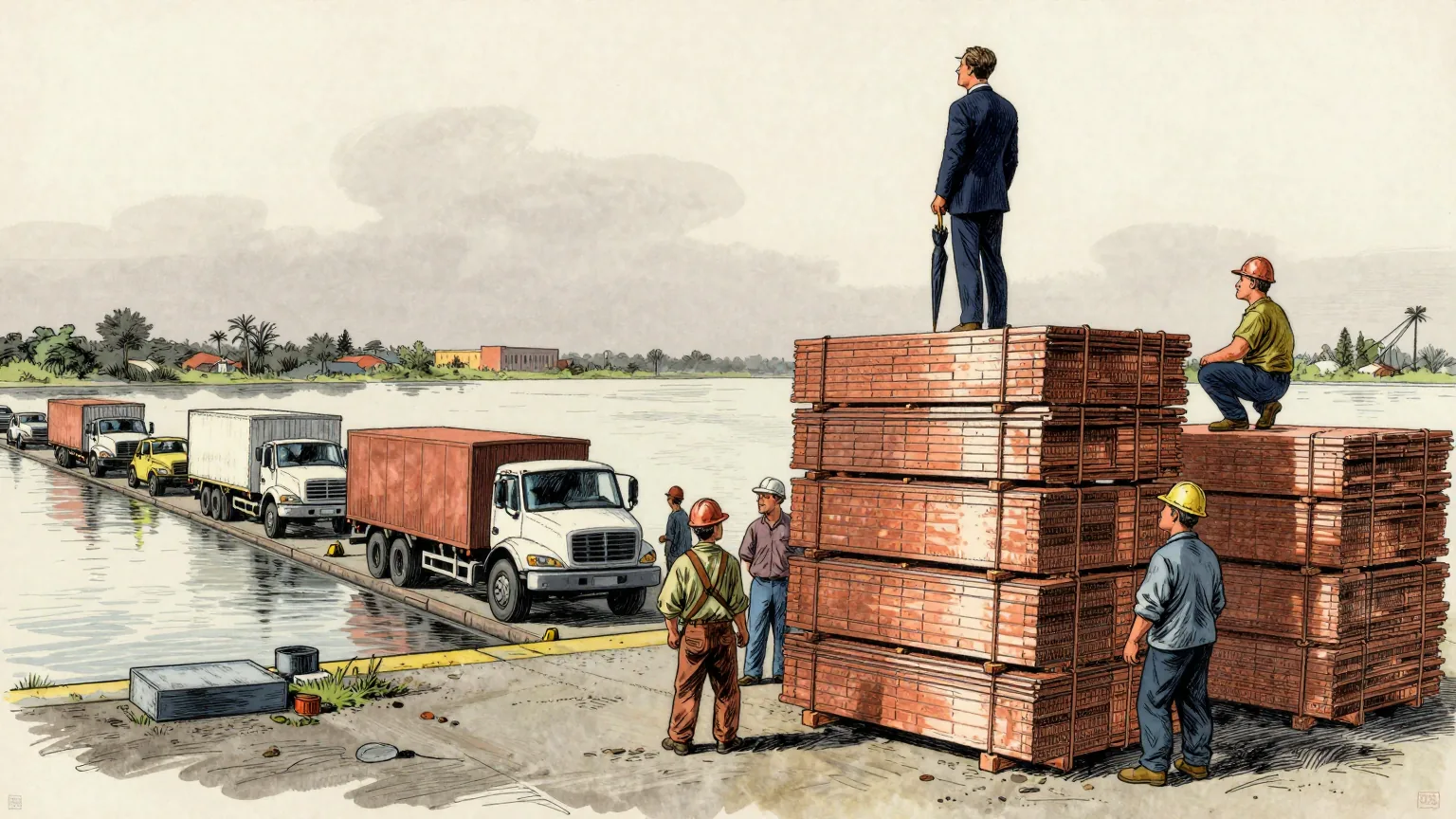
The Port of New Orleans is largely full of copper, and a great deal more is on its way.
The vessel Nord Norfolk is carrying about $500m of African copper, which the analytics firm Kpler records as the highest market value ever logged for a single commodity shipment.
Behind it, roughly 100,000 metric tons of African and South American copper is expected to reach the United States across September and October.
The terminals cannot move it fast enough. "We are seeing serious congestion at marine terminals in the New Orleans area, causing delays for loading copper and other metals and steel to trucks and railcars," said Anton Posner, chief executive of Mercury Resources.
The cause is a trade measure. Copper has risen about 50% on the London Metal Exchange benchmark since President Donald Trump proposed tariffs on the metal in February 2025, and traders have spent the intervening period shipping metal into the country ahead of any duty.
The premium that made the trade worth doing has narrowed. The arbitrage gap now stands at $169 a ton, against $789 a ton at its 2026 peak.
It has not closed. "I wouldn't call the arbitrage dead just yet," said Marcos Carias, North America economist at Coface.
The infrastructure has followed the metal. Comex has added twenty warehouses since 2025, about 725,000 short tons of storage, equivalent to 39% of annual US refined-copper consumption. New locations include Mobile, Chicago and Atlanta, with Mobile taking on traffic that New Orleans can no longer absorb.
Analysts are candid about what has happened. "The potential for tariffs alone has essentially had the effect they want from tariffs; that is, bringing lots of supply into the country and increasing domestic premiums to support domestic projects," said Ryan McKay, senior commodity strategist at TD Securities.
That observation deserves more attention than it usually gets. The tariff under discussion has not been collected. The copper came anyway.
This newspaper has looked for the flaw in the reasoning and cannot locate it. A tariff that exists only as a proposal has drawn roughly 100,000 tons of metal to the United States, filled a major American port, prompted the opening of twenty warehouses and added about half to the price of the underlying commodity. An enacted tariff could hope for very little more.
The advantages of the unimposed tariff are, on inspection, considerable. It needs no customs officers. It has no schedule of exemptions to administer and no rate to publish. It produces no refunds, no disputes and no appeals, for the straightforward reason that nobody has paid it.
It is also unusually durable. A tariff that has not been introduced cannot be repealed, cannot be struck down and cannot be retaliated against. It simply continues not to exist, at whatever level is proving most effective.
That level may be raised without limit. Since the duty is never collected, doubling it costs importers nothing, and on the evidence of the past eighteen months it moves a great deal of copper.
The Department of Unnecessary Research therefore recommends that the Treasury begin booking the revenue from tariffs it has not imposed, on the same principle. The metal is real. The warehouses are real. The congestion at New Orleans is real. The tariff is the only part of the arrangement that nobody has had to build.