
The U.S. Copyright Office has published a notice of inquiry on music streaming fraud, soliciting information from the public on how prevalent the practice is and how it may be affecting the music industry.
The notice, Docket No. 2026-6, was published on 7 October. It responds to a congressional request: a letter sent in May by Representative Scott Fitzgerald of the House Judiciary Committee to the Register of Copyrights, Shira Perlmutter, asking the Office to “examine the prevalence of streaming fraud across digital platforms and how it may be affecting the music industry as a whole”.
Initial written comments must be received by 23 November 2026 and reply comments by 21 December 2026, submitted electronically through the regulations.gov system.
The sums involved are substantial. The Digital Media Association estimates that streaming is “now driving around 70% of global sales”. For sound recording owners, the Office puts streaming revenues at approximately $9.5 billion domestically and $22 billion globally, and notes that streaming represented 82 per cent of total US recorded-music revenue last year for the fifth straight year, within an annual total that reached a record $11.5 billion.
On the songwriting and publishing side, the Office puts streaming revenues at roughly $7.3 billion domestically and $10 billion globally.
The notice describes how the fraud is carried out. “Streaming fraudsters use bot farms, click farms, playlist stuffing, account hijacking, or other methods of user manipulation to inflate their songs' plays,” it says, adding that such activities are frequently accomplished by unethical marketing companies, and that those involved “dilute the royalty pool for legitimately streamed works”.
The Office also asks whether existing countermeasures are effective, and whether legislation providing a remedy such as no-fault injunctive relief would help.
The regulations supply the unit under discussion. For the statutory mechanical licence, a “Play” is an eligible stream or limited download “lasting 30 seconds or more” - or, for a track shorter than that, the entire duration of the track - while excluding any play caused by user manipulation. “User Manipulation” is in turn defined as “any behavior that artificially distorts the number of Plays”, including manual means such as click farms and automated means such as bots.
A second regulation defines play frequency for certain services as “the number of times a sound recording is publicly performed by [an eligible service] during the relevant period, without respect to the number of listeners receiving the sound recording”.
Those two definitions sit side by side, and it is the second that makes the inquiry difficult.
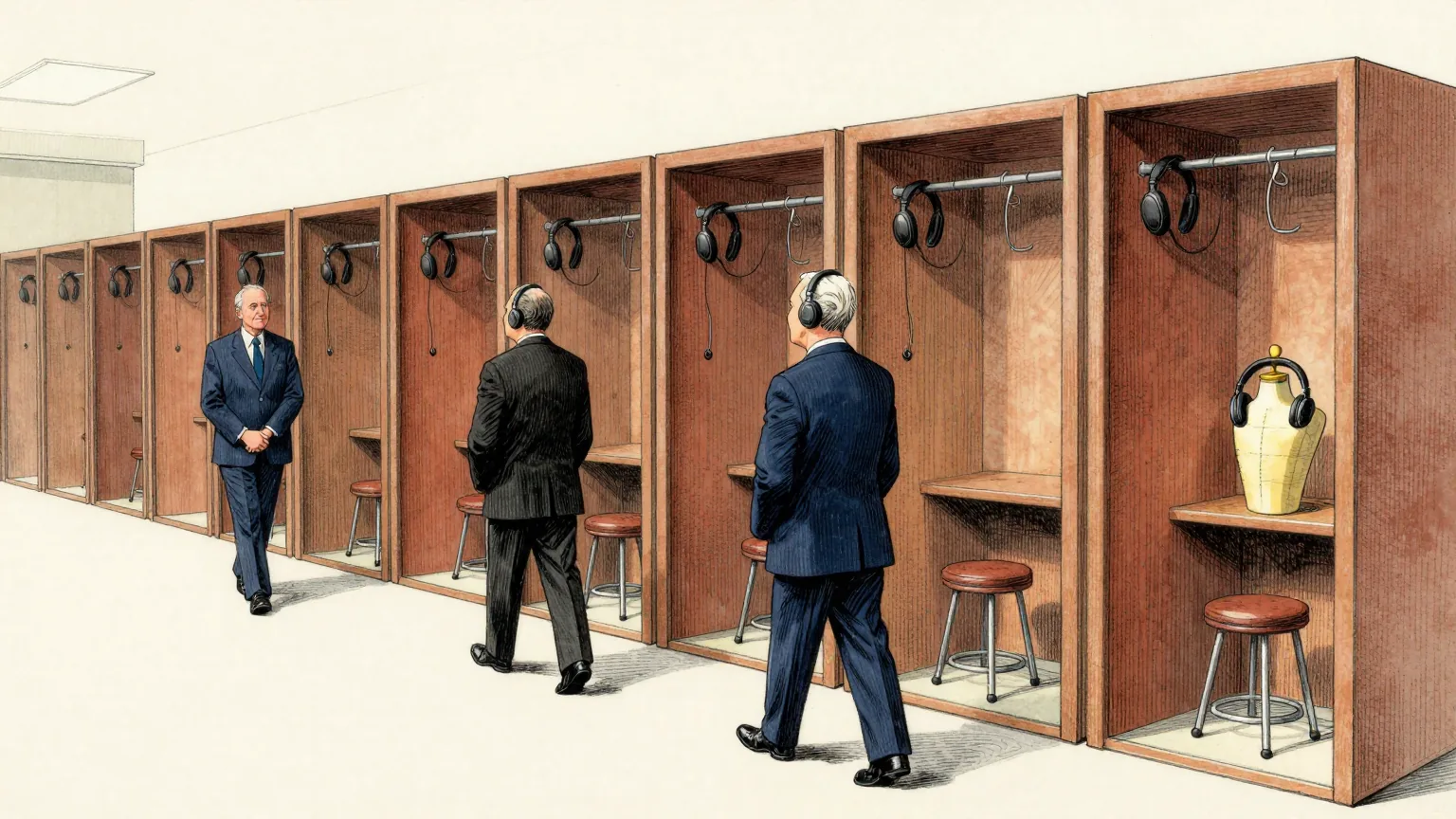
A play does not require a listener. The rule says so in terms: the count proceeds without respect to the number of listeners receiving the recording, and that includes the number zero. A recording performed to nobody for thirty-one seconds is a play, and is paid as one.
What disqualifies the bot, therefore, is not that nobody was listening. Nobody listening is permitted, and indeed specified. The bot is disqualified because of the manner in which nobody was listening.
This newspaper finds the distinction admirably precise and entirely invisible. Two identical streams of identical length, each received by no human being, differ only in how they were brought about, and that is not a property of a thirty-one-second audio event.
The Department of Unnecessary Research has accordingly reduced the Office's question to its working form: how to distinguish a play with nobody listening from a play with nobody listening. Forty-seven days have been allowed for answers, and a further twenty-eight for replies to the answers.
The royalty pool is finite and is divided by plays. Everything the industry calls a stream and everything it calls fraud meets the same technical definition, runs for the same minimum duration and is received by the same audience of nobody. The remaining difference is that one silence was arranged on purpose.