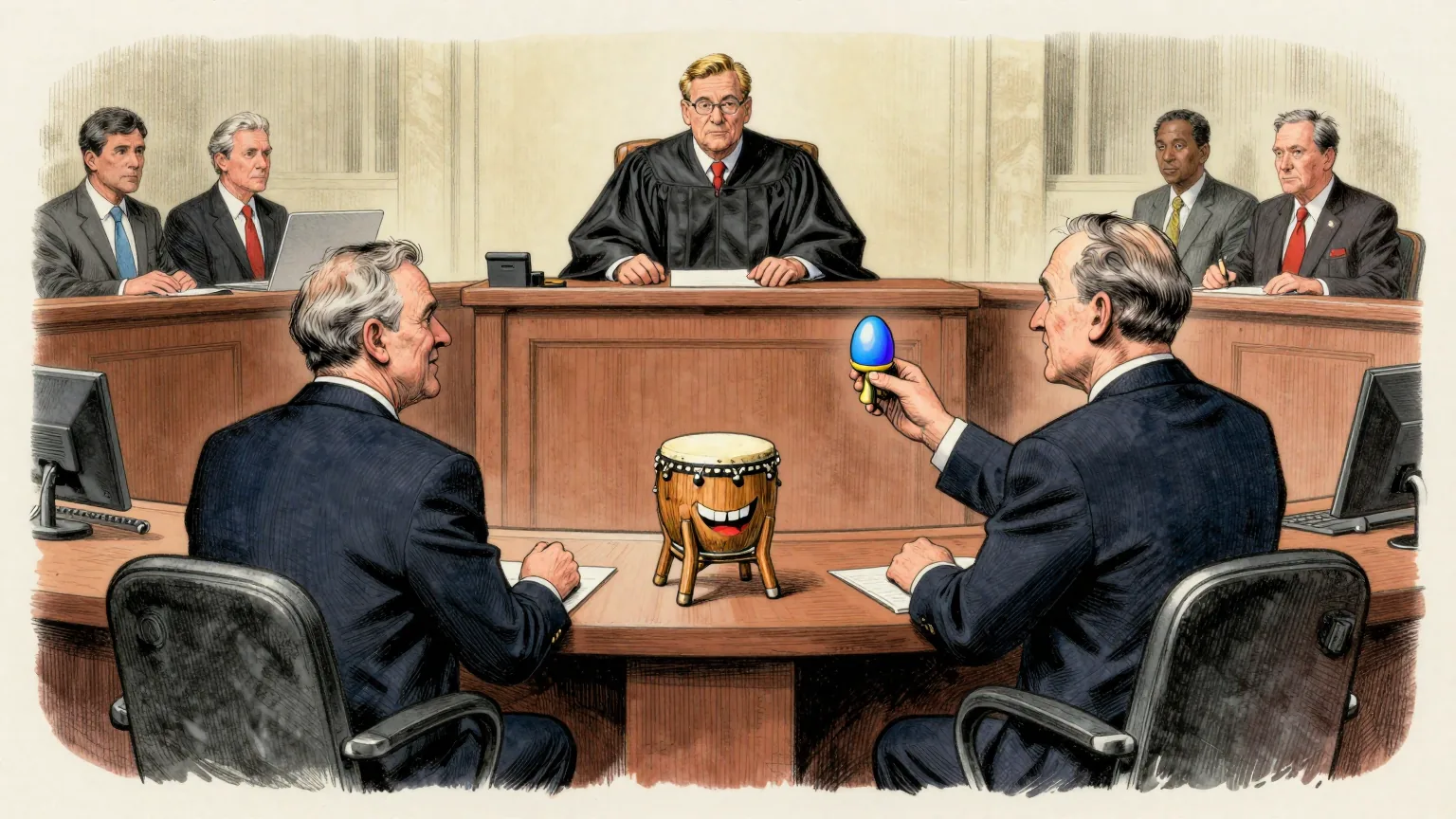
A dispute over an AI-generated internet character has reached the US district court for the northern district of California, where a games company is suing a French creative agency over the right to use the character in a popular Roblox game.
The character, Tung Tung Tung Sahur, also known as Triple T, was created in 2025 using OpenAI’s image-generation tool. It is based on a kentongan, a type of drum used to wake south-east Asian Muslims for their pre-dawn meal during Ramadan, and is an anthropomorphised version of the instrument with a broad smile and a vacant stare.
It belongs to the Italian brain rot genre, a universe of strange, AI-generated characters that also includes Ballerina Cappuccina, a ballet dancer with a coffee cup for a head, and Tralalero Tralala, a shark wearing sneakers. YouTube and TikTok host dozens of videos featuring Triple T, people dress as the character at cosplay conventions, and its likeness appears on plushies, perfume and stickers.
In May 2025 the video game company Do Big Studios released a game populated by such characters, "Steal a Brainrot", which quickly became one of the most-played games within Roblox.
In September 2025, Spyder Games LLC and Speedy Simulator Gaming LLC, the owners of Do Big, received a cease and desist letter from Mementum, the agency that represents the character’s originator, over the use of Triple T in the game. Do Big initially pulled the character and attempted to negotiate a resolution, then sued instead.
Its filing states: "Mementum’s claimed rights do not exist. Under established law, copyright protection requires human authorship, and AI-generated material does not qualify."
US copyright law applies only to human-made creations. A 2025 report from the United States Copyright Office said copyright protects "original expression" in work created "by a human author" even where the work also includes AI-generated material, but that it "does not extend to purely AI-generated material, or material where there is insufficient human control over the expressive elements". The report sets no clear standard: "Whether human contributions to AI-generated outputs are sufficient to constitute authorship must be analyzed on a case-by-case basis."
The record in this case is unusually precise about the human part. Court documents filed by Mementum in a separate trademark dispute in France show that Triple T was created over the course of 15 minutes using seven prompts before reaching its final form. They included "draw a pentungan sahur with a face and legs", then "human face", and "no hands, legs like a human, and a human face".
"We are not claiming in this case that AI-assisted work can never be owned by anybody," said Aaron Moss, a copyright lawyer representing Do Big. "In a case where somebody makes real creative choices, there is human authorship that is subject to protection. But it’s our position that sparse prompts — typing in a few words and picking [the image] you like — does not constitute human authorship."
Mementum’s approach is wider than copyright. It issued a takedown request under the EU’s Digital Services Act, which succeeded, then countersued in the United States for trademark infringement, although it does not yet hold a US trademark for the character. "Our client is pursuing a global strategy on all of this," said Steven Stein, a partner at the US firm representing Mementum Lab.
James Grimmelmann, a professor at Cornell Tech and Cornell law school, said the case "could do one of two things: we could get a court decision that tells us, in a concrete setting, what is copyrightable and what isn’t when AI is involved," and that it "could also start establishing best practices and widespread norms on how people use AI".
The argument is therefore about quantity, and it has been framed in a way that makes a number unavoidable. One side says sparse prompts are not authorship. The other says real creative choices are. Both accept that a threshold lies somewhere between them, and the record in this case supplies the only measurement anybody has: seven prompts, fifteen minutes.
Our analysts note what follows. If seven is too few, the court will be identifying a figure that is enough, and that figure will be a number of prompts. Authorship then becomes available at a price quoted in attempts, and the Copyright Office’s case-by-case analysis becomes the arithmetic of comparing one applicant’s total with another’s.
The documentation is already moving that way. Best practice, as proposed, includes recording which prompts were used, which converts a creative process into an audit trail with a running total. A character made in fifteen minutes with seven prompts is weaker, on that measure, than one made in fifteen minutes with eighty, and the sensible response for anyone who wants to own what they make is to keep going after the image is finished.
The Department of Unnecessary Research has asked the Copyright Office to publish the threshold it is using. It expects to be told there isn’t one, which it accepts, and observes only that a case-by-case standard applied to a countable input will eventually produce a number by accident. Triple T was finished on the seventh prompt. Nobody has yet established what the eighth would have been worth.