
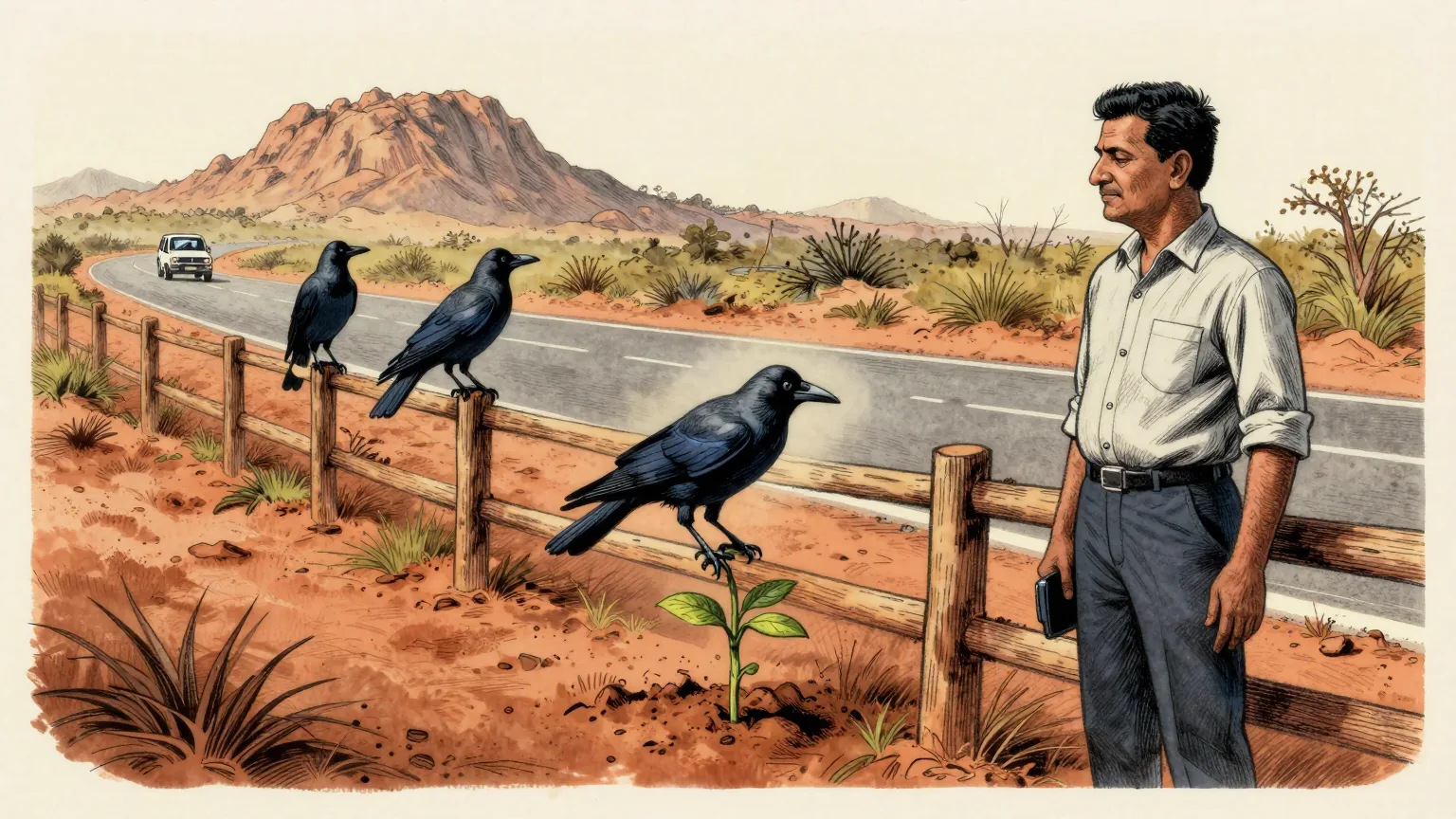
House crows are measurably adding to the green cover of Rayalaseema, one of the driest zones of Andhra Pradesh, according to a study at Sri Krishnadevaraya University in Anantapur.
The region receives 500 to 600 mm of rainfall a year and endures unforgiving summers and recurring droughts across the Anantapur, Sri Sathya Sai, Kadapa, Kurnool, Annamayya and Chittoor districts. Holding on to tree cover there is difficult and expensive.
Organised afforestation drives in Rayalaseema have a survival rate of less than 40%, undone by water stress, grazing and summer fires.
The study, by V.V. Bala Subramanyam, an associate professor in the department of zoology at the university, documents how house crows, Corvus splendens, feed on ripe neem fruits from March to June, eating 30 to 40 fruits in a single sitting.
The seeds pass through the birds and are deposited across villages, fields, tank bunds and semi-urban roads a kilometre or two from the parent tree. The process has a name: endozoochory.
"This process, called endozoochory, is silently contributing to natural regeneration," Bala Subramanyam said. His team marked droppings around the Penakacherla dam foreshore and the university campus in Anantapur, forest fringes in Annamayya district, the Idupulapaya road in Kadapa, the Kallur tank bund and Nandikotkur road in Kurnool, and the Tiruchanur Avenue and Chandragiri roadside in Tirupati.
"The data shows about a 2% increase in urban greenery in parts of Rayalaseema, not just from plantations but from birds," he said.
Crows are not working alone. Birdwatchers in the region have observed bulbuls, mynas, babblers and barbets dispersing peepal and banyan seeds across the same districts.
A forest official in Rajampeta set out the comparison in operational terms. Afforestation initiatives in the Nallamala stretches of Nandyal and the Lankamala Wildlife Sanctuary in Kadapa "require water, labour, and fencing, but bird-assisted regeneration needs only protection", the official said. "The selection of spots for this natural way of planting by crows or any other bird species is incredible and foolproof."
The birds themselves are in decline. Shopkeepers on busy streets in Tirupati, Anantapur, Kurnool, Chittoor and Hindupur report flock sizes nearly 50% lower than in 2015. The cutting of age-old trees for road widening, garbage burning and the covered garbage bins introduced under cleanliness drives are believed to be among the reasons.
Set the two figures side by side and the position becomes clear. The state's own planting programme survives at under 40%. The birds' site selection has been described by a forest official as foolproof. One of these operations involves procurement, fencing, water and labour. The other does not.
On that description, the most effective afforestation agency in Rayalaseema is unbudgeted, unsalaried and paid entirely in neem fruit, at 30 to 40 fruits per sitting, taken in advance.
It keeps no planting calendar, though it is reliably on site from March to June. It files no survival returns. It has never been asked to justify a site selection, and on the published assessment it would win the argument if it were.
This agency is now being downsized. Reported flock sizes are down by roughly half since 2015, in part because the bins have lids on them. A forestry operation with no headcount, no payroll and the best survival rate in the region has lost about half its workforce to improved waste management.
No department has been notified, because no department employs them.