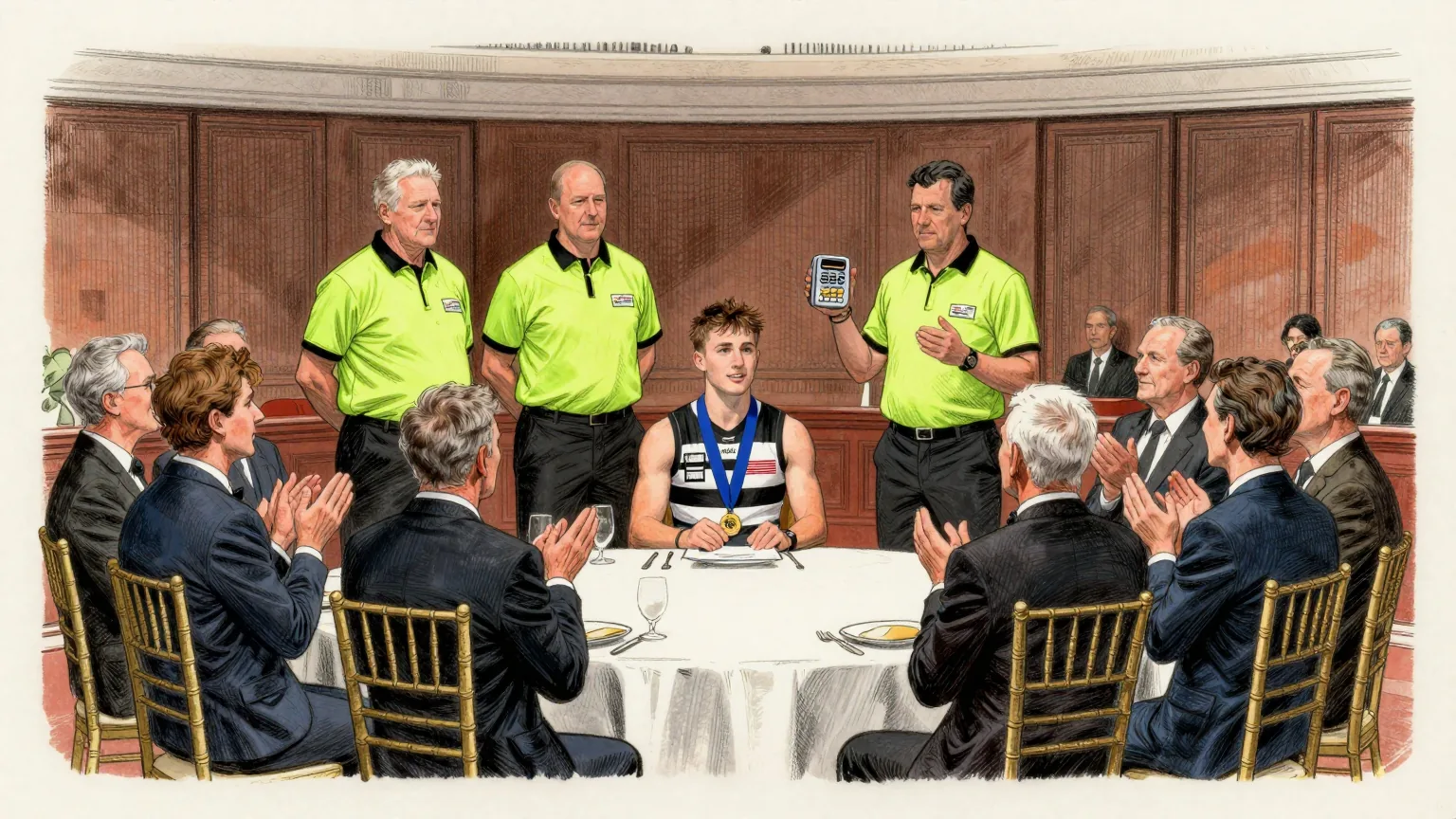
Nick Daicos has won his first Brownlow Medal with 47 votes, breaking the record of 45 set by Carlton's Patrick Cripps in 2024 and becoming Collingwood's first winner of the award since Dane Swan in 2011.
Daicos, 23, finished eleven votes clear of Geelong's Bailey Smith on 36. Marcus Bontempelli of the Western Bulldogs polled 34, Melbourne's Max Gawn 28, and Brisbane's Will Ashcroft, Cripps and North Melbourne's Harry Sheezel were level on 27.
The season behind the total was a consistent one. Daicos averaged 34.9 disposals, 5.7 clearances, 6.7 inside-50s and 1.1 goals a game.
He began by polling nine votes from his first three matches, the maximum available, and led the count from round 11 onwards. Between rounds 15 and 20 he was judged the best player on the ground six weeks running.
It was his fourth consecutive year as the pre-count favourite, and the first time the favourite's tag held.
"I've just learned not to trust the betting markets, to be honest," Daicos said afterwards. "There is relief. It's a massive award."
The Brownlow is decided by umpires, who award three, two and one vote to the players they judge best afield in each home-and-away match. A record in that system is a record in a particular kind of arithmetic.
Daicos polled the maximum three votes in thirteen matches. That is 39 votes. The remaining eight came from everything else he did all season.
The distribution deserves attention, because it tells you what the medal actually counts. Roughly five-sixths of the record-breaking total was earned on thirteen afternoons. The rest of the year contributed less than the first three weeks of it.
This is not a criticism of the player, whose disposal average did not fluctuate. It is an observation about the instrument. A three-two-one ballot does not measure how well a footballer played. It measures how often he was the most conspicuous person on the field at the moment somebody was asked.
On that measure the record is unambiguous. Thirteen times this season, the umpires were invited to name the best player on the ground, and thirteen times they could not think of anyone else.
The six consecutive best-afield performances between rounds 15 and 20 are the strongest evidence. For six weeks, in six different stadiums, against six different opponents, the question was put and the answer did not change.
The Department of Unnecessary Research notes that the record now stands at 47 and that the previous holder, on 45, finished this season on 27. It concludes that the Brownlow Medal is not an award for the best footballer in Australia but a survey with a very small sample and an exceptionally consistent respondent, and that Nick Daicos has won it by being the easiest answer available.