
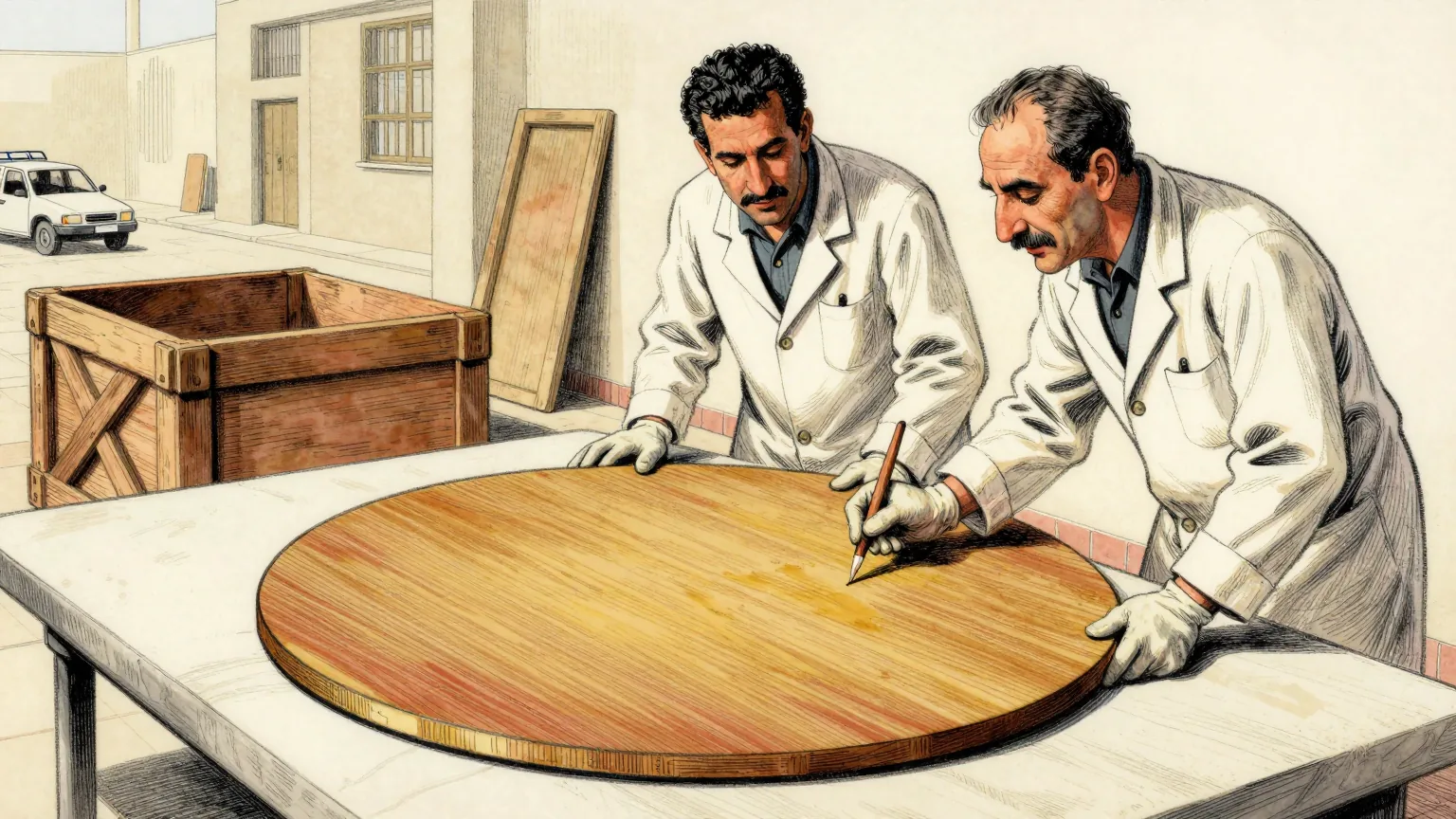
Egypt has unveiled a restored version of one of its best-known ancient paintings and announced that a large part of the collection it belongs to will leave the country for the first time, for an exhibition in Rome.
The painting is the Tondo of the Two Brothers, a circular second-century work showing two figures, and among the most prized of the Fayoum portraits. It was presented at the Egyptian Museum in Tahrir, in Cairo, in an Associated Press report published on Sunday.
The restoration was a joint effort. Specialists from Rome worked alongside the museum's own conservators for three weeks. Sherif Fathy, Egypt's minister of tourism and antiquities, cited the project as an example of international cooperation in heritage preservation.
Both halves of the object needed attention. Aly Abdel Halim, director general of the Egyptian Museum in Tahrir, said the wooden support and the painted surface each required careful intervention. The panel had been damaged by termites, and the paint itself was made from pigments mixed with molten wax, a technique that does not forgive rough handling.
The work recovered the features of the brother on the right. The brother on the left was already legible.
The exhibition in Rome runs from November 2026 to May 2027 and is being organised by MondoMostre, whose chairman, Tomaso Radaelli, described its contents: more than 110 objects, including painted panels, funerary shrouds, masks, marble portraits, plaster casts and ancient jewellery.
Egypt's description of the loan is that these portraits are travelling abroad for the first time, which is accurate as a matter of modern customs paperwork and worth examining as a matter of history.
The Fayoum portraits were painted in the second century, in a province of the Roman Empire, by people who were subjects of the state administered from the city to which the panels are now being shipped. Rome was not abroad. Rome was the capital.
The Department of Unnecessary Research therefore records the loan not as an export but as a long-deferred summons to the metropolis, delayed by approximately 1,800 years and now complied with in full, with more than 110 objects answering it.
The itinerary supports this reading. The restorers travelled from Rome to Cairo to prepare the panels, spent three weeks on them, and are now receiving them at the other end. In the ordinary language of provincial administration, this is an inspection followed by a transfer to head office.
One procedural inequality remains, and it is not the museum's fault. The brother on the right has been fully restored for the journey. The brother on the left has not, because he did not need it.
They will arrive in the imperial capital in the same frame, at the same moment, after the same wait, as two portraits in visibly different states of preparation. Nothing in the loan agreement addresses this.
The exhibition closes in May 2027, after which the collection returns to Cairo. On the account the paperwork gives, that will be the first time these portraits have ever gone abroad.