
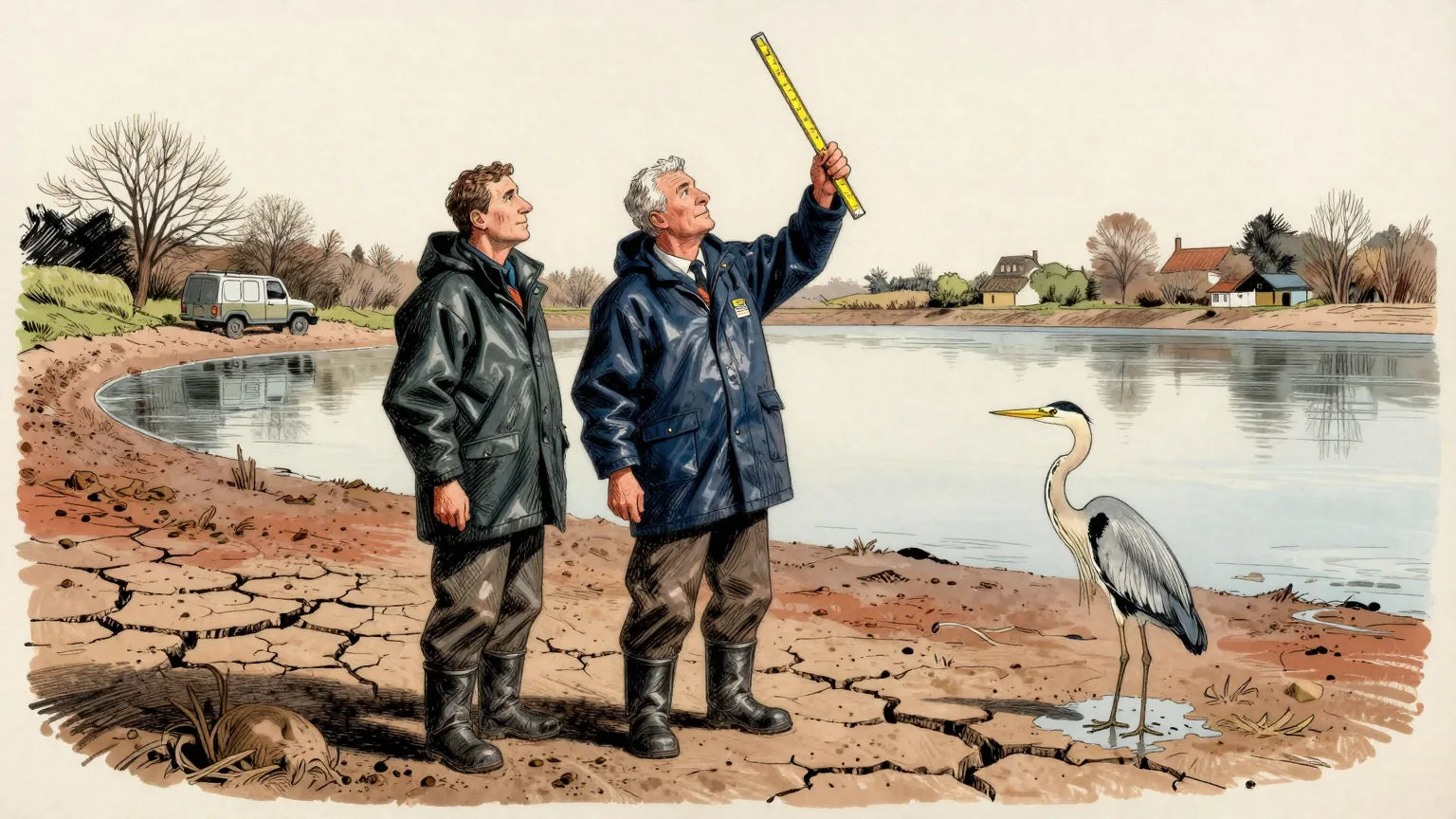
Severe drought has been declared in parts of southern England after months of dry weather drove some reservoirs to exceptionally low levels.
The classification, the highest available, now applies to parts of Cornwall, Devon, Dorset, Somerset, East Sussex and West Sussex. It was reported by the BBC's climate reporter Mark Poynting with the data journalists Jess Carr and Phil Leake.
Most of England and all of Wales were already under drought conditions following both nations' hottest summers on record, which has taken a toll on rivers, crops and nature. Parts of north-east and north-west England sit in the category below, called prolonged dry weather. There are no official droughts in Northern Ireland.
Roughly 30 million people across parts of England and Wales are covered by hosepipe bans, officially called temporary use bans, as water companies manage supplies. Eleven UK water companies have announced them in 2026: ten across central, southern and eastern England, and one in Wales.
The declaration means environmental authorities will increase monitoring of reservoir levels, river flows and water quality, and carry out extra checks on businesses withdrawing water from natural sources.
Low reservoirs are the main reason southern England has crossed the threshold. The Environment Agency says it would expect England's reservoirs to be about three-quarters full at this point in the year; they are just over half full on average. Ardingly Reservoir in West Sussex and Wimbleball Reservoir in Somerset are among those at exceptionally low levels.
The agency says south-east and south-west England have had their driest April to September in more than a century. Most monitored river flows in England were classed as below normal, notably low or exceptionally low in July, according to the UK Centre for Ecology and Hydrology, and by September more than half of monitored groundwater sites across the UK were below normal or lower.
Conditions elsewhere are easier. Dŵr Cymru Welsh Water says most Welsh reservoir levels are normal for the time of year, and reservoir levels in Northern Ireland and Scotland are close to average. Scotland does not declare droughts but monitors water scarcity, and some south-eastern areas remain in its moderate or significant categories.
One detail of the announcement deserves to be read carefully. The severe drought classification was introduced following the 2012 drought, and this is the first time it has been implemented.
The category is fourteen years old and has, until this week, never been used. The driest April to September in more than a century has therefore been placed in a container built in 2012 and empty ever since.
The government has also stated that two previous events would have met the severe drought classification, had it been in place at the time. One of them is August 1976, in Devon and Yorkshire in England and in Gwent, Monmouthshire and Glamorgan in Wales.
Our analysts have assembled the resulting record. There has been one severe drought. There have also been two severe droughts that do not count, because the category had not been invented when they happened.
This produces a classification whose first entry is simultaneously unprecedented and the only precedent available. Nothing can be compared with it, because the two events that could be compared with it are formally outside the scale.
The Department of Unnecessary Research has considered whether the 1976 drought is retrospectively severe. It was severe. It is not, however, officially severe, and the Department can find no procedure by which a drought that ended fifty years ago may be upgraded.
The Department's conclusion is that the present drought holds the record by default, and will continue to hold it until a second one occurs. It has asked the Environment Agency to confirm the position in the meantime: that this is the driest it has ever officially been, on a scale that has only ever been read once.