
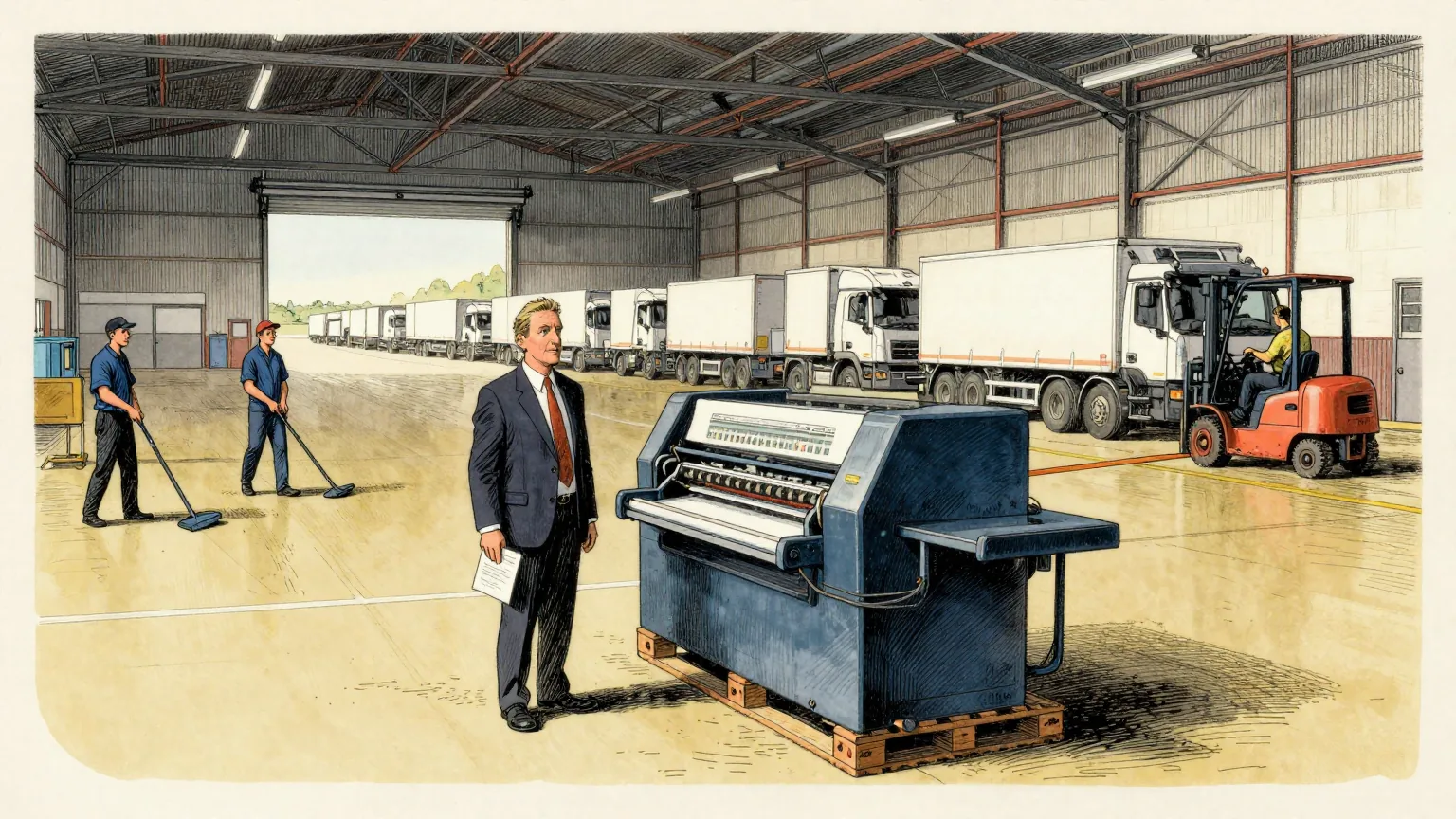
The Dutch company whose machines sit inside almost every advanced chip factory in the world is currently selling none of them in Europe.
Frank Heemskerk, the executive responsible for ASML's global public affairs, said the company has no chipmaking machine sales on the continent at present, for the straightforward reason that nobody there is building chip plants to put them in.
"We are not selling anything in Europe at all. That is because Europe is not investing, and no chip factories are being built here," Heemskerk said.
He added that the United States, China and India are all trying to persuade ASML to expand its operations in their countries. The remark lands while the European Union works on a revision of its semiconductor law.
The EU Chips Act took effect in 2023, shaped by the global chip shortage during the Covid-19 pandemic. Its headline goal was to double Europe's share of the global chip market by 2030.
That target now looks out of reach. The European Court of Auditors concluded last year that the EU is unlikely to hit it, and the law has done little to get new semiconductor factories built in Europe.
For ASML the gap is commercial as much as political. The company is the only maker of the advanced lithography machines needed to produce the latest generation of chips, which customers such as TSMC and Samsung Electronics use to print transistor patterns onto silicon wafers.
Other regions are spending. China alone was expected to account for more than 25 per cent of ASML's total sales in 2025, according to Shen Bo, president of ASML China, speaking last November. India's first large chip plants are coming up in Gujarat and Assam. The United States has for years pushed the Netherlands to block some of ASML's most advanced machine sales to China, a reminder that the order book is shaped by geopolitics as much as by demand.
Heemskerk's comment is the latest in a run of pointed remarks from the company's leadership. In January, chief executive Christophe Fouquet told Europe to be "realistic" about tech sovereignty, arguing that the chip ecosystem is spread across the world and that some imports will always be needed. On the same day ASML posted better-than-expected results and announced 1,700 job cuts.
Chief financial officer Roger Dassen went further in October 2025, blaming EU regulation for driving artificial intelligence talent abroad and saying a skilled engineer's first move is often "buying a ticket to Silicon Valley". ASML had just become the largest shareholder in the French AI company Mistral with a 1.3 billion euro investment.
Heemskerk himself has said, quoting a former company executive, that it is easier to get a senior White House meeting than one with an EU commissioner.
It is worth stating the Chips Act target precisely, because the precision is the point. The instrument does not commit Europe to a number of factories, a volume of wafers or a quantity of machines. It commits Europe to a multiple. The share is to be doubled.
A multiple is a relationship between two quantities, and it holds or fails independently of their size. This newspaper has checked the arithmetic and can confirm that the relationship currently holds exactly.
ASML's European sales are zero. Two times zero is zero. The doubling has therefore already occurred, is occurring now, and will continue to occur without interruption at every moment between here and 2030.
The European Court of Auditors takes a different view, but the Court's concern appears to be with the size of the numbers rather than the relationship between them, which is not what the target specifies.
The Department of Unnecessary Research notes that zero is the only starting value from which a doubling target cannot be missed, and recommends that Brussels hold it. No fab has to be built. No machine has to be sold. The multiplication is already correct, and will stay correct for as long as nothing happens.