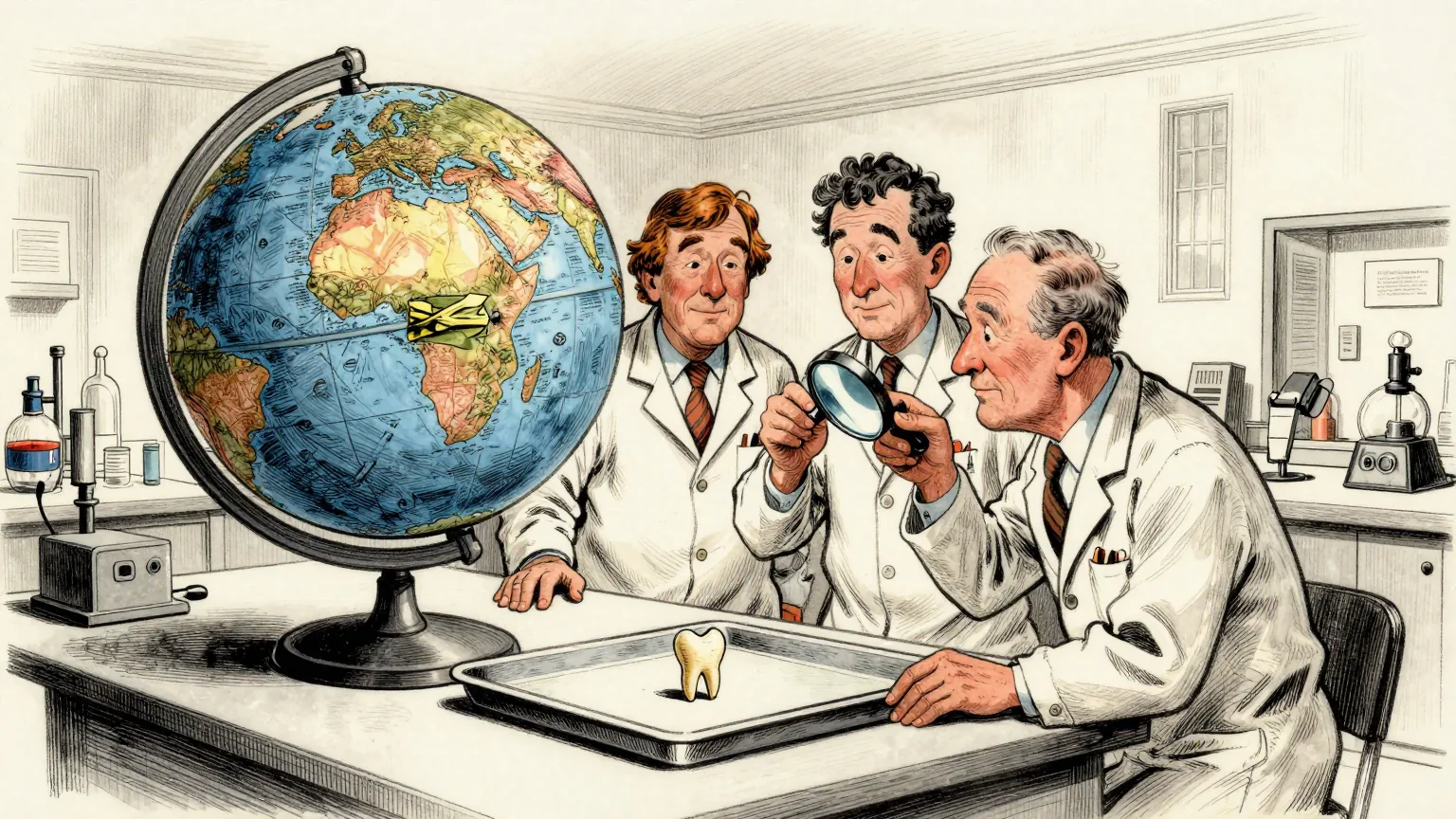
A baby tooth has moved the known northern edge of a European monkey by 1,800 kilometres. Researchers from the Senckenberg Centre for Human Evolution and Palaeoenvironment at the University of Tübingen and from Leiden University have examined a deciduous molar recovered at Schöningen in Lower Saxony and attributed it to a macaque closely related to the living Barbary macaque, Macaca cf. sylvanus, which lived there more than 300,000 years ago.
The tooth is almost completely preserved and less than a centimetre long. It came from an individual roughly one year old. "The small tooth we examined was recovered during the 2004 excavation campaign from lakeshore sediments," said Jordi Serangeli of the Senckenberg Centre, who heads the excavation at the site.
The study was led by Thijs van Kolfschoten of Leiden University and published this year in the journal Quaternary Environments and Humans. Schöningen is already well known for its exceptionally well preserved Palaeolithic archaeological and palaeontological material, and the lakeshore deposits there are prized for what they record of the environment and climate of the period.
The find is the northernmost evidence of this primate anywhere in continental Europe, and one of the northernmost macaque remains known from the Middle Pleistocene. Schöningen lies about 1,800 kilometres, or 1,120 miles, north of the species' present northernmost range.
Macaques are a long-established group. They first evolved in the late Miocene, about 16 million years ago, presumably in North Africa, and their European fossil record runs through Spain, Italy, Greece and Germany. Several Barbary macaque remains have even been found in England.
"In northern Germany, the animals had likely reached the northern limit of their potential range," van Kolfschoten said.
The European population did not last. Its decline and eventual extinction during the last ice age are attributed to climate change, habitat loss and probably to increasing pressure from early humans.
That is the finding, and it is a careful one. What deserves a moment's attention is the bookkeeping, because palaeontology awards its northern records on the basis of where a specimen was found rather than where its owner ever intended to be.
On that basis, the holder of the continental northern record for the Barbary macaque was approximately twelve months old. Within a life of about a year it is credited with a position 1,800 kilometres beyond anything its living relatives manage, which is a formidable annual rate for an animal that was still working its way through its first set of teeth.
The record has stood for more than 300,000 years. Nothing has come closer. The species has had three hundred millennia in which to beat a yearling, and has used them to move the line 1,800 kilometres in the opposite direction.
There is a further detail that distinguishes this achievement from the rest of the discipline. The record was set with a milk tooth. The equipment that proves it was temporary even at the time, and would have been shed within a year or two had its owner continued.
The Department of Unnecessary Research has therefore asked whether a species' range should be reported as the furthest point it has reached or the furthest point it has kept, and notes that for the Barbary macaque the two answers differ by 1,800 kilometres and 300,000 years.
On the first measure, the northernmost monkey in Europe is a one-year-old who lost the only tooth that proves it.