
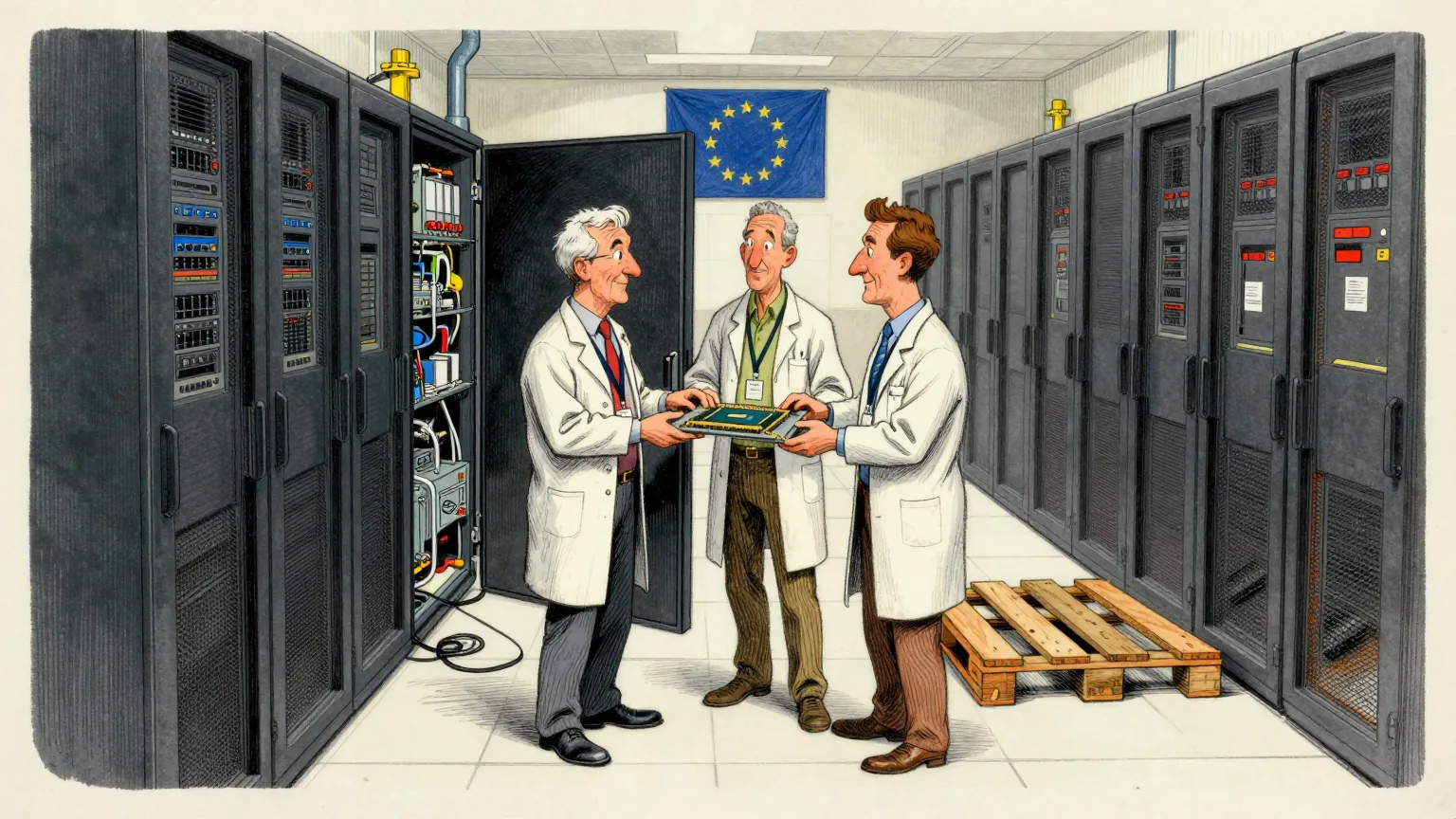
Europe's most powerful supercomputer is finally getting the domestic silicon it has been waiting for. On Tuesday, the French chip designer SiPearl began delivering its long-anticipated Rhea1 CPUs to Bull, the system builder behind JUPITER, for integration into the machine.
JUPITER came online last year and became the European Union's first exascale supercomputer. It currently holds fifth place on the Top500 ranking of publicly known supercomputers.
That feat was not achieved with European silicon. The JUPITER Booster, the section that set the EU record, is powered by 24,000 American-made GH200 superchips from Nvidia, each pairing a Grace CPU with an H200 GPU.
The Booster is only part of the larger system. SiPearl's chips will power a second, CPU-only partition, and the delivery has been framed by everyone involved as a turning point for sovereign supercomputing.
Rhea1 has been in development for several years. It is based on Arm's Neoverse V1 core designs, which are already showing their age: even the Grace CPUs in the Booster use Arm's newer V2 cores. The chip is nonetheless a substantial piece of engineering, with 61 billion transistors across 80 cores, designed specifically for scientific workloads that do not suit GPUs.
Each Rhea1 carries four stacks of HBM2e memory totalling 64GB and achieving 1.8TB/s of bandwidth, alongside four DDR5 memory channels. Many high-performance computing workloads benefit from a high ratio of memory bandwidth to floating-point throughput, which is why systems built on similar principles have historically performed well on benchmarks that reward memory access over raw arithmetic.
"Its high memory bandwidth is particularly well suited to applications that benefit from efficient access to large amounts of data," said Thomas Lippert, director of the Jülich Supercomputing Centre. "Bringing this European processor technology into JUPITER is an important step in making these capabilities available to the scientific community."
Anders Dam Jensen, executive director of EuroHPC JU, called the delivery a major turning point. "This achievement demonstrates what Europe can accomplish by bringing together research, industry and world-class infrastructure to build a stronger European HPC ecosystem," he said.
When complete, JUPITER's CPU partition will fill 1,300 nodes holding 2,600 processors, with estimates putting its total output at five petaflops. The Register notes that this is tiny compared with the Booster, but remains relevant because not all workloads can use GPU compute.
It is worth putting the sovereignty on a scale, since the machine already comes with one. Exascale means a thousand petaflops. The European partition is estimated at five.
Europe's sovereign share of Europe's most powerful computer is therefore approximately one two-hundredth of it, and this newspaper considers that a firm and auditable basis for a target.
The Department of Unnecessary Research has calculated the remaining programme. At one delivery per half a per cent, full sovereignty over JUPITER requires 199 further deliveries of Rhea1, at which point the Booster's 24,000 Nvidia superchips would still be in the building, because nothing in the announcement removes them.
The figure also needs adjusting downward. The sovereign chip is built on core designs licensed from Arm, so the domestic fraction of the domestic fraction is smaller than the domestic fraction, and our analysts have not established where the series terminates.
SiPearl's next win offers no relief. The Alice Recoque supercomputer is slated to use the firm's Rhea2 chips in its CPU partition and AMD's MI430X accelerators in its GPU partition, which is the same arrangement in a different order.
Sovereignty is now being delivered by the pallet, and Europe has taken receipt of the first half of one per cent.