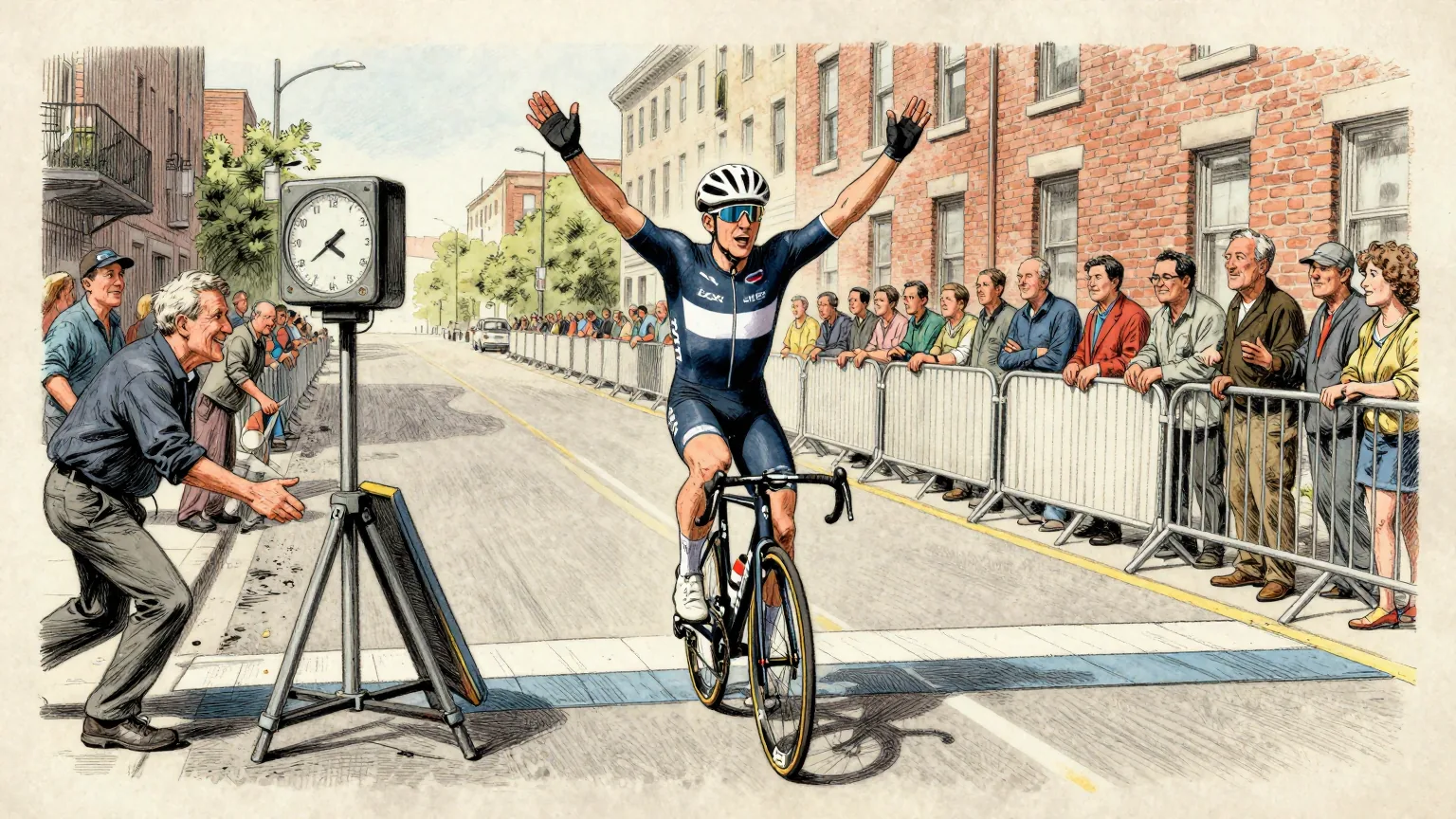
Remco Evenepoel has won a fourth successive men's world time-trial title, dominating the event in Montreal on Sunday.
The 2024 Olympic champion came into the race as the overwhelming favourite and did not disappoint. He was already more than 30 seconds ahead of the rest by the second intermediate check, just over halfway along the 39.2km route.
By the finish the 26-year-old Belgian had put almost a minute into Filippo Ganna of Italy, with the French rider Paul Seixas third, another 15 seconds back.
Evenepoel becomes the first man to win the time-trial world title four times in a row, and equals the record number of overall titles held by Germany's Tony Martin and the Swiss rider Fabian Cancellara.
Ganna started slowly, lying tenth at the first check before moving up to second by the third, but he could make no impression on a rider who did not stop increasing his lead from start to finish. Jakob Soderqvist, the young Swede who was second at the first two checks, faded over the final 10km to finish fifth.
It has been Evenepoel's best season: victories at the Amstel Gold Race, the Clasica San Sebastian and the Grand Prix de Quebec, and second place behind Tadej Pogacar at the Tour de France. He has not lost a time trial since the 2025 Tour.
Earlier on Sunday, Marlen Reusser retained the women's title, beating the 21-year-old British rider Zoe Backstedt by 40 seconds, with Germany's Franziska Koch a further six seconds behind. Reusser was competing on her 35th birthday. "It's a good present," she said. "I also thought, win or not, I have something to celebrate."
A time trial is, by the sport's own definition, an individual effort against the clock. Riders set off at intervals. They do not race one another.
That settles the question of whom Evenepoel actually beat. Not Ganna, who was on the course at a different moment. Not Seixas. In the race of truth the opponent is the clock, and the clock has now lost four world championships in a row.
Its form has been poor for some time. Evenepoel has not lost a time trial since the 2025 Tour de France, which is another way of saying the clock has not won one since then either.
The account from Montreal is not flattering. It had conceded more than 30 seconds by just past halfway and never recovered. Against a competitor that runs at a fixed rate, holds no tactical reserve and cannot be surprised by a headwind, a single rider pulled away continuously for 39.2 kilometres.
The women's race went no better. There the clock was beaten by 40 seconds by a rider who was spending her 35th birthday on the course, and by a further six seconds by the rider behind her.
Consistency of a kind should be acknowledged. The clock has never posted a bad ride. It produced exactly the performance it always produces, in Montreal as in Kigali, and lost both races on the same afternoon.
The Department of Unnecessary Research has written to the UCI seeking confirmation of the clock's eligibility for 2027. It has been defeated in every event it has entered, is registered with no trade team, and has never been left off a start list. No other competitor in the sport enjoys that arrangement.