
Researchers have produced a detailed digital model of the imperial woodpecker, a Mexican bird that has not been confirmed in the wild for nearly seventy years.
The study, published on 15 October in Natural History Collections and Museomics by Pensoft Publishers, is led by Joshua Medina of the University of Massachusetts Amherst, with the Moore Laboratory of Zoology at Occidental College in Los Angeles and Oregon State University.
Campephilus imperialis is the largest woodpecker on record, at over 60 centimetres, or 24 inches, long. It lived in the old-growth pine forests of Mexico's Sierra Madre Occidental and is presumed extinct following widespread logging. It has not been confirmed in the wild since 1956.
Around 100 preserved specimens survive in museums worldwide. The only moving images of the bird are a few seconds of grainy film, also from 1956.
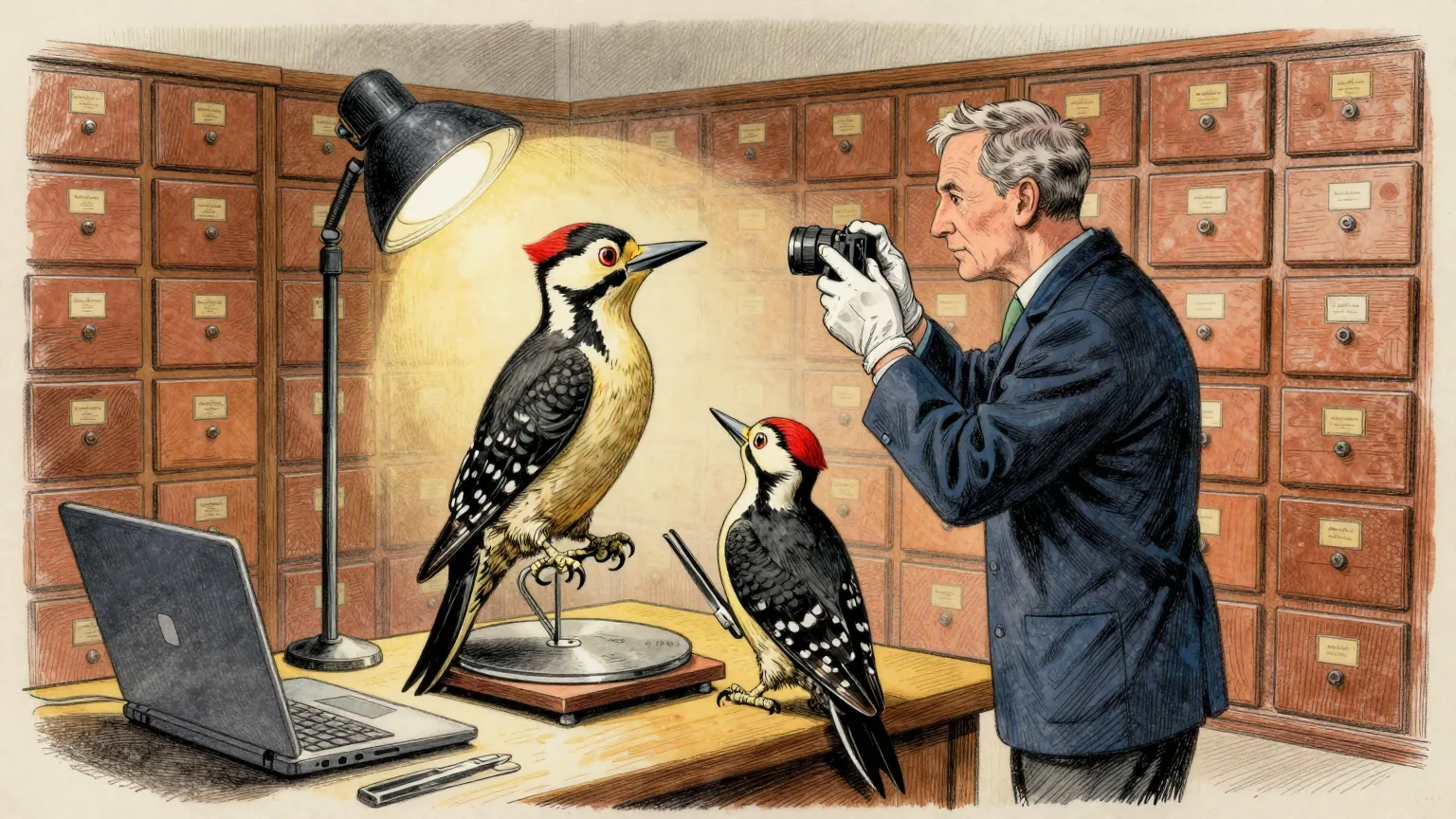
The model was built from a female specimen held at the Moore Laboratory, which has the world's largest collection of Mexican birds. The team photographed it 288 times and used photogrammetry to derive its shape to sub-millimetre accuracy.
Feathers were handled separately. Their shapes were modelled on the pileated woodpecker, a living relative, then resized to the imperial woodpecker's proportions. Ten primary, ten secondary and twelve tail feathers were individually modelled and rigged in Blender, the open-source animation package.
The team produced two animations: a looping flight sequence and a short clip of the bird climbing and drumming on a tree. Both draw on the 1956 film, on behavioural video of the pileated woodpecker and on published wingbeat timing data.
The authors say the model can be used to estimate body volume and surface area, to compare the bird's shape with living relatives and to simulate flight and feather movement, and suggest it may inform the design of bird-inspired flying robots. They are candid about its limits: it rests on a single female specimen, and its soft tissue and flight movement depend partly on estimates drawn from living relatives.
The species features in the traditions of Indigenous communities in the Sierra Madre Occidental, though few if any museum specimens are held in Mexico. The authors suggest that freely shared digital models may help offset such barriers, while noting that whether they can assist the repatriation of biological and cultural heritage remains an open question.
The achievement is best stated precisely. The shape of the imperial woodpecker is now known to within less than a millimetre, and there is nothing left against which to check it.
Our analysts have examined the structure of that claim. Sub-millimetre accuracy describes the model's fidelity to the specimen that was photographed, which is one stuffed female. The feathers are a different species, resized. The flight comes from a relative and from a few seconds of film shot in 1956.
The result is the most exactly measured imperial woodpecker that has ever existed, and it is the only one whose measurements cannot be disputed by an imperial woodpecker.
The Department of Unnecessary Research observes that the usual direction of scientific confidence has been reversed. Ordinarily precision rises as the evidence improves. Here, precision has risen to a fraction of a millimetre on evidence that stopped accumulating in 1956, which is also the last year anyone could have said whether it was right.
The Department has one request for the authors. Since the model's accuracy is stated against the specimen rather than the species, it would like to know the figure for the species, and accepts that the figure may have to wait.