
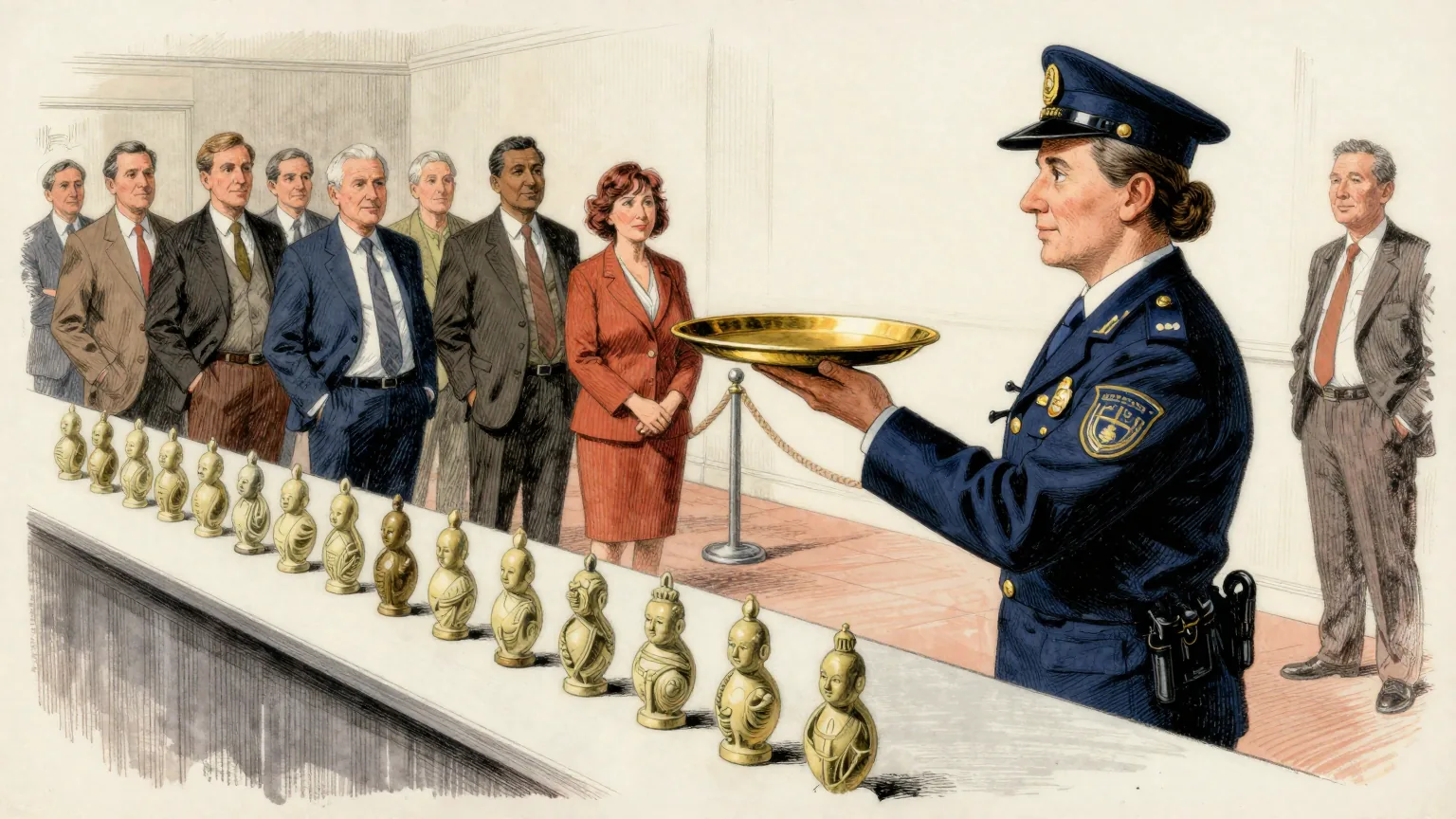
A study of Australia's domestic ivory market has found that almost none of the elephant ivory advertised for sale in the country is offered with paperwork showing that it was legally imported.
The research, published in the journal Biological Conservation, examined 1,698 ivory listings from 70 vendors over a six-month period. Together they were worth about $1.2 million.
Fewer than 1 per cent of the listings were advertised with proof of legality. Nine per cent gave a country of origin. Sixty-two per cent gave an approximate age.
Age is the figure that matters at the border. Imports of Asian elephant ivory are permitted only where the material predates 1975, and African elephant ivory only where it predates 1990, and in both cases certification of legitimacy is required.
Once the material is inside the country, the rules change. Domestic resale is lawful, and a vendor is not required to verify the item or to hold proof of its legality.
"Very, very, few dealers mentioned up-front in their online listing that their item came with paperwork," said Dr Damien Huffer, an illicit trafficking researcher at Adelaide University and the study's lead author.
The contrast with the rules for native wildlife is the one the research draws out. In most parts of Australia a feather from a native bird cannot be sold without a permit. Elephant ivory can be sold through social media without proof that it has been ethically sourced.
In 2019 the federal government pledged to enforce a domestic ban on the trade in ivory and rhinoceros horn. The commitment never came to fruition. China, the United Kingdom and the United States all operate domestic bans, and ten years ago a conference of the parties to CITES, of which Australia is a signatory, recommended that members close their domestic markets because of poaching.
The environment department has set out its view. "Australia's domestic market does not represent a major threat to wild elephant or rhino populations," it said, adding that "Australia is not identified as a country with substantial ivory smuggling or seizures."
Parts of the trade would accept restriction. The Auctioneers and Valuers Association "supports a prohibition on commercial trade in elephant ivory and rhinoceros horn, accompanied by tightly defined exemptions for appropriate historical, cultural and other legitimate items", its chief executive Troy Williams said.
The background figures are not in dispute. Asian elephant numbers have halved to about 50,000 over the past 75 years, and African elephants, estimated at about 1.3 million in 1979, number about 400,000 today.
The two central findings of this story sit together far more comfortably than they first appear. Fewer than one listing in a hundred carries documentation, and the country records no substantial seizures. Both statements are true, and on inspection they are the same statement.
A seizure needs something to seize on: a document that does not match, an origin that cannot be right, a date that fails. Where more than 99 per cent of listings carry no document, 91 per cent name no country and 38 per cent give no age, there is nothing against which an officer may compare anything. The paperwork cannot be wrong, because the paperwork is not there.
The Department of Unnecessary Research regards this as the strongest compliance position available to any jurisdiction. A market in which no claims are made cannot contain a false one. A market that supplies no evidence cannot supply contradictory evidence.
Read in that light, the feather rule is the anomaly. Requiring a permit for a native bird's feather creates a record, a record can be checked, and a check can fail. The ivory arrangement forgoes the record, and with it the failure.
Australia is accordingly not identified as a country with substantial ivory smuggling or seizures. On the information collected, it could not be.