
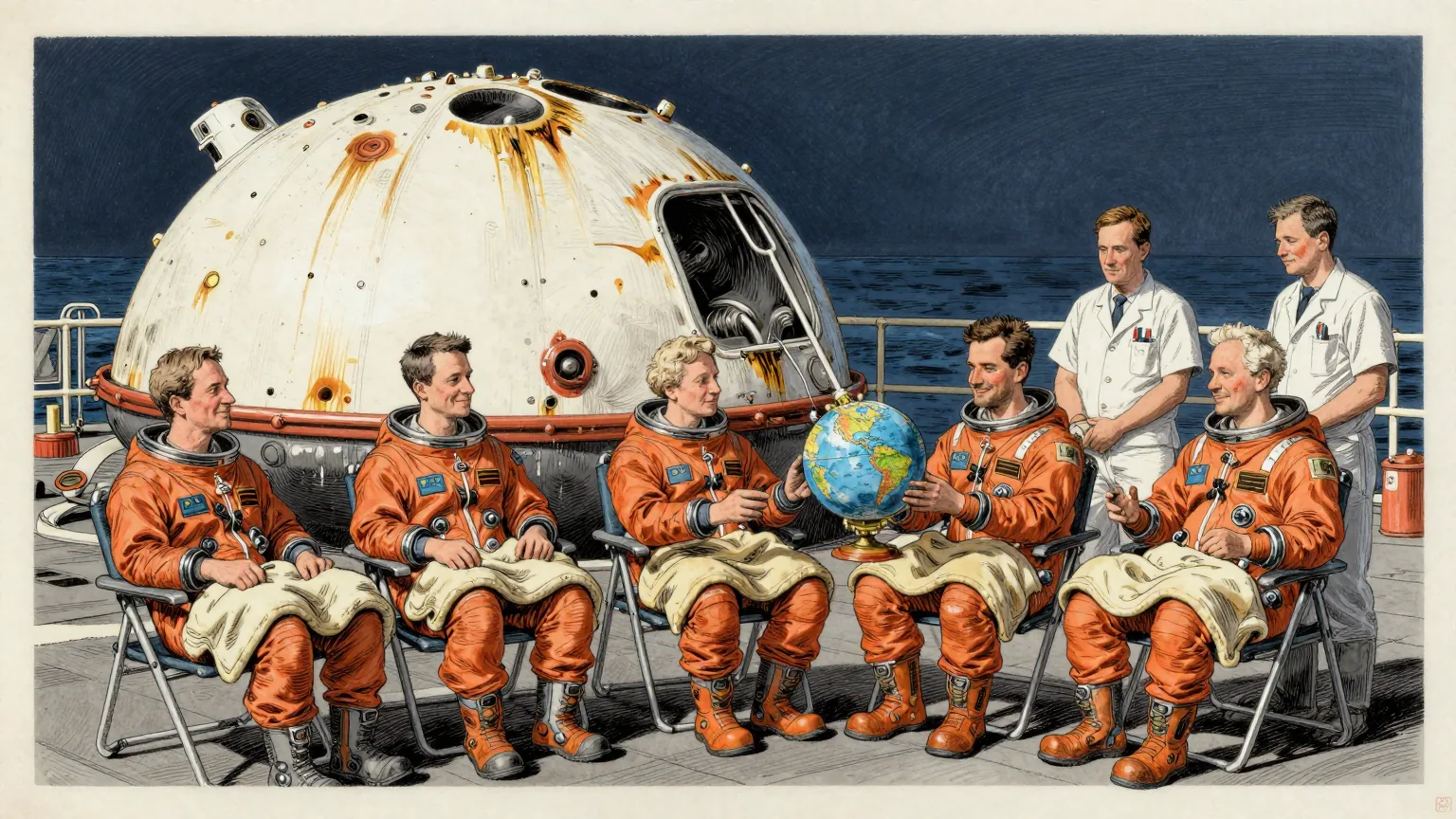
Four astronauts returned to Earth on Thursday after seven and a half months in orbit, completing a mission that NASA says covered more than 100 million miles.
NASA's SpaceX Crew-12 splashed down in the Pacific Ocean off the coast of Los Angeles at 8:34 a.m. PDT, where teams aboard SpaceX recovery vessels retrieved the spacecraft and its crew shortly afterwards.
Aboard were the NASA astronauts Jessica Meir and Jack Hathaway, the European Space Agency astronaut Sophie Adenot and the Roscosmos cosmonaut Andrey Fedyaev. The mission was a second flight for Meir and Fedyaev and a first for Hathaway and Adenot.
They launched at 5:15 a.m. EST on 13 February and docked with the International Space Station a day later, beginning a stay of 237 days.
NASA put the mission totals at more than 100 million miles travelled and more than 3,792 orbits of the Earth.
Meir completed four spacewalks, taking her career total to seven, which places her third all-time among women at NASA behind Peggy Whitson and Suni Williams. Adenot completed three and became the first French woman to walk in space.
The science programme ran to hundreds of hours. The work included testing stem cell production for cell-based therapies, demonstrating on-demand generation of intravenous fluid for future missions, nutrition research, and a study of how physical characteristics may affect blood flow during spaceflight.
"Building the capability, experience, and confidence to do this repeatedly is exactly what will allow us to go farther," the NASA administrator, Jared Isaacman, said.
Dana Weigel, who manages NASA's Low Earth Orbit Program at the Johnson Space Center, said: "We're grateful for the dedication across the human spaceflight team that makes this possible."
After postflight medical screenings the crew will fly to shore and then return to the Johnson Space Center in Houston. NASA has set a news conference for 3:30 p.m. EDT on Thursday 15 October, with Meir, Hathaway and Fedyaev taking part; Adenot will be returning to Europe.
The distance is not in dispute, and neither is the shape. More than 100 million miles were covered. They were covered in more than 3,792 laps.
Measured from the planet the mission left to the planet it arrived at, the net displacement is nil. The same planet was used on both occasions.
This newspaper regards the figure as sound and the achievement as considerable. A hundred million miles is a hundred million miles. The destination is simply the only part of the itinerary that never changed.
NASA's own account supports the reading. The administrator identifies the achievement as the capability to do this repeatedly, and our analysts at the Department of Unnecessary Research can confirm that nothing in the known universe is more repeatable than a circle. It is the only route that returns its own starting conditions free of charge.
The spacewalks are, on this analysis, the only portion of the mission in which anybody went anywhere at all. Each of them also ended where it started, but it was at least a different where.
The odometer reads more than 100 million miles. The map reads one planet, twice.