
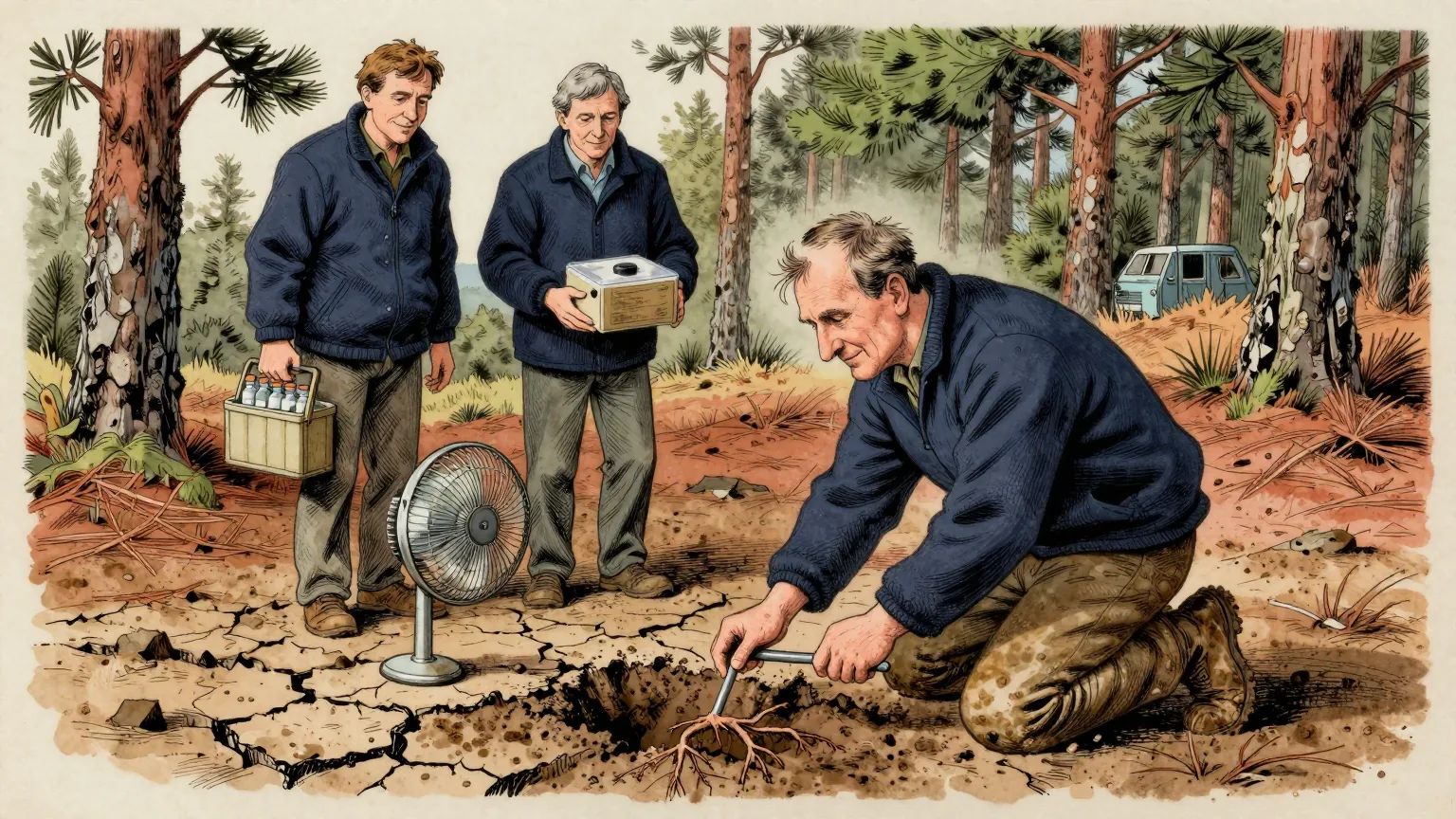
Forest soils in south-western Germany have been taking more methane out of the air every year for a quarter of a century, and the reason appears to be that the ground has been getting drier and warmer.
Researchers from the University of Göttingen and the Baden-Württemberg Forest Research Institute, known as the FVA, examined measurements collected at 13 forest sites over periods of up to 24 years. On average, the amount of methane absorbed by the soils increased by approximately 3 per cent annually. The findings were published in the journal Agricultural and Forest Meteorology and announced by the University of Göttingen in a release carried by ScienceDaily.
Methane is a potent greenhouse gas, but microorganisms living in the soil can break it down before it builds up in the air. The German analysis draws on what the university describes as the world's most comprehensive collection of long-term measurements of methane absorption by forest soils.
The mechanism is a matter of plumbing. When soil becomes saturated with moisture, water fills many of the tiny spaces between soil particles, making it harder for gases to move through them. Drier soil contains more pores filled with air, allowing atmospheric methane to travel deeper into the ground, where microorganisms use it as an energy source. Rising temperatures can slightly accelerate that microbial activity.
The measurements were not casual. Every two weeks, researchers collected air samples through thin tubes installed beneath the ground and analysed them in a laboratory, building soil gas profiles at different depths. To confirm the result, the team also used an independent technique involving airtight chambers placed directly on the soil surface.
"Our long-term data shows that climate change does not necessarily have a negative impact on how much methane forest soils absorb. While the largest study to date from the US found a decline in methane uptake of up to 80 percent due to increasing rainfall, our significantly more comprehensive field study in south-western Germany found the opposite," said Professor Martin Maier of Göttingen University's Department of Crop Sciences, who led the study.
"We observed a significant long-term increase in methane uptake in the forest areas we studied," he added.
Absorption varied considerably between the 13 locations, but a clear overall pattern emerged: the soils were particularly effective at removing methane during periods of lower rainfall and higher temperatures. The result runs against several international meta-analyses that have concluded methane absorption by forest soils is declining.
The authors are explicit about what this does not mean. The findings do not show that climate change is beneficial for forests overall; they show that its effects on methane uptake differ considerably depending on local temperatures, rainfall patterns and soil conditions.
There is, however, a reading of the result that the researchers have gone to some trouble to rule out, and it is the one this newspaper proposes to adopt. The soil is being paid in methane, and the drier the weather, the harder it works.
Consider the arrangement from the soil's side of it. Rain blocks the pores and the work stops. Drought opens them and the work resumes, with a small productivity bonus supplied by the warmth. Output has improved by about 3 per cent a year, for up to 24 years, at 13 sites, without supervision.
Compound that figure and the trend becomes a career. Three per cent a year, sustained across the 24 years of the German record, roughly doubles a site's uptake. The Department of Unnecessary Research has extended the same arithmetic forward and declines to publish the year in which the forest floor overtakes the atmosphere.
The management implication is harder to avoid. Uptake is a function of rainfall, and rainfall is the one input these forests have been receiving less of. Göttingen has therefore identified the first greenhouse gas sink that responds to neglect.
The 80 per cent decline recorded by the largest American study, under increasing rainfall, reads in this light as an industrial dispute.
Professor Maier's own conclusion is that long-term measurement series and monitoring programmes are indispensable for assessing the real effects of climate change. We would put it more strongly. Across 24 years and 13 sites, the monitoring is the only part of this arrangement that anybody has been paying for.