
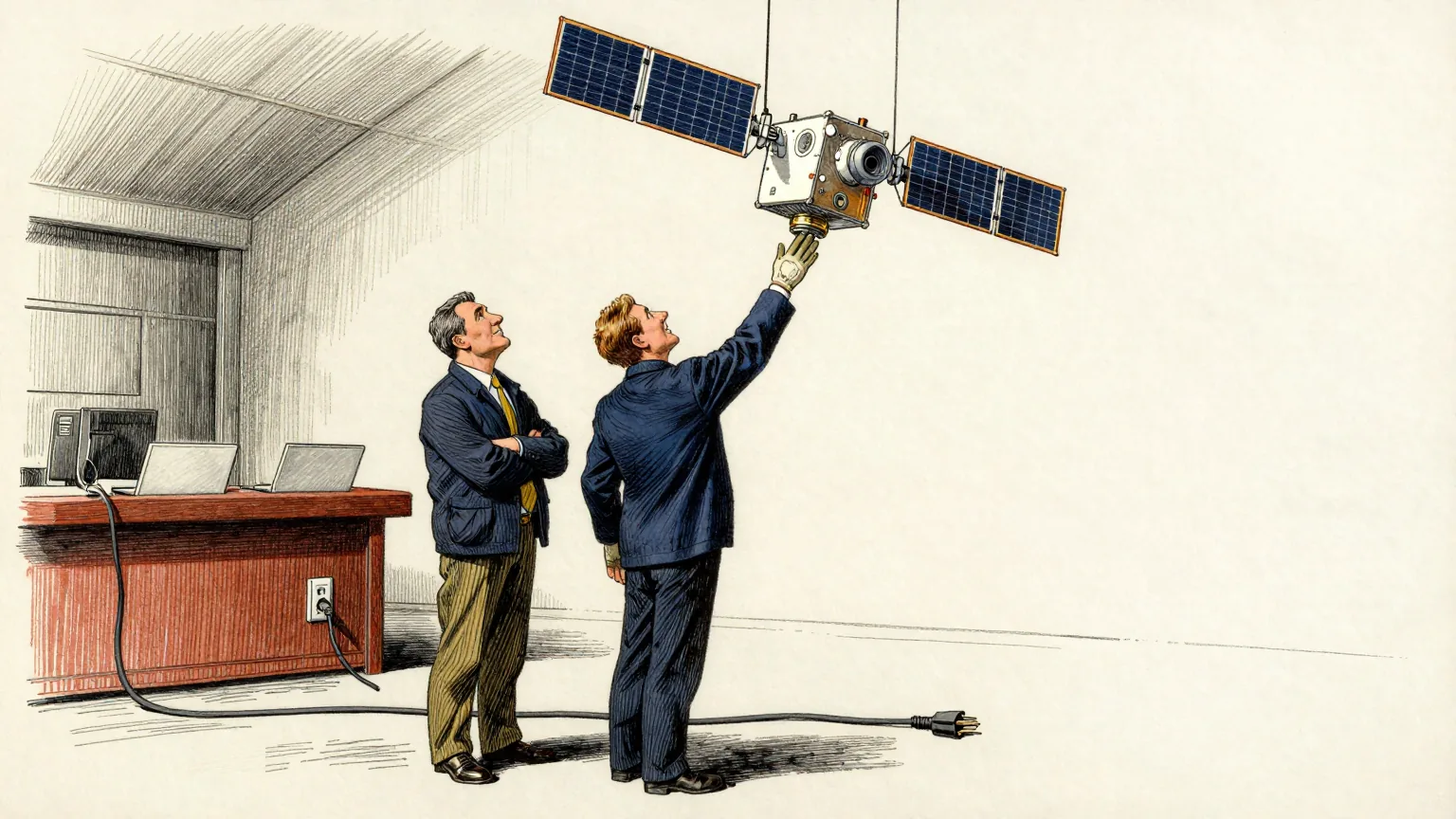
Google's first "Suncatcher" data centre satellite has reached space, carrying the company's tensor processing units into orbit for the first time.
Project Suncatcher is a test of whether the chips Google uses for machine learning can survive a rocket launch and then keep working in the radiation, vacuum and thermal extremes of low Earth orbit. The underlying proposition is that sunlight in space is effectively unlimited and uninterrupted, and that this might one day make the cost of putting servers above the atmosphere sensible rather than eccentric.
Alongside the announcement of the successful launch, Google linked to its own peer-reviewed research on the subject, a paper titled "Toward a future space-based, highly scalable AI infrastructure system design". The paper is notable mainly for the length of the list of problems it says remain unsolved.
The central question is cost. The paper notes that SpaceX and others have suggested orbital data centres become viable when the price of putting a kilogram into orbit falls to $200.
Google's researchers observe that SpaceX has reduced its cost per kilogram by 20 per cent after every doubling of the cumulative mass it has launched. Extending that trend to $200 per kilogram, they calculate, would require a further 370,000 tonnes of cumulative mass reaching orbit, which is the equivalent of roughly 1,800 successful launches of SpaceX's Starship rocket, with components re-used 100 times.
On those terms, the paper concludes, $200 per kilogram is "plausible under reasonable assumptions".
Google does not yet know what one of its future data centre satellites would weigh. For the purposes of comparison the paper points to Starlink's second-generation satellites, which weigh 575kg, and sets the cost of launching a satellite against the cost of powering servers on the ground.
Its conclusion is carefully hedged: "If launch costs reach ≲$200/kg, annualized cost per unit of power in space could be approximately comparable to terrestrial spend."
The remaining technologies are largely theoretical. Existing networking equipment is probably not suitable for linking satellites into a working cluster, the paper says, because the speed of communication required means the constellation would need a design "significantly larger and entail much closer formation flight … than any previous or current satellite constellations".
Satellite design would also have to change. "Our system design work to this point assumes a relatively conventional, discrete compute payload, satellite bus, thermal radiator, and solar panel design," the paper states, before suggesting that scaled production would eventually demand an integrated compute, radiator and power design based on "computational substrates based on neural cellular automata".
Getting the data back down is a further problem. The researchers found that "robust optical satellite-ground communications will also be critical for scaled operation but will necessitate overcoming challenges including atmospheric turbulence, high-speed relative motion errors, and precision beam tracking". NASA's TeraByte Infrared Delivery mission, which has demonstrated 200 gigabits per second between the ground and low Earth orbit, is cited as a promising line of attack.
Google's researchers therefore conclude that the ambition "will require sustained research, iterative refinement of our design, and the achievement of several critical future milestones".
It is worth setting out the structure of the business case, because it is unusually clean. The orbital data centre is cost-comparable with the terrestrial one if launch costs reach $200 per kilogram. Launch costs reach $200 per kilogram if 370,000 further tonnes go up. That happens after about 1,800 Starship launches, provided the components are each used a hundred times. None of this has happened.
The Questionable Times regards the finding as sound. Every term in the chain is conditional on the next, and the final term is conditional on nothing at all, which is the strongest position a term can occupy. The plan is therefore already affordable, in the same sense that it is already finished.
The accounting is equally secure. An annualised cost per unit of power requires a satellite, and Google does not know what the satellite weighs, so the cost per kilogram is being applied to an unknown number of kilograms. The result is a figure "approximately comparable" to terrestrial spend, and it is difficult to see how it could be anything else.
The Department of Unnecessary Research has accordingly revised the project's capital requirement into the only unit the paper supplies, and now prices the first orbital data centre at 1,800 Starships. It awaits Google's view on whether the second one is cheaper.