
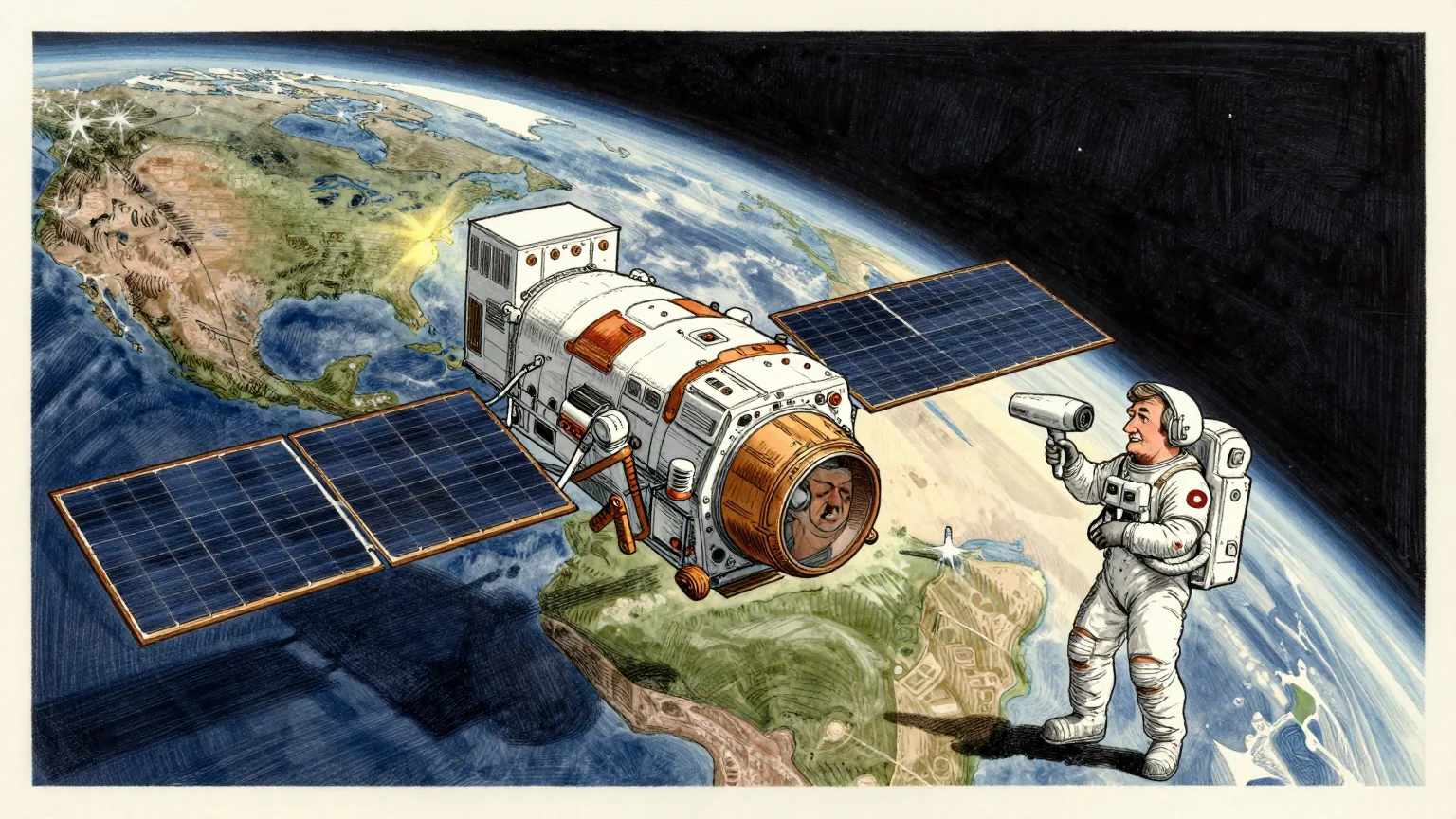
Google will launch the first experimental satellite of Project Suncatcher, its effort to design orbital artificial-intelligence data centres, on 1 October.
Suncatcher, announced last year, is Google's self-described moonshot: a constellation of AI satellites, pitched by its backers as an alternative to building ever more divisive data centres on the ground. The satellite launching next week is intended to test whether the idea works at all.
The spacecraft, dubbed MVP, is about the size of a refrigerator. Inside it are four of Google's custom TPU accelerators, the chips used to train AI models and to run inference. On Earth, a data centre runs thousands of them, consuming very large amounts of power, which is one of the reasons solar-powered hardware in orbit looks attractive.
MVP is starting small. Its solar panels supply only about one kilowatt, which The New York Times reports is enough to power a microwave or a hair dryer.
Google did not build the satellite from scratch. The AI hardware inside is Google's; the spacecraft itself comes from the satellite imagery firm Planet Labs. The original plan was to launch two custom satellites in 2027, but Google wanted to move faster, and opted to integrate its chips into a spacecraft Planet Labs had already built for an early test.
The launch is part of the Transporter-18 rideshare aboard a SpaceX Falcon 9. In the longer term Google wants networks of orbiting satellites communicating over high-speed laser connections, which would probably require expensive dedicated launches. This one satellite will operate for just a few months.
The point of the flight is to find out how the chips behave in space. Radiation can damage them outright, or interfere with calculations by flipping bits; vibration and high g-forces during launch pose problems of their own. Many space missions use hardware designed specifically for extreme temperatures or radiation. These are the same TPUs Google puts in servers on the ground.
Cooling may be the biggest issue of all. Radiator systems exist in space, but they are designed to remove a relatively small amount of heat, and AI accelerators generate far more. Google's solution uses a layer of malleable "thermal interface material" connecting the chips to aluminium and copper heat pipes, which conduct the heat into a radiator that projects it away into space.
Google will run Gemini models on the TPUs for testing, but not continuously. The cooling system will only be able to operate in brief spurts of about 15 minutes, after which the TPUs need to shut down to allow the radiators to catch up.
The 2027 launches remain on the agenda, and the team expects it will be years before Suncatcher moves from project to product.
The arithmetic deserves setting out plainly. A data centre on Earth runs thousands of these chips continuously. This one runs four, in quarter-hour instalments, on the power budget of a hair dryer.
The constraint is not the sun, which is abundant, and it is not the cold, which is also abundant. It is the cold that is the problem. With no air to carry heat away, a radiator is the only exit, and the radiator is slower than the chips are.
So the coldest environment available to the industry turns out to be the one place where a chip cannot be cooled quickly, and the cheapest energy in the solar system arrives with a fifteen-minute ceiling attached. Google has not built a data centre in orbit. It has built a data centre with an interval.
On Earth, the same kilowatt runs a hair dryer, and it runs it for as long as anybody holds the button.