
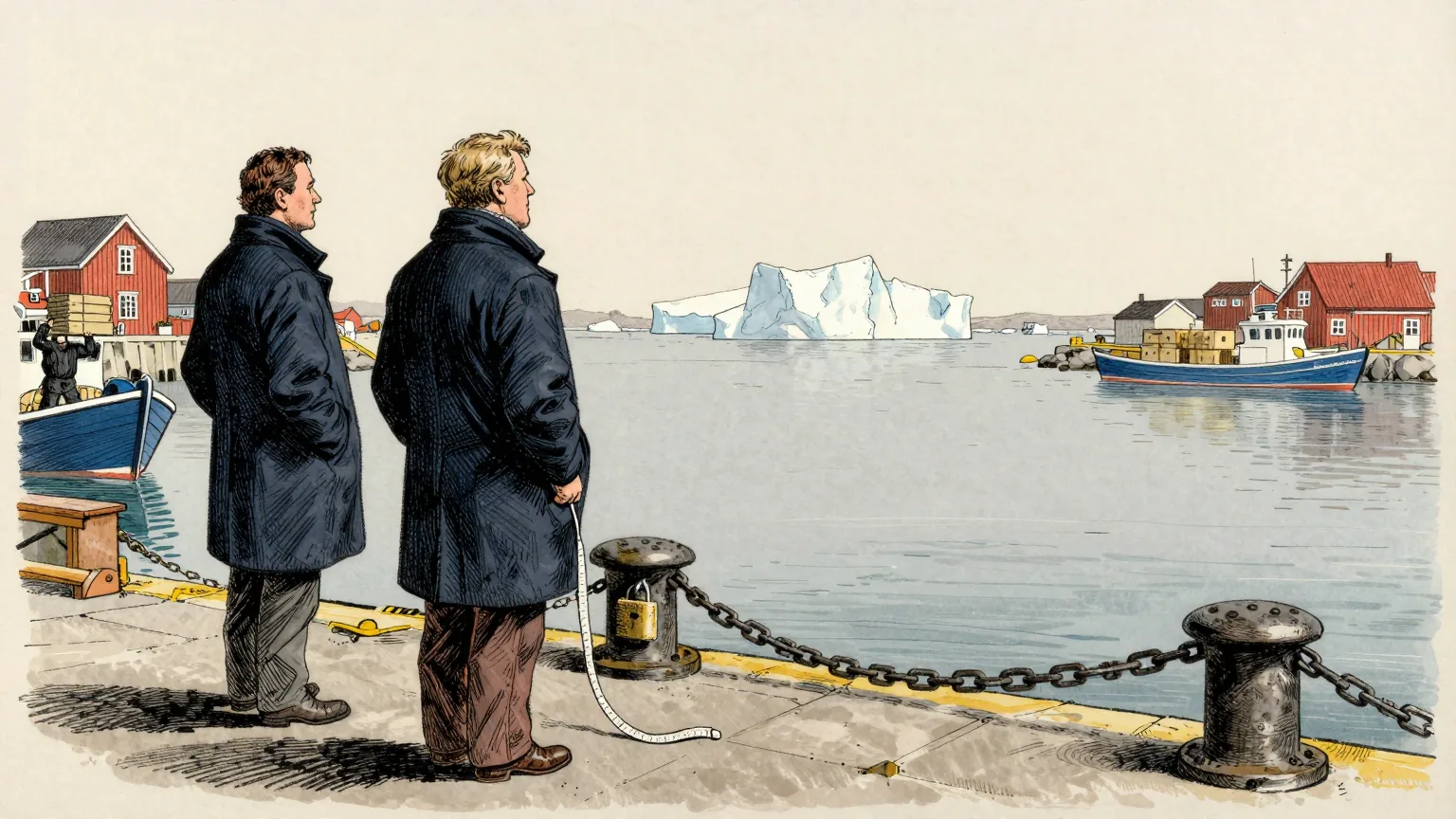
Greenland's parliament has unanimously adopted a resolution directing the government to draft legislation temporarily banning deep-sea mining.
The resolution was adopted on Thursday, the Danish news agency Ritzau reported in an account carried by The Copenhagen Post. The proposed ban would remain in effect through 31 December 2029, with the possibility of two-year extensions.
Naalakkersuisut, Greenland's government, supported the considerations behind the resolution. It said it would introduce a bill for the temporary ban during parliament's spring 2027 session.
The resolution is not itself a prohibition. It is an instruction that one be written.
WWF Greenland, the local branch of the World Wide Fund for Nature, called the decision "an important step in the right direction", according to AFP, and said deep-sea mining can damage marine ecosystems and biodiversity.
"With this decision, Greenland has the opportunity to send a strong signal that the protection of the ocean, nature and the Greenlanders' livelihood must be taken seriously when we face new forms of exploitation of marine resources," the organisation said.
The organisation added that there is still relatively limited scientific knowledge about the potential consequences of deep-sea mining for the marine environment. Inhabitants of the Danish autonomous territory are wary of what such mining could do to it.
The economic context is straightforward. Fishing is the main driver of Greenland's economy, while hunting remains important to local communities. Both depend on the waters the resolution concerns.
Greenland has long received subsidies from the Danish government that account for about 20 per cent of its economy, and would need massive investment to survive on its own, AFP reports.
There is precedent for the approach. Greenland suspended new oil and gas exploration permits in 2021. Industrial oil drilling and gas extraction have never been conducted there, according to AFP.
The arithmetic of the measure is worth setting out, because the ban has an end date and no start date. It expires on 31 December 2029. It becomes law at some point after the spring 2027 session, once a bill has been drafted, introduced and passed.
The period in between is covered by a different mechanism, which is that nobody is mining the Greenlandic seabed. Compliance in those months is expected to be total, and will be achieved without legislation, inspection or expense.
This produces the most efficient form of prohibition known to public administration: one in which the prohibited activity stops before the prohibition arrives, leaving the statute to take the credit on arrival.
The two-year extensions operate on the same principle. Each renewal would extend a measure whose enforcement record is already unblemished, and would do so by reference to the calendar rather than to any assessment of what had been prevented.
Our analysts note that the quickest route to the longest protection is therefore further delay. Every month in which the bill is not introduced is a month in which the seabed is not mined, at no cost to the drafting department; and because the ban's end is fixed to a date rather than to its own duration, a sufficiently unhurried draft would see the measure expire on schedule, fully observed, without ever having been law.
The Department of Unnecessary Research goes further and recommends that the extension power be exercised immediately, in two-year increments, from today. The protection it would supply is indistinguishable from the protection currently in force.
The seabed is to be protected from some point in 2027 until the last day of 2029. It is also protected now, by nobody.