
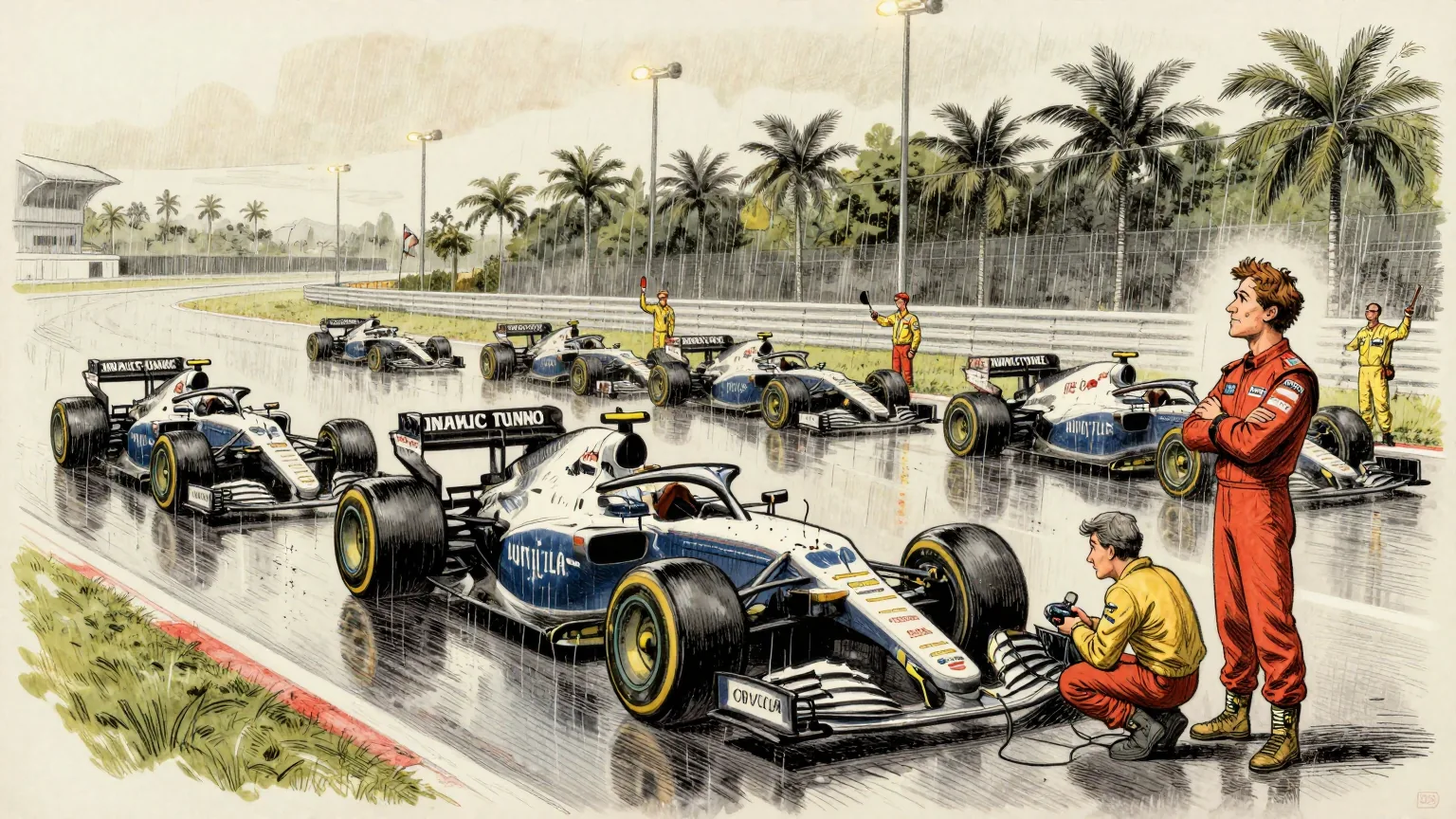
Formula One's Bahrain Grand Prix was held several thousand miles from Bahrain on Sunday and still managed to produce the most disrupted start of the season, after a software bug stopped much of the grid before the race had begun.
The event ran at the Sepang International Circuit in Malaysia, which stepped in to fill the slot after the race was relocated. A late-1990s design of a familiar type, Sepang pairs a couple of long straights with the tropical weather that makes it one of the toughest physical challenges on the calendar.
Heavy rain arrived about half an hour before the scheduled start, delaying proceedings significantly. The sport carries two treaded wet-weather tyres and neither was an obvious answer. The full wet throws up so much spray, and such slow lap times, that it is essentially only useful for circulating behind the safety car. The intermediate has much shallower grooves and suits a damp but not soaked track, although it overheats and degrades quickly as the surface dries.
The organisers settled on two formation laps behind the safety car. Circulating at lower speed would let the drivers read the conditions and let the intermediates pump some water off the track surface. That plan did not take account of a bug lurking in the cars' software.
Driving slowly behind the safety car with reduced hybrid power in some parts of the track convinced several of the cars that they were being tricked into breaking a hard-coded rule meant to prevent cheating. Each triggered an automatic 60-second shutdown of its electric motors. Cars slowed for the car in front, then took varying lengths of time to reboot their systems.
"It was like the Lego race," said Max Verstappen of Red Bull, referring back to the human-size Lego cars used for a driver parade at the 2025 Miami Grand Prix. "At some point, we were five-wide on the straight because we couldn't understand what was going on. Then we did a lap and then I see eight other cars crawling still... I mean that's not what you want, right, for the sport."
The organisers aborted the start altogether. The bug had never come up in testing, and the FIA had to write and distribute a software update at the circuit. An hour after the first aborted start, the cars lined up on the grid again.
"In wet conditions, there are some different software settings for the cars for safety reasons to reduce the power in certain sectors from the maximum to a lower level," explained Nikolas Tombazis, head of single-seater racing at the FIA. "And this year, we've had very little wet weather running or none at all, almost. So it wasn't maybe adequately checked."
The software was developed by the FIA with the teams and engine makers. "So it's common software for all cars," Tombazis said, adding that "there was a combination of events between those software settings and the fact that some cars went incredibly slow during the formation lap and those entered a sort of a bug into the software which was stopping those cars to reaccelerate and to go to normal speeds." He put the fix at about 20 minutes to issue, plus the time teams needed to load it and ask questions.
By then the rain had abated and the standing water had drained, so just over half the grid gambled on slick tyres. Only nine drivers started on the intermediate, among them Verstappen on pole, championship leader Kimi Antonelli and his Mercedes teammate George Russell. The race restarted on lap 13. Lewis Hamilton, who had started second on a slick and been left behind, came back from 15th to finish third behind Verstappen and Antonelli, with Fernando Alonso eighth.
It is worth being precise about what the cars actually did. The rule in question is hard-coded to prevent cheating. Several cars, driving slowly in the wet because they had been instructed to drive slowly in the wet, concluded that this was an attempt to trick them into breaking it. Each then shut down its own electric motor for sixty seconds. No driver was penalised, because no driver needed to be.
This newspaper regards it as a significant advance in sporting governance. The stewards' room was not involved. There was no summons, no investigation and no right of reply. The offence was detected, adjudicated and served inside a second, by the party best placed to know.
The sanction is admirable in its economy, too. Sixty seconds without an electric motor is close to the exact advantage the rule exists to deny, applied immediately to the car that had not taken it. Nothing had to be calculated after the race and nothing had to be deducted from anybody's time.
Compliance was also unanimous. Every affected car reached the same finding independently, in identical conditions, on software issued in common to the entire field. When eight or nine competitors arrive at the same reading of the same regulation at the same instant, the Department of Unnecessary Research is reluctant to second-guess them.
One procedural gap remains. The cars convicted themselves of a rule they had not broken, and the governing body responded by issuing a patch. No appeal has been lodged, because the cars that would have lodged it have been updated.