
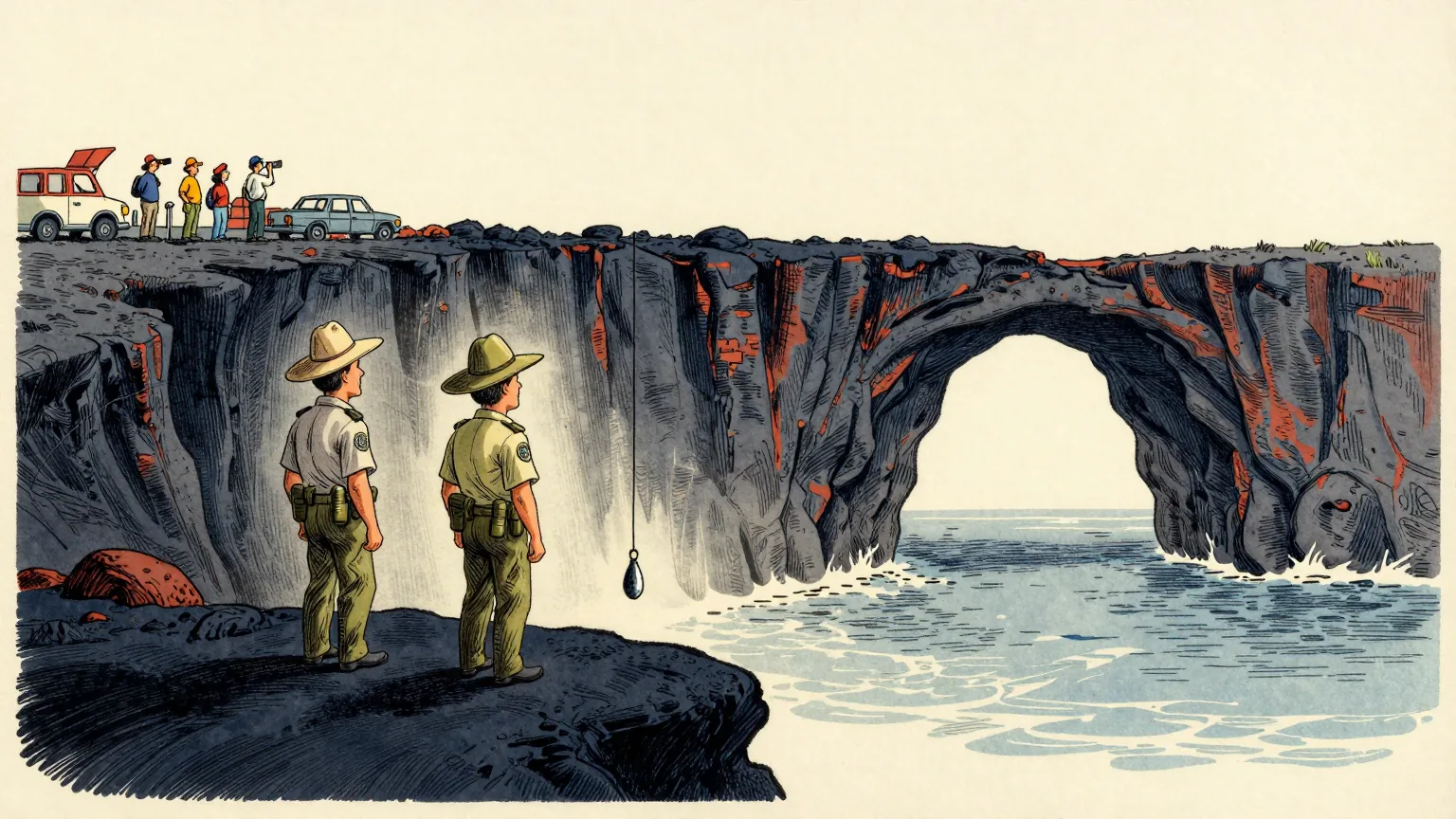
A sea arch that stood on the southern coast of Hawaii's Big Island for more than five centuries has collapsed into the Pacific Ocean, the National Park Service confirmed on Friday.
The Holei sea arch, at the end of Chain of Craters Road in Hawaii Volcanoes National Park, was a formation of lava rock standing about 90ft (27.4m) high and one of the most heavily photographed features on a remote and rugged coastline.
It formed about 550 years ago by differential erosion: ocean waves removing the softer rock in ancient lava flows along cracks and weak points, and leaving the harder rock standing.
The exact moment of the collapse is not known. The park service says the arch was still projecting from the coast on Wednesday 23 September, when the park was temporarily closed during Tropical Storm Nolo, and had gone by the night of Sunday 27 September.
Nolo intensified into a hurricane on 24 September. Storm activity in the Pacific has been running above average this year, a pattern experts associate with El Nino years.
The collapse surprised nobody who had read the file. "The coastline flanking the sea arch has been showing signs of instability for years," the park service said.
Earthquakes during the 2018 Kilauea eruption and summit collapse damaged the cliffs around the arch. In January 2020, new cracks and instability closed the original viewing area, and a replacement opened a few months later at a safer distance from the cliff edge. Later that year, surf from Tropical Storm Darby broke a chunk off the arch's lower portion.
The United States Geological Survey had been explicit as long ago as 2014. "The arch formed in ancient lava flows by removing rock along cracks and weaker rocks," it wrote. "It will not be here for ever. Every day the ocean crashes against the pillar of the arch, eroding it a little more. One day, it will be gone."
The park service made the same point in 2021. "This formation is beautiful, but temporary, and has a limited life span," it said. "The sea arch will eventually crumble into the sea. However, others will replace it as the cliff slowly migrates inland."
Park officials have urged visitors to stay back from the coastal cliff edges, which drop vertically into the ocean, and to keep out of the closed area where the arch stood. Unstable cliff edges can collapse without warning, they said.
That 2021 statement is worth a second reading, because it does not describe a loss. It describes a schedule.
The arch was not an object the park happened to own. It was a stage in a process the cliff performs continuously: the sea takes away the weak rock, the hard rock is left standing, and the result is an arch. The process has not stopped. Only this particular arch has.
The Department of Unnecessary Research therefore records the Holei arch as retired rather than destroyed, and notes the agency's own undertaking that others will replace it as the cliff migrates inland. On the park service's figures, the replacement interval is approximately 550 years.
This makes Hawaii Volcanoes National Park the holder of a renewable landmark. The next arch is already present, in the sense that every part of it is already there. It is merely surrounded by the rock that has yet to be taken away.
On this reading the ocean is not a hazard to the coastline but its contractor, working unsupervised and slightly behind schedule. Nothing has been lost. The item is on order, and the contractor has never once failed to turn up.