
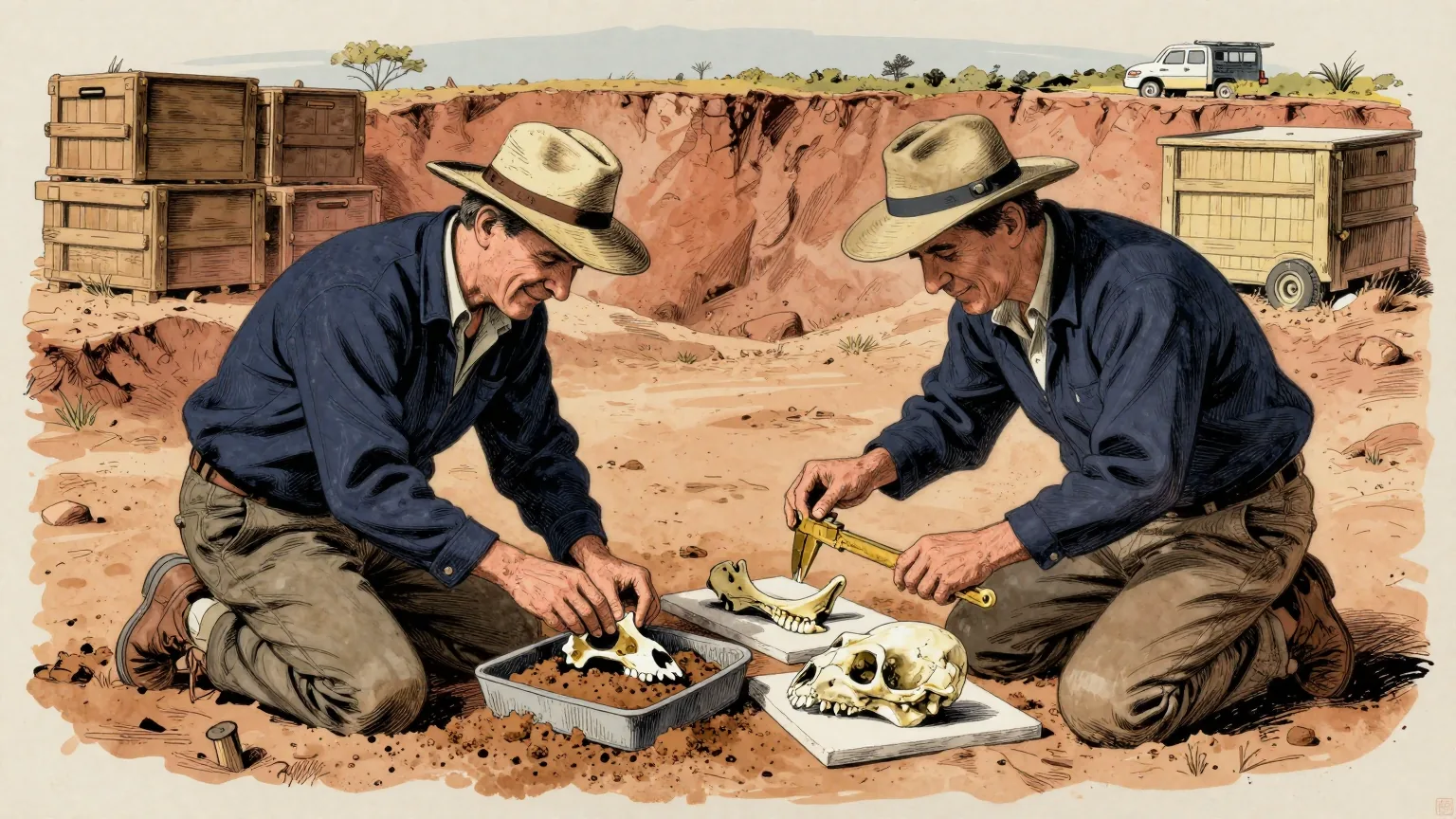
Archaeologists from La Trobe University have described 18 newly published hominin fossils from South Africa, including a second skull fragment belonging to Homo erectus.
The discovery adds stronger evidence that the species was present in southern Africa 2.0 million years ago, about 200,000 years earlier than traditionally believed.
The fossils come from Drimolen Main Quarry in South Africa's Cradle of Humankind, one of the world's richest sites for the remains of ancient human relatives. Although the quarry was discovered in 1992 and excavated through 2019, many of the fossils recovered there had never been formally described and remained largely unknown to science.
Researchers from La Trobe, working with colleagues in South Africa and the United States, have now analysed and described another 18 fossils from the site, assigning the remains to Homo erectus and to Paranthropus robustus.
In research published in Annals of Human Biology, the team reports the first known adult Homo erectus fossil from Drimolen. The specimen is about 2 million years old, making it roughly 200,000 years older than adult Homo erectus fossils discovered elsewhere, including specimens from Dmanisi in Georgia that date to about 1.8 million years ago.
“Homo erectus is the first species of hominin that researchers broadly agree fits within our own genus Homo and is likely directly ancestral to us. Drimolen preserves evidence for the first appearance of this species 2 million years ago; however, the original fossil, DNH 134, belonged to a child aged between two and four, and there was uncertainty about what the adult version may have looked like,” the lead researcher, Dr Jesse Martin, said.
“This paper publishes a new adult fossil attributed to Homo erectus, DNH 127, providing further confirmation that this species first appeared in southern Africa 2 million years ago.”
The newly described fossils also provide evidence that P. robustus changed over time. Between about 2 million and 1.8 million years ago the species developed larger teeth and more powerful chewing muscles as it adapted to shifting environmental and climatic conditions.
The sequence of the evidence is the part worth setting out plainly. At Drimolen the species was first represented by a child of between two and four years old, and the adult has only now arrived.
Until this week, then, the earliest confirmed Homo erectus was a toddler, and the oldest known adult of the species was 200,000 years younger and in Georgia. Read in order, the fossil record describes a childhood of some two hundred millennia, concluding at Dmanisi.
This newspaper regards the growth rate as the find's real contribution. Two hundred thousand years from the ages of two-to-four to adulthood is slow by the standards of the genus, and would place the species' school years somewhere in the early Pleistocene.
The Department of Unnecessary Research notes that the problem has now been corrected from the other end. DNH 127 is an adult of the same age as the child, which settles the growth rate but raises the question of what a two-year-old was doing in a population that, until Thursday, contained no grown-ups at all.
Paranthropus robustus, meanwhile, spent the same 200,000 years acquiring larger teeth and stronger chewing muscles, which is the sort of progress that shows up in the record.
The quarry was excavated through 2019 and the fossils have been sitting undescribed ever since. Homo erectus reached adulthood in 2026.