
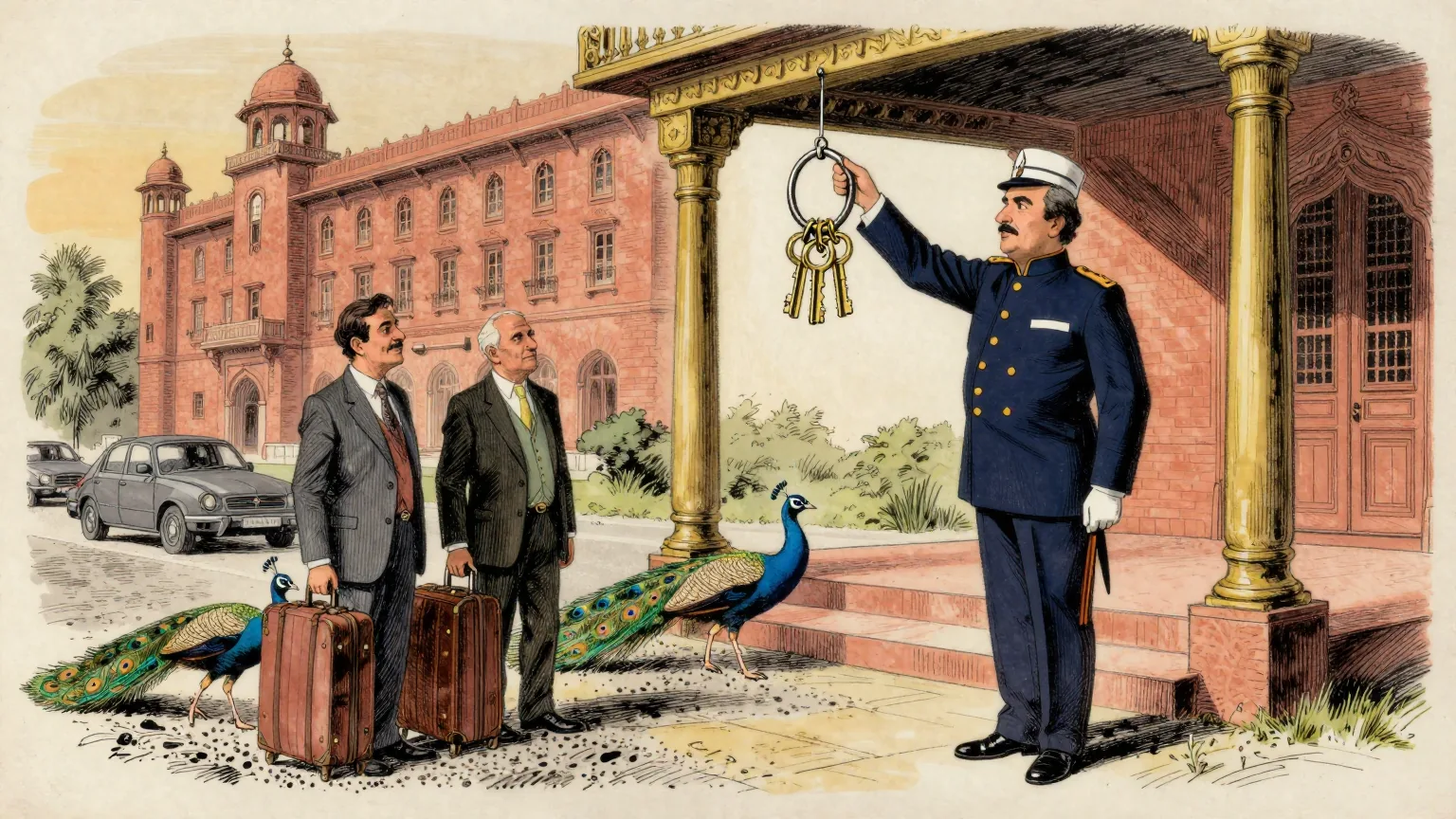
Forty-seven hotels in India were awarded Michelin Keys in the guide's 2026 selection, announced on Tuesday 22 September, a rise of about 30 per cent on the 36 recognised a year earlier.
Two Indian hotels hold Three Keys: Taj Falaknuma Palace in Hyderabad and Taj Lake Palace in Udaipur. Fifteen hold Two Keys and 30 hold One.
The Keys are the guide's hotel distinction, separate from the stars it gives restaurants. They rate the stay itself, on service, design, character and value for money.
The scale runs to three tiers. One Key denotes a "very special stay", Two an "exceptional" one, and Three an "extraordinary" experience that is "virtually its own destination".
Worldwide the 2026 selection lists 155 Three-Key hotels, 657 with Two Keys and 2,020 with One.
The programme launched in 2024, so this is only its second year of existence.
The Indian list ranges well beyond the heritage palaces. It includes Dolkhar in Ladakh, Mharo Khet near Jodhpur, The Ritz-Carlton in Pune, Soho House in Mumbai, The Oberoi Rajvilas in Jaipur and the Taj Mahal Palace in Mumbai, alongside a wildlife resort in Bandhavgarh and a restored palace in Patiala.
For an industry that has spent two decades competing on star ratings awarded by everybody, a second scale with only three tiers and a short list is a straightforwardly useful signal.
The distinction is awarded in keys, and keys are countable. Two hotels hold three each, fifteen hold two, thirty hold one. India's national holding is therefore 66 keys, up from a figure a year ago that nobody has published.
This matters for the sector's most basic constraint. A One-Key hotel can be entered once. A Three-Key hotel can be entered three times, or once by three parties, depending on how the guide intends its tiers to be read.
The global stock can be computed on the same basis. There are 465 keys at the top tier, 1,314 at the second and 2,020 at the third, giving a world supply of 3,799. India holds 66 of them, or 1.7 per cent, a figure our analysts describe as the country's true share of hospitality access.
Falaknuma and Lake Palace between them hold six, the largest concentration in India. Neither has disclosed what the keys open.
The Department of Unnecessary Research has written to the guide with a single question, which is whether a hotel that loses a Key is obliged to change the lock.