
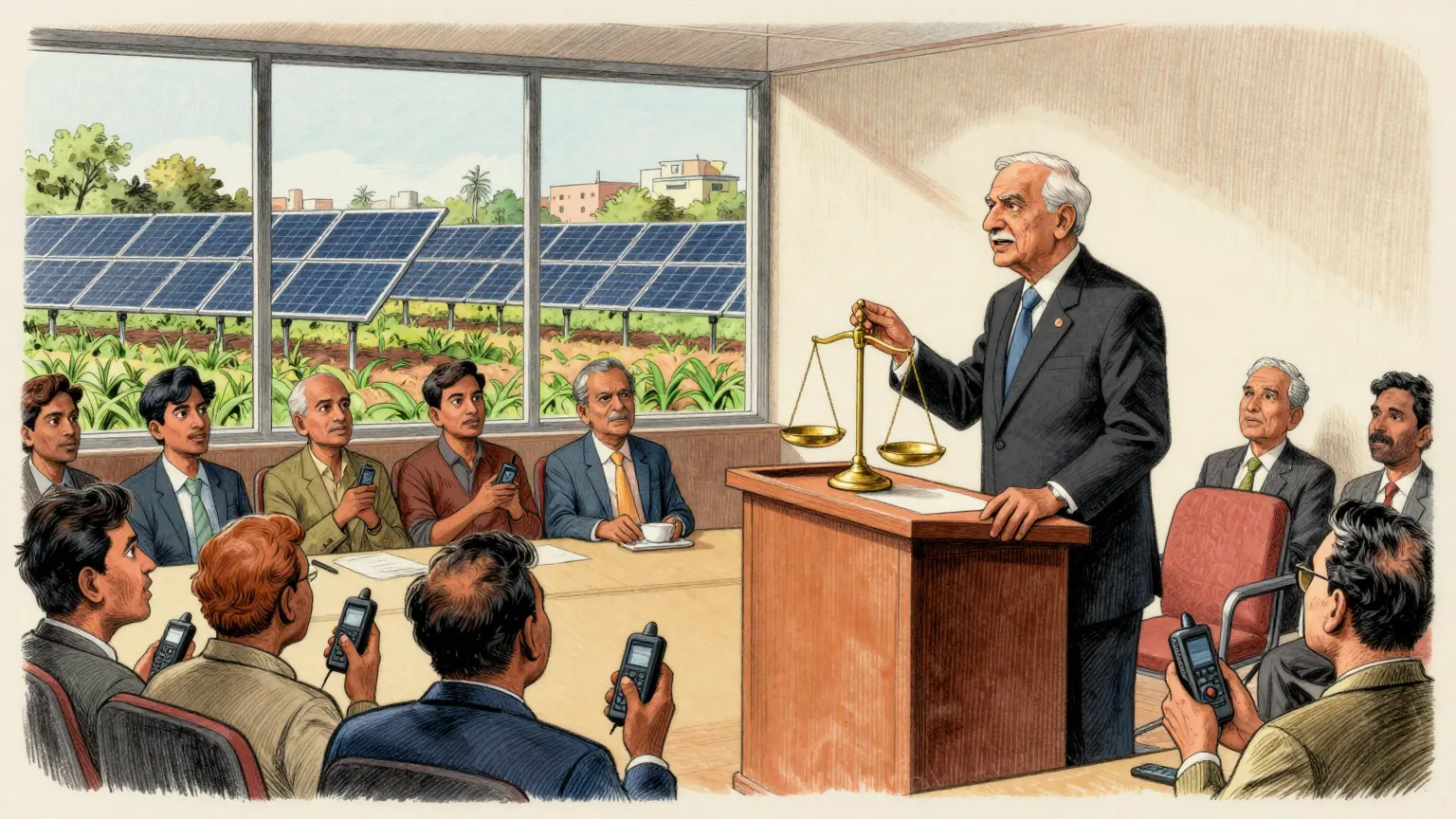
India's agrivoltaic capacity could rise above five gigawatts within the next three to four years, the senior civil servant at the Union Ministry of New and Renewable Energy has said, with the outcome depending on how quickly individual states act.
Santosh Kumar Sarangi, Secretary at the ministry, gave the figure to reporters at a briefing ahead of the seventh Agrivoltaics World Conference, to be held in New Delhi from 21 to 23 October.
“It is difficult to estimate but it should be upwards of 5-gigawatts in the next 3-4 years. It depends on state's enthusiasm, ability to quickly notify a feed-in tariff,” Mr Sarangi said.
Agrivoltaics is the practice of keeping agricultural land in its primary use while also generating solar photovoltaic power on it, so that the same field produces both a crop and electricity.
The constraint Mr Sarangi identified is tariff policy rather than technology. “Once they (the states) are ready with feed-in tariffs. It would provide certainty to the farmer-producers organisations and cooperatives to make the investment decision. If states act quickly then 5-gigawatts plus should not be an issue,” he explained.
He added that the ministry had observed enthusiasm from state governments as well, and that several states, among them Odisha, Maharashtra and Madhya Pradesh, had conducted their own pilot projects for agrivoltaics.
Central support is also being prepared. “We are planning for a central sector scheme which will support it (agrivoltaics). Probably we will make it a part of one of our existing schemes as and when those schemes are getting revised,” Mr Sarangi said. “On that we are working with the Finance Ministry on how this could be done and how states could be incentivised to do different kinds of agrivoltaic models.”
A feed-in tariff is a guaranteed price paid for electricity fed into the grid, and it is notified by individual states. Until one is notified, a farmer-producer organisation or cooperative weighing an investment has no price to plan against.
The forecast therefore rests on two quantities. One is the speed at which states publish tariffs, which is a measurable administrative process with dates attached to it. The other is enthusiasm.
This newspaper notes that enthusiasm has now been given a load-bearing role in a national capacity projection, and that it is the variable the projection is most sensitive to.
The implications for planning are considerable. If five gigawatts depends on state enthusiasm, then enthusiasm has a unit, and the unit is the gigawatt. A moderately keen state is worth some number of megawatts. A reluctant one subtracts them.
Our analysts have begun the necessary conversions. Odisha, Maharashtra and Madhya Pradesh have each run pilot projects, which under this framework is the observable signature of enthusiasm, and the ministry has confirmed that it has observed it.
The Department of Unnecessary Research raises only the question of measurement. A feed-in tariff is notified on a date and can be checked in a gazette. Enthusiasm is not notified, carries no date, and cannot be read off anything.
The Secretary was careful throughout, and said so at the outset: the figure is difficult to estimate. The estimate is five gigawatts.