
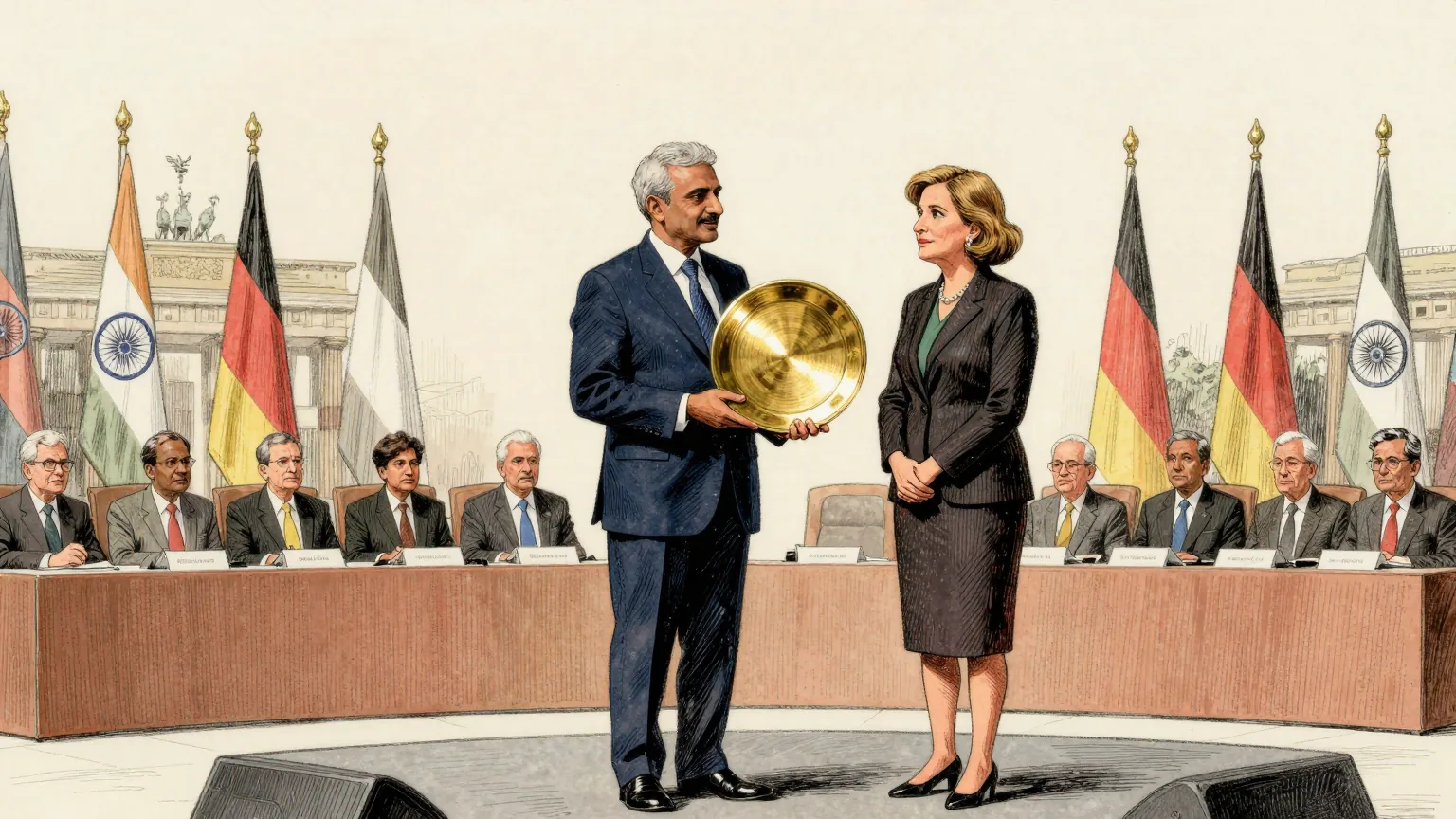
India has set itself a target of tenfold growth in trade with Germany, to 310 billion euros, from 31.5 billion euros in 2025.
The figure came from Piyush Goyal, the commerce and industry minister, speaking on Thursday at the inauguration of the India Centre and the Indo-German Business Forum in Berlin, in a report by The Times of India.
"We had 31.5 billion euros (in 2025) and (if) we were to be able to add a zero to that, make it 310 billion euros. How would that sound? Now, we can certainly make that happen," Goyal said, pressing businesses to draw up concrete plans rather than wait.
Goyal is visiting Germany and the Netherlands from 22 to 27 October, leading a delegation of around 100 Indian businesses and startups to explore opportunities in trade, investment and industrial cooperation.
The target is pinned to the India-EU free trade agreement. Goyal said the agreement could be signed by December and implemented within four to five months. Negotiations concluded in January this year, following talks between Prime Minister Narendra Modi and the European Commission President, Ursula von der Leyen, and the minister said the deal had unanimous support from all 27 EU member states. India-EU trade stood at 118 billion euros in 2025.
He argued the two economies were complementary rather than competitive, pairing Germany's precision engineering and commitment to quality with India's infrastructure expansion, digital capabilities and young, skilled workforce, with scope for collaboration in manufacturing, technology and supply chains.
"This is the time partnerships need to be forged. This is the time connects need to be made with potential customers, collaborators, investors," he said, adding that companies must prepare to "trade, invest smarter, faster and get the best out of this agreement".
Germany's minister for economic affairs and energy, Katherina Reiche, set out a more contained ambition at the same event. Bilateral trade remained below potential, she said, with India not featuring among Germany's top 20 trading partners despite goods trade worth around 31 billion euros in 2025. "We could at least double the trade amount we have right now," Reiche said.
German companies hold an investment stock of over 28 billion euros in India, Reiche said, and a proposed German-Indian chief executives' forum is expected to bring business leaders together and encourage fresh investment. Goyal's own list of priorities ran to economic security, industrial opportunities in the green transition, emerging technologies and closer cooperation on apprenticeships and skilling.
The method, however, repays inspection. Thirty-one and a half billion with a zero added is three hundred and fifteen billion. The target announced in Berlin is three hundred and ten. Five billion euros have gone missing somewhere in the appending of a digit.
This newspaper has no objection to the technique. A zero is the cheapest growth instrument available to any economy. It requires no port, no apprenticeship scheme, no customs schedule and no ratification by 27 member states, and global supply is unconstrained.
The five billion euros are best understood as the rounding loss that occurs when a zero is appended to a figure already carrying a decimal point. Governments wishing to avoid it should hold their trade statistics in whole numbers before announcing targets.
The same arithmetic also dissolves the gap between the two ministers. Mr Goyal's instrument multiplies by ten. Ms Reiche's multiplies by two. Converted into the units actually in use at the forum, Germany is proposing three-tenths of a zero.
The Department of Unnecessary Research finds the positions closer than they appear. They are seven-tenths of a digit apart, and the agreement is expected in December.