
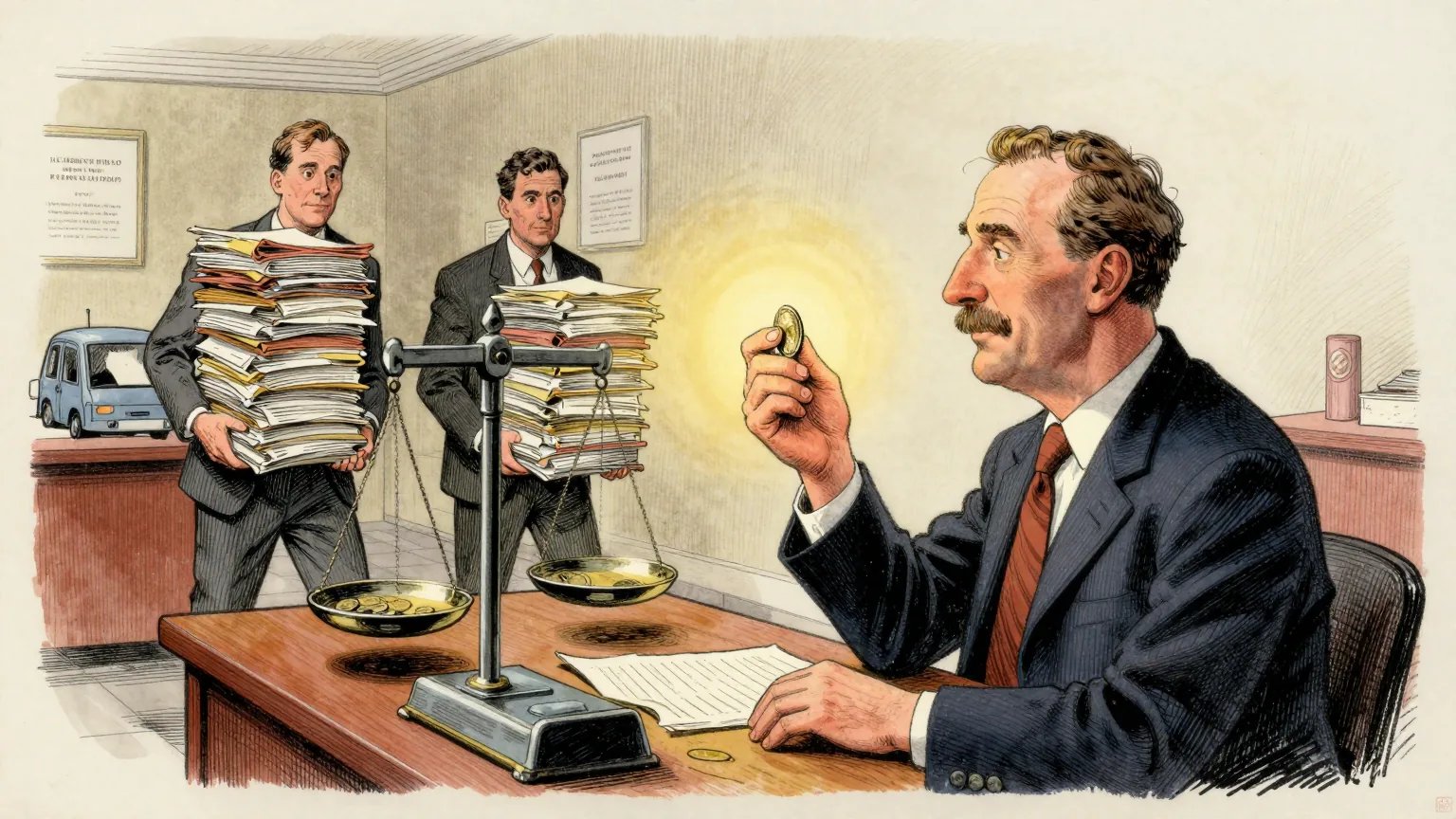
India's GST Council has recommended a floor beneath which the tax administration will no longer write to taxpayers at all. Meeting for the 57th time at Bharat Mandapam in New Delhi on 8 October, chaired by the Union Finance Minister, Nirmala Sitharaman, the Council proposed a minimum threshold of Rs 10,000 for show cause notices issued under Sections 73, 74 and 74A of the GST law.
The threshold is defined by the sum in dispute rather than the conduct alleged. In the formulation reported by Taxscan, "the aggregate amount of CGST, SGST and cess should be Rs. 10,000 or below" for the exemption to apply. Where it does, no notice is to be issued.
The recommendation reaches backwards as well as forwards. The Council proposed a statutory provision for notices and appeals already pending when the threshold takes effect: those below Rs 10,000 would be decided "as though the ₹10,000 threshold had been applicable at the time when the original notice was issued". In a separate report of the same meeting, Taxscan quoted the Finance Minister telling the press conference: "We will not be showing any notices for monetary threshold of Rs. 10,000 or below." She added: "If it was issued, it will be withdrawn."
The stated purpose is to stop small sums generating large amounts of litigation, and to let assessing officers concentrate on bigger demands. The Council made no changes to GST rates; the Finance Minister told the press meet "there is no rate changes".
Several other recommendations point the same way. The Council proposed removing the arrest powers of GST officers, and raising the monetary threshold for launching prosecution from Rs 1 crore to Rs 5 crore.
On penalties, it recommended a reduced penalty of 5 per cent in non-fraud cases where the tax and interest are paid within 30 days of an adjudication order under Section 73, or within 60 days under Section 74A. It also recommended removing the minimum penalty of Rs 10,000 in non-fraud cases.
And it recommended that the general penalty under Section 125 be reduced from a maximum of Rs 25,000 to a maximum of Rs 10,000.
On appeals, the Council proposed an upper limit of Rs 40 crore on pre-deposits, made up of Rs 20 crore of central GST and Rs 20 crore of state or union territory GST, and no pre-deposit at all for appeals to the GST Appellate Tribunal where no tax or penalty is payable.
These are recommendations rather than law. The amending legislation, rules and notifications have still to follow, and the Finance Minister has indicated that the process reforms would take effect from 1 April 2027.
The arithmetic, however, is already settled, and it deserves a closer look than it has received. Rs 10,000 now does three jobs in the same statute. It is the ceiling below which no notice may issue. It is the minimum penalty being abolished. It is the maximum general penalty being introduced.
Follow that through. A general offence attracting the full severity available under Section 125 produces a figure of Rs 10,000. Rs 10,000 is Rs 10,000 or below. The heaviest general penalty the administration can impose is therefore exactly equal to the heaviest sum it has undertaken not to raise correspondence about.
The floor and the ceiling have been set to the same number, and the file is left standing on both at once.
Everything now depends on a single rupee. At Rs 10,001 there is a case, a notice, an adjudication and an appeal with a pre-deposit. At Rs 10,000 there is silence. The entire apparatus of enforcement balances on the smallest coin the currency has, which is at least a defensible place to put it.
The Department of Unnecessary Research has written to the Council to ask which of the three Rs 10,000 figures outranks the other two in the event of a disagreement, and has not yet received a notice in reply.