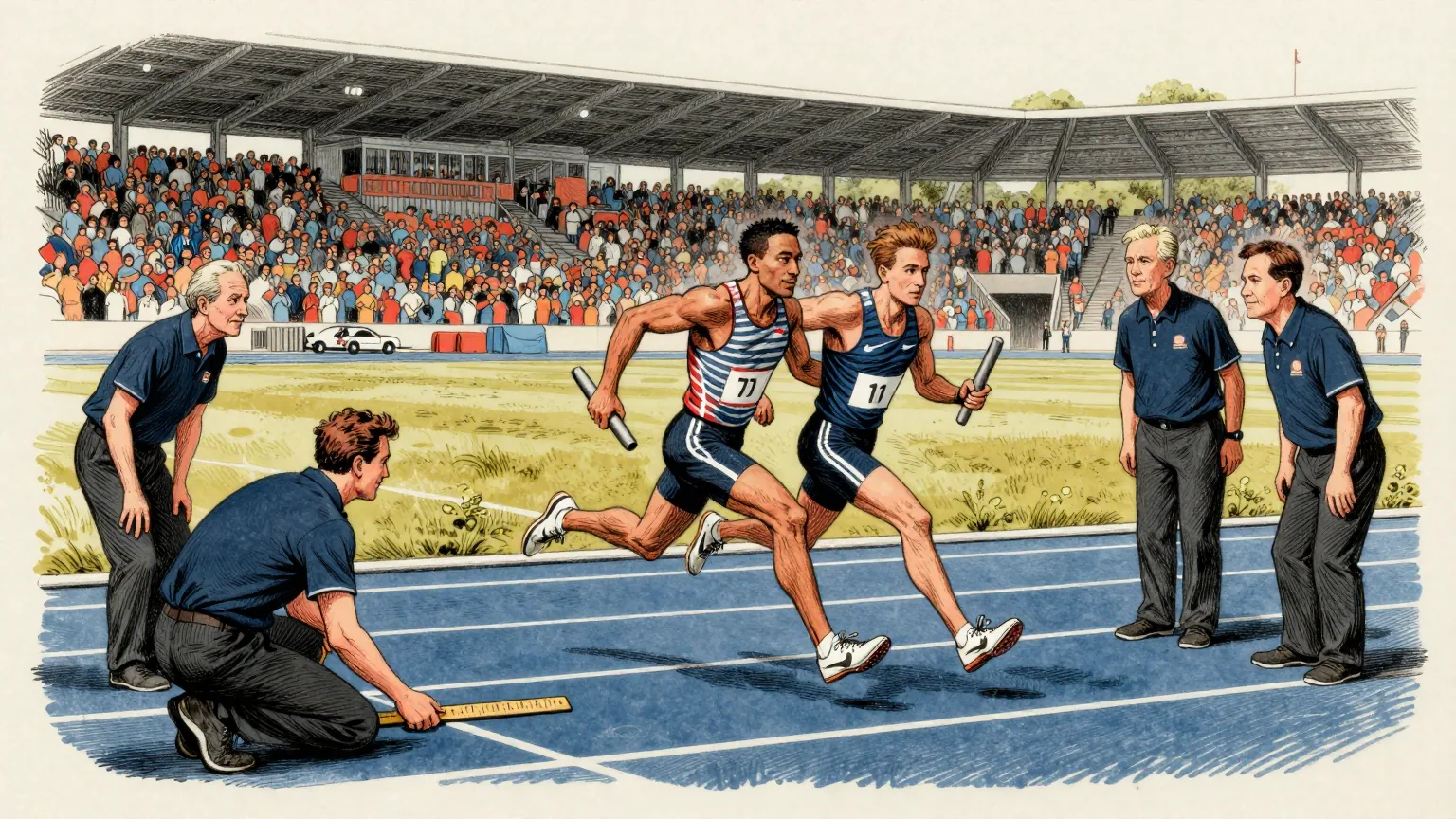
India won silver in the mixed 4x400m relay at the Asian Games in Nagoya on Thursday, finishing eight hundredths of a second ahead of Vietnam.
The team was Vishal TK, Poovamma Raju Machettira, Manu and Vithya Ramaraj. Vishal started for India but could not make much ground early on.
Poovamma then took over with India at risk of slipping out of the medal race, before a burst in the final 50m brought the team back into contention. She handed the baton to Manu with India in third.
Manu kept India in the race before handing over to Vithya Ramaraj for the final leg. Vithya, known for her strong anchor legs, made up ground on the last lap and pulled India into second place to seal the silver.
Bahrain's Salwa Eid Nasser had already moved clear at the front and powered her team to gold in a Games record of 3:12.87. India finished in 3:14.46, with Vietnam taking bronze in 3:14.54.
Earlier in the day at the same stadium, Seema Kumari won bronze in the women's 10,000m, ending India's 16-year wait for a medal in the event at the Games. Winfred Yavi won gold in 32:39.18 and Japan's Nozomi Tanaka silver in 32:41.54, with Seema completing the race in 32:50.05.
That race built slowly before coming alive in the closing stages. Seema stayed in medal contention until the end and pulled clear of the rest of the field to take third, while Yavi and Tanaka broke away for a sprint finish between them.
Eight hundredths of a second is a figure the timing equipment can supply and the eye cannot, so it is worth converting into the unit the athletes were actually working in.
India covered the relay's four legs, 1,600 metres in all, in 194.46 seconds, an average of 8.23 metres a second. At that pace, 0.08 of a second is about 66 centimetres.
The silver medal was therefore settled over roughly two thirds of a metre of track, after the four runners had covered 1,600 of them. As a share of the race, the margin is four hundredths of one per cent.
The gold was a different sort of contest. Bahrain's 3:12.87 was 1.59 seconds clear of India, which at the same pace works out at around 13 metres. The gap between first and second was about twenty times the gap between second and third.
This leaves the podium with an awkward job. It is built to show three distinct heights. On Thursday it was asked to represent thirteen metres on one side and sixty-six centimetres on the other, using steps of the same size.
Everything else in the stadium reported the finish at a coarser resolution. The clock could separate the second and third teams, because separating them is what a clock is for. Nothing else present could.
Had the race finished two thirds of a metre earlier, the silver and the bronze would have changed hands, and nobody in the stadium would have been able to see the difference.