
India's festive buying season opens with Navratri on 11 October, and the metal the trade expects to carry it is silver.
At current prices, 10 grams of 24-carat gold costs around Rs 1.5 lakh. Spent instead on silver, at roughly Rs 2.3 lakh a kilogram, that sum buys approximately 650 grams.
Gold has stayed expensive despite a recent fall, putting it out of reach for a large part of the middle-class market. Silver, traditionally the supporting act in Indian jewellery, is being moved forward in its place.
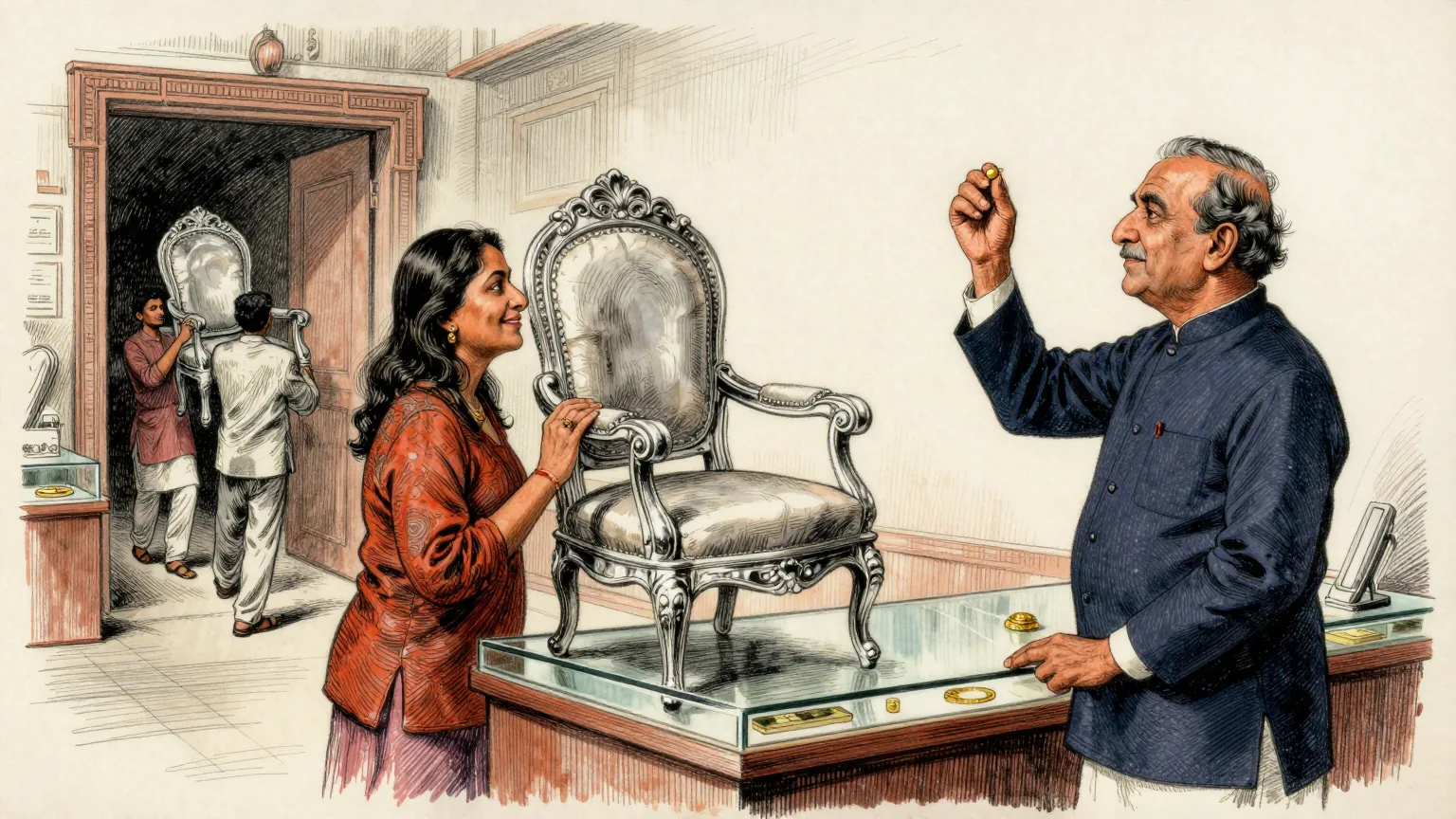
Jewellers and traders are widening what they offer in the white metal, from ornaments and idols to furniture, aiming at consumers and investors at once.
For some retailers the shift has already happened. One jeweller reports that silver now generates 25 to 30 per cent of total revenue, against 10 per cent two years ago.
"I am a third-generation diamond jeweller based in Surat. But today, I earn more from silver than from diamonds," said Nagnesh Pachchigar of SN Jewellers, for whom silver contributes up to 35 per cent of annual revenue.
"Silver is clearly the next gold. I expect 40% of our annual silver sales only during the monthlong festive season starting with Navratri," he said.
The trade body is forecasting growth as well. "We estimate that silver buying during this Diwali season will rise by 17- 18% from the corresponding period last year," said Surendra Mehta, national secretary of the India Bullion and Jewellers Association.
Supply is no longer the constraint it was in the spring. The government relaxed silver import restrictions in July, having imposed them in May partly to limit foreign exchange outflows. Imports then crossed $1 billion in August, a 127 per cent increase on the same month a year earlier, according to commerce ministry data.
Some buyers are treating the metal as a position rather than a purchase, in the hope that prices climb to Rs 4 lakh a kilogram.
This newspaper has done the division, and the result deserves a wider audience. For the price of 10 grams of gold, a household takes home about 650 grams of silver. That is sixty-five times as much metal for the same money.
Measured as precious metal per rupee, the Indian consumer has just secured a sixty-five-fold improvement in purchasing power with no change in income, price or policy. The improvement was available the whole time. It required only a change of element.
The Department of Unnecessary Research has extended the method. Copper is cheaper than silver, which means the same Rs 1.5 lakh converts into a considerably larger quantity again, and the household's holdings, measured in kilograms, improve accordingly.
Followed to its conclusion, the optimal festive purchase is whichever metal weighs most per rupee, and the ideal store of value is the one nobody wants.
Jewellers, to their credit, have grasped the principle ahead of the economists. They are now selling silver furniture. By weight, a chair is an unanswerable investment.