
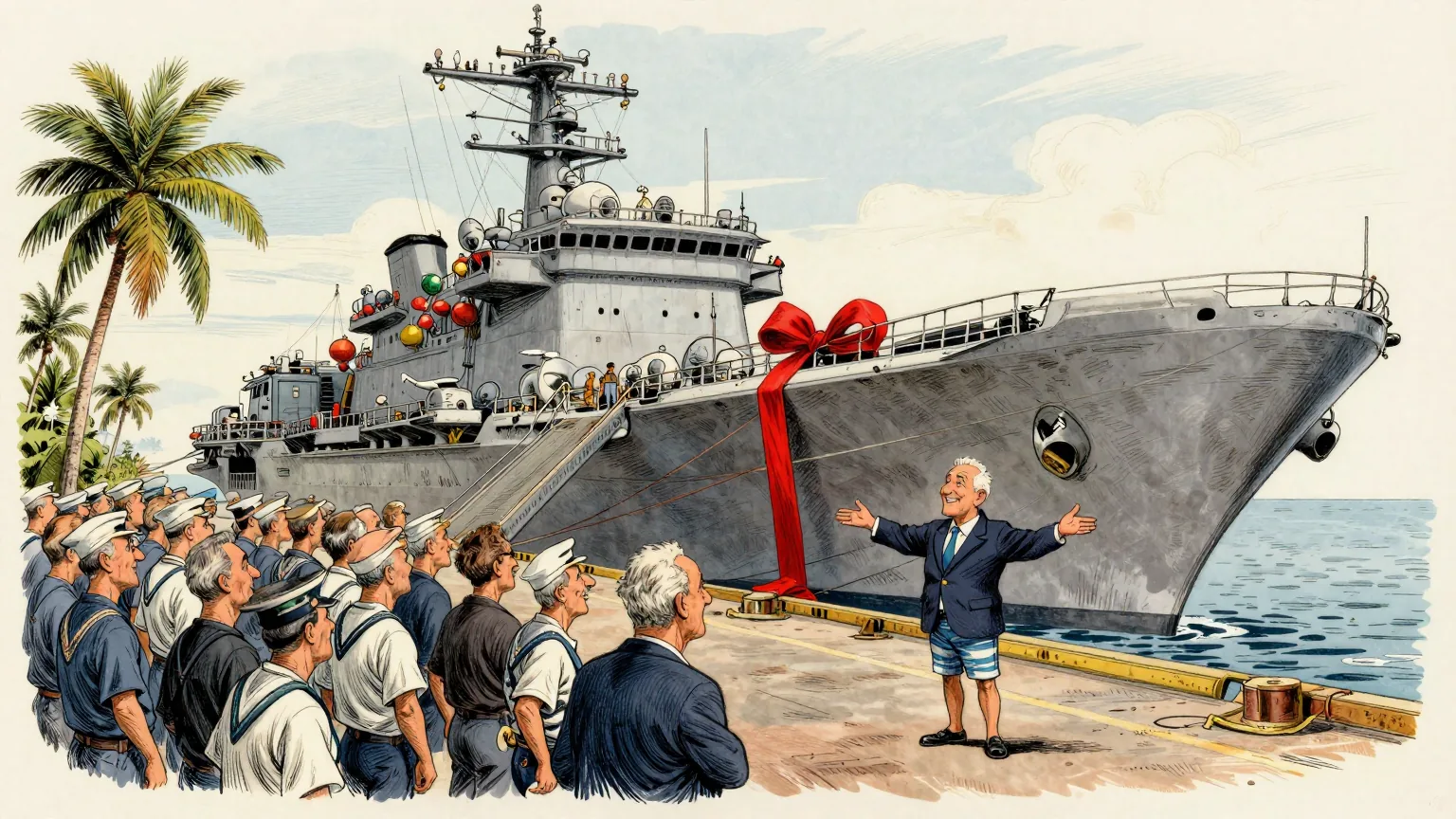
Indonesia has received its first aircraft carrier, a former Italian warship that the government says will strengthen the archipelagic nation's maritime security and disaster response capabilities.
The 41-year-old former ITS Giuseppe Garibaldi, which can operate short take-off and vertical landing aircraft and helicopters, arrived on Friday morning at a naval base in North Jakarta's Tanjung Priok port, where it was welcomed with a military ceremony.
Italy agreed in March to give the carrier, which was retired in 2024, to Indonesia, in a move aimed at broadening Italy's defence engagement with the south-east Asian country. Italy is seeking deals on submarines and aircraft. Gifting the carrier also saves Italy the cost of decommissioning the ship.
The transfer makes Indonesia only the second country in south-east Asia with a carrier in its fleet. The first was Thailand's HTMS Chakri Naruebet, commissioned in 1997 after being procured from Spain along with carrier-capable AV-8S Matador jump-jets.
The vessel will be formally commissioned into the Indonesian Navy next week as the KRI Gajah Mada, named after the 14th-century Majapahit-era military leader whose vision of a unified archipelago has made him one of Indonesia's most celebrated historical figures.
Unlike major naval powers, which use carriers to operate fighter aircraft far from home, Indonesia describes the ship as a mobile command centre and support hub for helicopters, drones and maritime operations across its thousands of islands.
Speaking at a disaster management meeting earlier this month, President Prabowo Subianto said the vessel would help authorities tackle the forest and peatland fires that regularly blanket parts of south-east Asia with hazardous haze.
He said the carrier could accommodate up to 10 medium-sized helicopters, including aircraft with capabilities comparable to the Black Hawk and the Mi-17, and could carry large quantities of water to areas with large numbers of fire hotspots. He also outlined plans to fly drones from the ship and to use it as a platform that could be moved quickly to help after natural disasters, which are common in a country sitting on the Pacific "Ring of Fire".
The acquisition has prompted debate among defence analysts, economists and opposition politicians, who question whether Indonesia needs a carrier at all and whether the government should be spending on refurbishing and operating an ageing ship while facing fiscal pressure at home.
Indonesia's finance ministry approved $450m in financing for the aircraft carrier programme in 2025. Some lawmakers have warned that the overall bill could be far higher. TB Hasanuddin, a member of parliament's Commission I, said the cost of retrofitting the carrier alone could reach 16tn rupiah, about $900m.
Operating a carrier is expensive in any navy, and experts have questioned whether the necessity has been fully worked through. Economists have warned of slowing growth and weaker state revenues, which has brought closer scrutiny of large government spending projects.
The arithmetic here deserves more respect than it has been given. The ship was a gift. Its purchase price was zero. Whatever the retrofit costs, it cannot be a cost of acquiring the carrier, because the carrier was acquired for nothing.
This leaves the figure of about $900m attached to no asset at all. It is a cost of helicopters, water tanks, fire hotspots and the Ring of Fire, none of which Indonesia bought this week either. On a strict reading of the receipts, the Indonesian Navy has expanded by one aircraft carrier at a unit price that no other navy in the world has matched.
Italy's position is better still. By transferring the Garibaldi it has avoided the cost of scrapping it, which means both countries have recorded an improvement on the same hull. Our analysts note that this is the rarest event in defence procurement: a warship that made money going in both directions.
The implication for naval policy is straightforward. If a carrier acquired as a gift costs nothing, the cheapest possible fleet is one assembled entirely from gifts, and the most efficient naval power of all is the one that has just given its carrier away.
The Department of Unnecessary Research has written to both ministries recommending the obvious next step. A navy that owns nothing cannot be outspent.