A new capital city has been built into the rainforest of Borneo. It has a presidential palace, modern offices, residential towers and wide, open roads. About 10,000 people live in it.
Nusantara, known in Indonesia as IKN, sits in the province of East Kalimantan, more than 1,200 kilometres from Jakarta. It was designed to hold 1.2 million people by 2029, and to be a hub for 1.9 million by Indonesia's 100th anniversary in 2045. Construction began in 2022.
The case for building it was Jakarta. The current capital is home to nearly 42 million people and was last year declared the world's most populous city, overtaking Tokyo. It is notorious for its poor air quality and for traffic congestion among the worst anywhere.
Greater Jakarta holds 1.5 times as many people as Australia, in a space about 1,200 times smaller than Australia's landmass. About 40 per cent of the city sits below sea level, and a sea wall in the north serves as a line of defence against tidal floods. Parts of the north still flood regularly in the rainy season.
Proposals to move the capital go back to the 1950s. In 2019 the then president, Joko Widodo, known as Jokowi, made the call to build a new one in the jungle of Borneo. It was pitched as the true centre of Indonesia's thousands of islands and an engine for future economic growth, and as a way of wresting control from the Java-centric decision-makers of Jakarta.
In 2024 Jokowi celebrated Indonesia's Independence Day at the newly constructed palace, after the city had been partially inaugurated and named as the new capital. He spent about 43 trillion rupiah, roughly 3.5 billion US dollars, on Nusantara that year.
The annual budget was then cut to 13 trillion rupiah in 2025 and 6.3 trillion rupiah in 2026 under President Prabowo Subianto. The 45 billion dollar plan was expected to be covered by 80 per cent private investment and 20 per cent government spending. The Nusantara Capital Authority, which manages the development and is known as OIKN, says private investors have so far committed 6 billion dollars, with another 10 billion dollars from public-private partnerships.
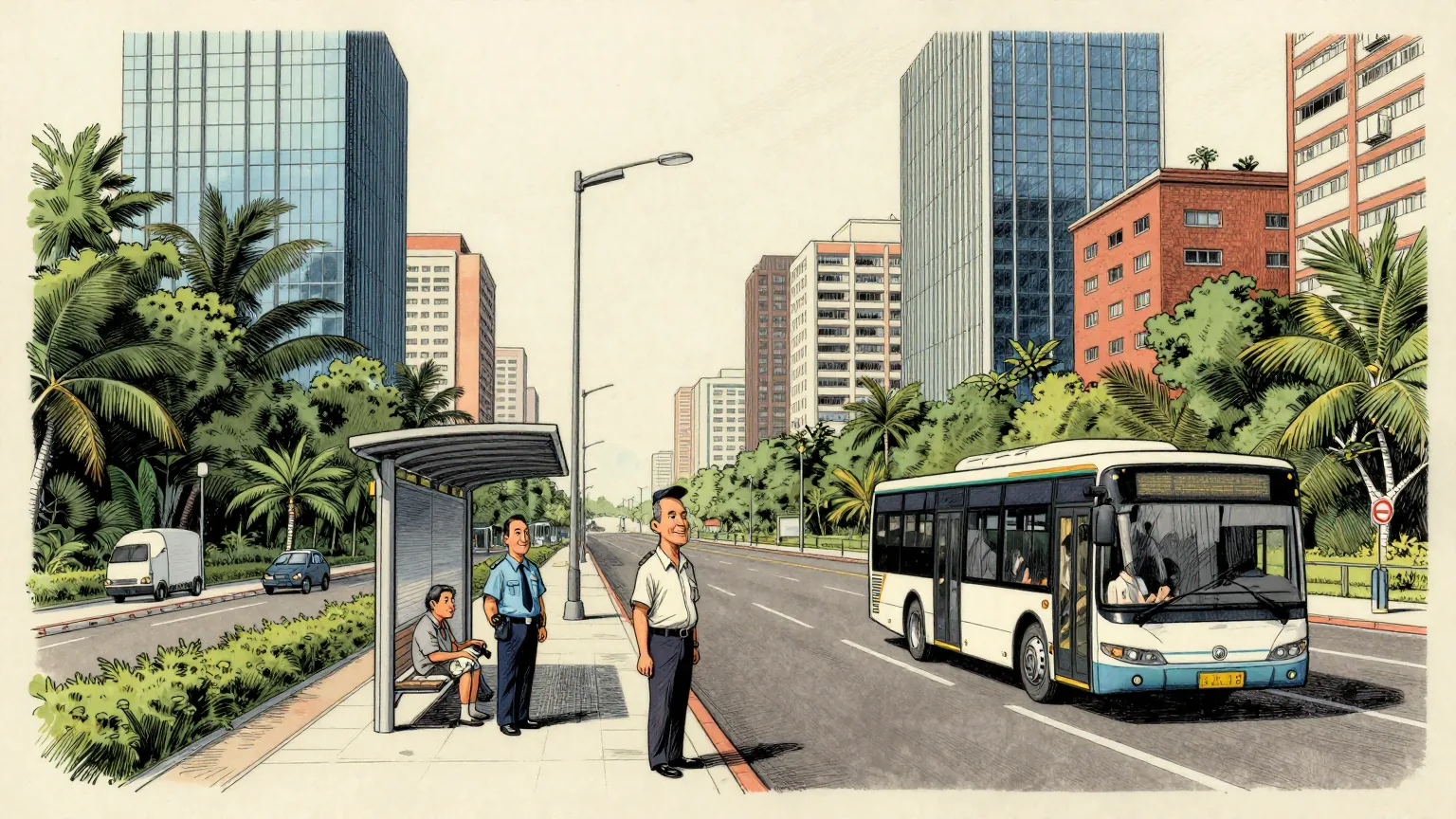
The wider Nusantara area, which takes in dozens of villages and sub-districts, has a population of 147,000. Far fewer live in the inner core of the newly developed city: the brand-new residential towers are home to about 1,800 public servants and defence and security personnel. An electric bus runs on a loop through the city, passing several hospitals and two hotels. Shopping centres are slated to be built in the coming years.
The city has advantages Jakarta does not. Filtration systems mean residents can drink water straight from the taps in their apartments, something almost impossible in Jakarta without risking getting sick. Recycling is compulsory and water and electricity use is monitored.
Not everyone is convinced it will pay off. Bhima Yudhistira, an economist at CELIOS, told the ABC that "Nusantara risks becoming a 'white elephant' - an expensive project with minimal impact", and that it "could end up as a stranded asset, as the state budget may only suffice for basic building maintenance".
It is worth being precise about what the project set out to achieve. The problems it was built to answer are overcrowding, congestion and air quality, and it was built 1,200 kilometres from all three of them. Measured against each of those objectives, Nusantara is outperforming every capital city on earth.
The design capacity is 1.2 million people. The occupancy is about 10,000, which is a little over 0.8 per cent. No capital has thinner traffic. The electric bus completes its loop without obstruction. Several hospitals stand ready for 1,800 public servants. Nobody has queued.
This newspaper therefore regards the ghost city framing as unhelpful. A capital with no congestion, clean air and drinkable tap water is not a planning failure. It is planning that has worked so completely that the population is now the only remaining threat to it, and the schedule requires 1.19 million more of them by 2029.
At 1.9 million by 2045, the city will have arrived at roughly the condition its designers left Java to avoid. The Department of Unnecessary Research has written to OIKN asking which of its two stated objectives takes precedence, and has suggested that the targets be withdrawn while the results are still good.
Ten thousand people have moved to Nusantara. The remaining 1.19 million are the only thing standing between the new capital and the old one.