
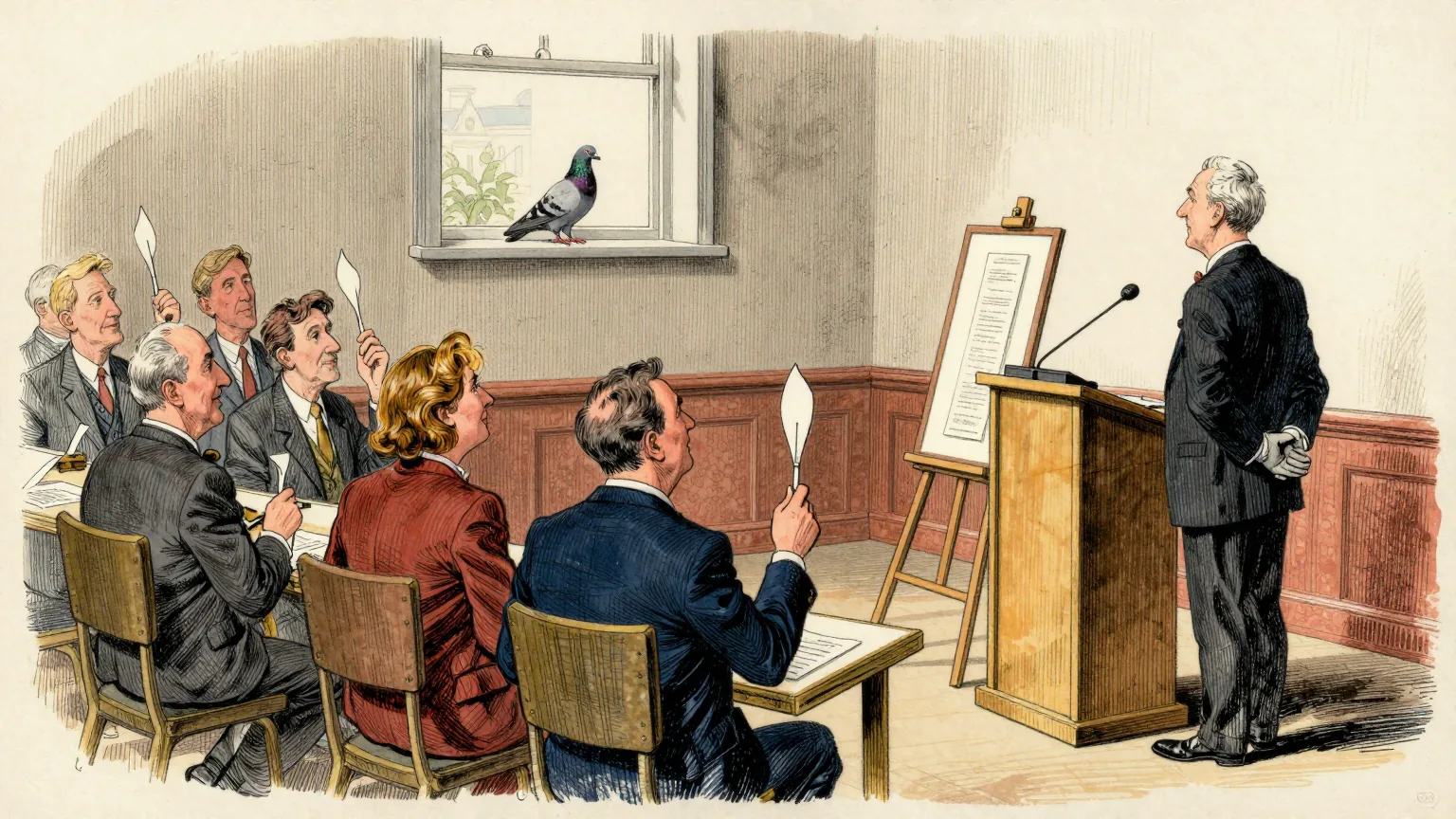
A single internet packet that was carried by pigeon has gone under the hammer at Christie's, in the auction house's sale of Fine Printed Books and Manuscripts Including Americana and Science. The lot was reported by Carly Page at The Register.
The packet is a small paper scroll, 41 millimetres by 210 millimetres, still creased from being rolled up and attached to a bird's leg. It is now framed, with an inscription on the reverse identifying it as the property of David Waitzman, to whom it was presented in 2002.
Waitzman is the American network engineer who, on 1 April 1990, published RFC 1149, "A Standard for the Transmission of IP Datagrams on Avian Carriers". The document was an April Fools' proposal, and observed that avian carriers could provide high bandwidth, while latency would be another matter entirely.
Eleven years later the Bergen Linux User Group decided to implement it. On 28 April 2001 the group ran the standard using racing pigeons, printers and scanners, printing IP packets as strings of hexadecimal on paper strips and attaching them to the birds' legs.
The birds flew between two lofts about 5 kilometres apart, roughly three miles. Nine packets were dispatched. Four replies came back, a packet loss rate of about 56 per cent.
Christie's gave the lot an estimate of $2,000 to $3,000 and described the experiment as an example of the internet's tradition of the "artful hack". By the time The Register's report was published, on 12 October, bidding had already reached $4,000, with the lot closing the following day.
The surviving scroll is therefore one of the arrivals rather than one of the losses, which is the whole of its value.
This newspaper wishes to be clear about what the market has priced. A link that drops more than half of everything entrusted to it is, on any other day, a fault requiring escalation to the carrier. At Christie's it is provenance.
The arithmetic rewards the failure precisely. Had all nine packets been delivered, the collector would be bidding against eight identical strips of paper. Because five did not arrive, the four that did are scarce, and scarcity is what has taken the lot past its estimate.
Our analysts note that the 56 per cent loss rate was achieved without any of the techniques ordinarily used to restrict supply. There was no retransmission limit, no congestion control and no deliberate throttling. The packets were simply given to birds.
The Department of Unnecessary Research has reviewed the specification and finds it was honest throughout. RFC 1149 promised high bandwidth and said nothing reassuring about latency, and in the event the latency has run to 25 years and is still rising, since the packet is now framed.
Countless packets have crossed the internet since April 2001, almost all of them faster, cheaper and more reliably. None of them is for sale.
This is the one that stopped.