
A space mission is set to launch on Tuesday morning that will attempt to grab a piece of Mars's moon Phobos and bring it back to Earth. The spacecraft is scheduled to leave the Tanegashima Space Center at 0441 local time on 20 October, which is 2041 BST on Monday evening.
If it succeeds, it will be the first time a sample has been returned from Mars or its moons to be analysed in laboratories here on Earth. The Mars Moons Exploration mission, known as MMX and led by the Japanese Space Agency, will arrive at Phobos in August 2027.
There are only three moons in the inner Solar System: our own, and the two around Mars. Both of the Martian pair are tiny and irregularly shaped. Phobos is about 20km, or 12 miles, across; Deimos is about 10km, or six miles.
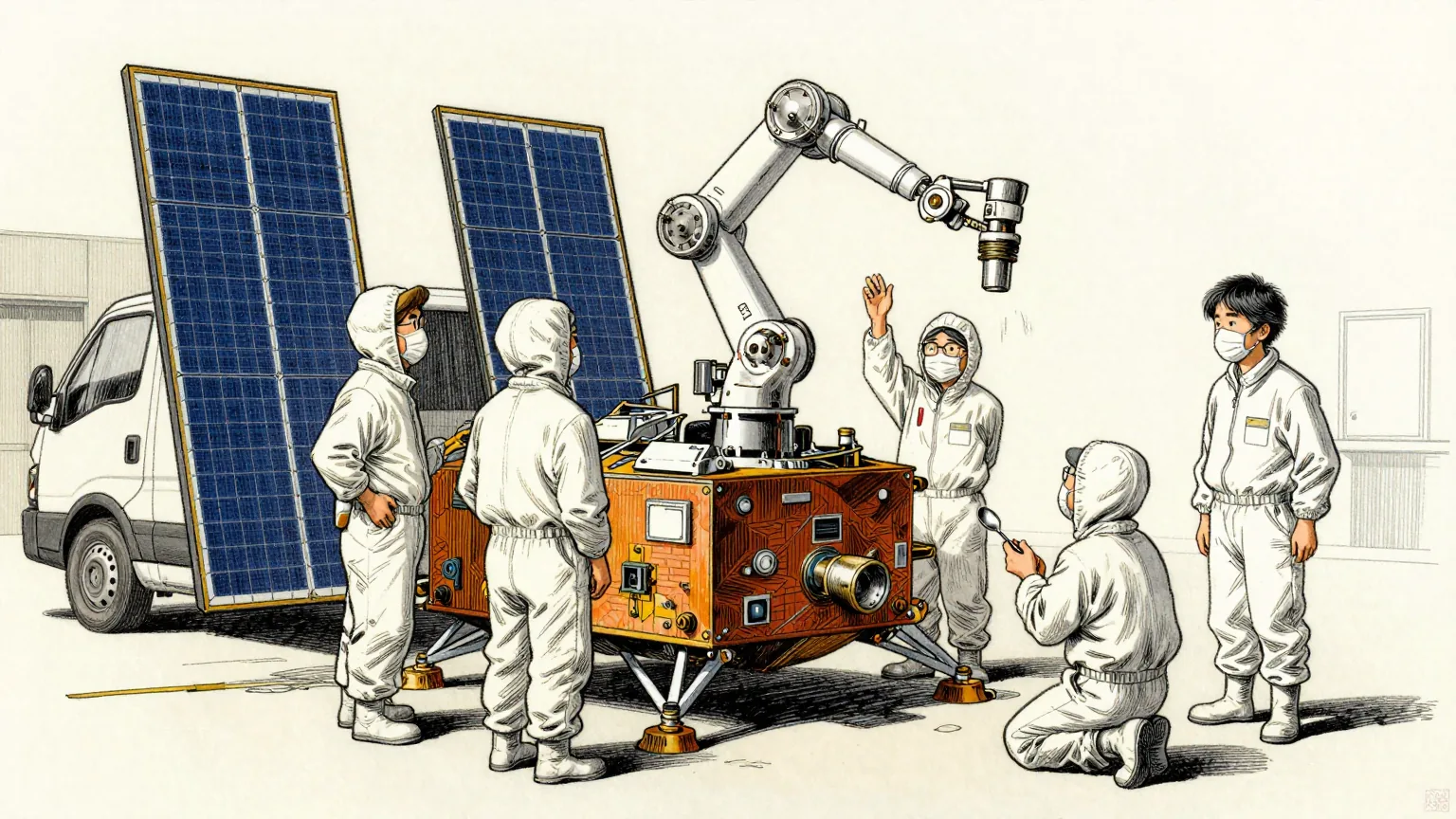
The spacecraft will study Deimos as it arrives in the Mars neighbourhood and then focus on Phobos. It plans to set down a small rover to scout a landing site, after which the spacecraft itself will touch down, deploy a robotic arm and two samplers, and collect moon dust.
None of that is straightforward. "The moon itself doesn't have very much of its own gravity," said Prof Sara Russell of the Natural History Museum, the mission's deputy for sample analysis. "But it's next to an enormous planet that's got a much higher gravity, and that makes it much harder to get a rover onto the surface." "There hasn't yet been a successful mission to go to Phobos and bring a bit back to Earth," she said. "I think this is an incredibly ambitious and fun mission."
The material will be packed into a small capsule that returns to Earth in 2031, landing in the Woomera desert of South Australia. The amount coming back is 10g.
"It's a very small [amount] actually," said Dr Chrysa Avdellidou of Leicester University, who is working with the Japanese mission. "However we can do several studies even on individual grains... You don't need to have kilos back from a surface in order to do science. So it's worth every gram."
The scientific prize is the origin of the Martian moons, which Mars acquired about 4.5bn years ago by means nobody has established. Either a space rock smashed into the planet early in its history and the moons formed from the debris, or they are wandering asteroids from the outer Solar System that were captured by its gravity.
"When we get the sample back, we'll be able to look in detail at its chemistry and its mineral composition - and the two hypotheses will produce very distinct results," Russell said. "It should be pretty much immediately obvious" which of the two it is.
There may also be a bonus. "One of the really exciting things is that Phobos is so close to the Mars surface that whenever there's an impact into the Mars surface, little grains might actually become implanted into Phobos itself," Russell said. "And that means that the sample we get back may actually contain grains of Mars as well. So it can give us really direct information about the composition and history of Mars."
Getting Martian material to Earth has long been an ambition. NASA's Perseverance rover has been collecting samples on Mars since 2021 and storing them in canisters, but the NASA and ESA mission that would have picked them up, Mars Sample Return, has been effectively cancelled after its funding was halted by the US Congress. China plans its own sampling mission, launching in 2028 and returning material in 2031.
Fragments of Mars are in fact already here, as Martian meteorites: pieces blasted off the surface by asteroid strikes and hurled towards Earth. They are extremely rare, and like all space rocks that fall to our planet they become contaminated as soon as they arrive, mixing with the air, dust, soil and water. A pristine sample is what nobody has.
It is worth setting the logistics out plainly. Pieces of Mars arrive on Earth free of charge and have done for a very long time. The objection to them is not that they are the wrong rock. It is that they landed here. The same pieces also land on Phobos, where nothing whatever happens to them, and MMX is therefore a five-year collection run to a cleaner depot.
On this reading Phobos is best understood as a 20km storage facility in a close orbit, holding Martian material in the only conditions anybody will accept. The robotic arm and two samplers constitute a withdrawal of 10g. The rest of the inventory stays where it is, and the facility requires no staff.
The contamination that ruins the meteorites is air, dust, soil and water, which is a complete list of the things Earth is made of. A sample of Mars is therefore pristine for precisely as long as it is kept away from the planet the laboratories are on. The Department of Unnecessary Research has concluded that the mission's single unavoidable design flaw is its destination, and has asked whether the capsule might usefully be opened on the way.
The capsule is due in the South Australian desert in 2031. It will be pristine until it lands.