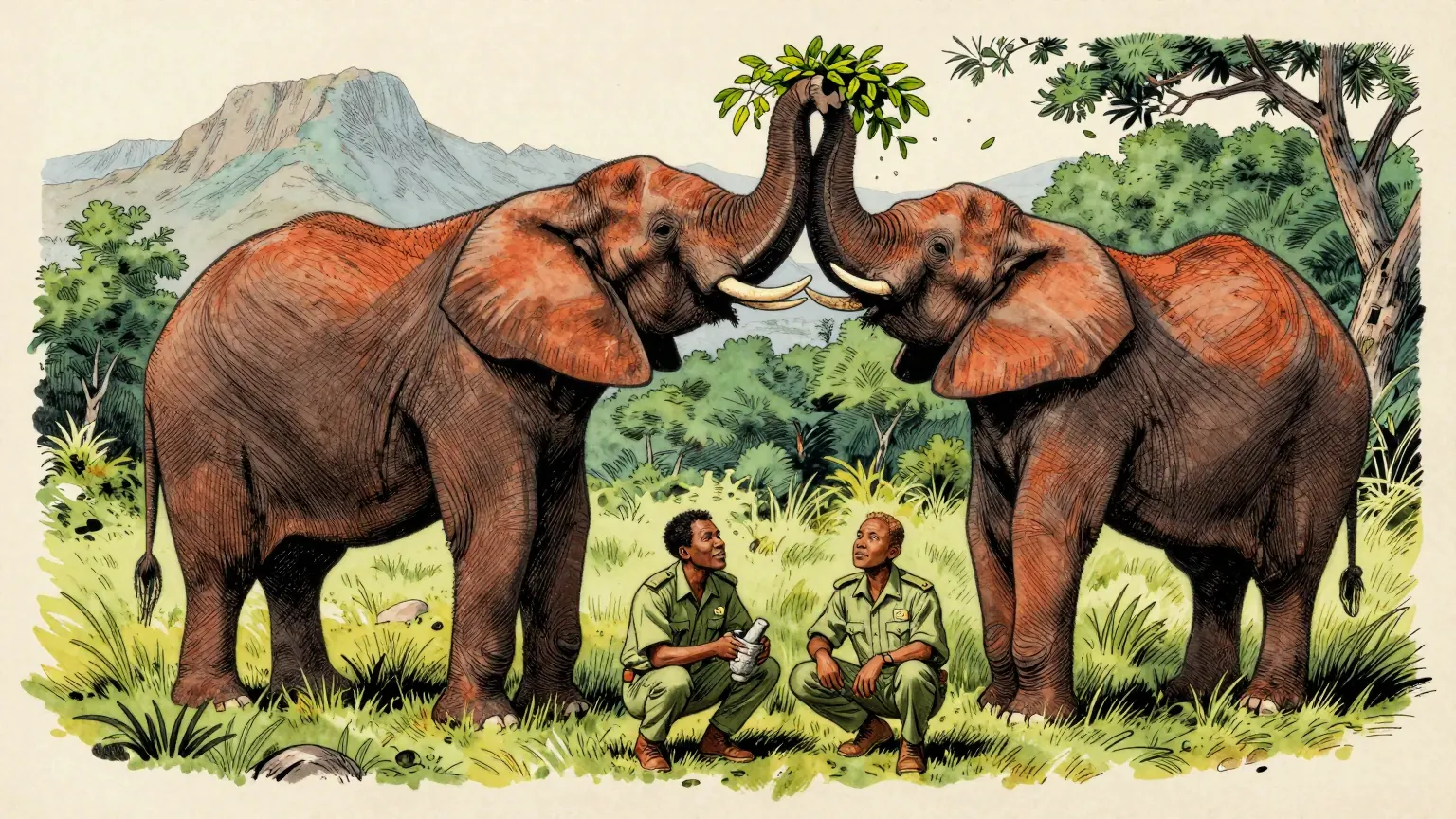
African elephants in the Mount Elgon region of Kenya use dozens of different plants to treat themselves and their families when they are sick, according to newly published research.
The study, in the journal Scientific Reports, was built from interviews with the people who live and work alongside the animals, including wildlife scouts and community elders, in collaboration with the conservation charity the Mount Elgon Foundation. The interviewees were not named, so that participants felt free to share their accounts.
From those accounts the researchers concluded that the elephants use 35 different plant species, and that 25 of them are known locally to have medicinal uses.
These are the animals known as salt-mining elephants, because they go into caves and scrape the rock with their tusks to extract minerals for their diet. Camera traps set up by the foundation have recorded them doing it.
One testimony described elephants using a plant known as Angurweet "as medicine to give to babies". Angurweet is used as a remedy for ailments including stomach ache.
The scout described mothers "removing the leaves and chewing it until smooth, along with the roots of some other trees", and recounted seeing them mix the resulting material with their own milk. "They give it to the babies, who chew on it themselves and spit out the solids", he said.
Dr Elodie Freymann of Brown University, one of the lead researchers, said the work raised the question of whether the destruction of forest habitat deprives animals, and humans, of the medicines they need to thrive. "This shows just how entangled our medicines are with the non-human world," she told BBC News.
Professor Michael Huffman, a primatologist at Nagasaki University who was not involved in the study, called that particular account "tantalising", but said more evidence would be needed to prove that elephants provided bespoke treatment for their calves. The team has since given the local wildlife experts cameras to record what they witness, and is analysing the plants themselves.
Dr Fabien Schultz of the Bernhard Nocht Institute for Tropical Medicine in Hamburg, another of the lead researchers, said: "Local knowledge has given us a map". The team now wants to "follow the elephants and investigate whether they select particular plants in particular health contexts, and whether those plants have relevant biological activity."
The researchers describe the forests as natural pharmacies. "Medicine factories that exist all around us," as Dr Freymann put it. Self-medication is widespread in the animal kingdom: Professor Huffman noted that mosquitoes, flies and bees all do it. The earliest scientific account involving elephants dates to the early third century, when the Roman author Claudius Aelian described one making a full recovery after consuming flowers and oil from an olive tree.
The phrase natural pharmacy rewards a literal reading, and the inventory holds up better than it has any right to. Thirty-five lines are stocked. Twenty-five carry a recognised local indication. That leaves ten products on the shelf with no stated purpose, which in any other dispensary would be a matter for the regulator.
The dispensing model is unorthodox but consistent. Preparation is carried out in the mouth. The paediatric formulation is chewed to a smooth consistency, combined with root material from other trees, and suspended in milk at the point of delivery. The patient chews the dose and spits out the solids, which is compliance of a sort.
Record-keeping is the weak point. The dispensary keeps none, which is why the study had to reconstruct it by interviewing the staff, whose evidence is anonymous and given from memory. Aelian's olive tree is therefore the oldest surviving entry in the log.
On that evidence the forest at Mount Elgon has been trading for eighteen centuries without a licence, a prescription or a single day closed for stocktaking.